 EN
 Deutsch
 Español
 Français
 Italiano
 Português
 Nederlands
 Polski
 Bahasa Indonesia
 Русский
 Українська
 العربية
 עברית
 हिन्दी
 日本語
 한국어
2026-06-08 · Season 2
From AI Hype to Business Value with Kayode Ajayi [MVP-MCT]

Quick answer: turn AI hype into business value is covered in this M365 FM episode with a practical focus on how it works, where it fits, and the architecture, security, governance, or operational choices that matter in real Microsoft environments.
Does AI Hype really deliver business value? You see bold claims everywhere:
- “AI is not just a tool; it’s a partner for human creativity.” — Satya Nadella
- “The key question isn’t ‘What can AI do?’ but ‘What should AI do?’” — John C. Havens
Many leaders rush to adopt ai, expecting instant transformation in business performance. However, MIT researchers found a measurement gap. Most organizations struggle to show how ai creates value. About 88% of ai pilots stall before production, and only 5% of generative ai projects have measurable impact. You need to look past the hype and focus on what makes ai work for your business.
Key Takeaways
- AI hype often overshadows real business value. Focus on measurable outcomes.
- Set clear objectives for every AI project to ensure alignment with business goals.
- Track progress using meaningful metrics like cost savings and productivity improvements.
- Be aware of hidden costs in AI adoption, such as training and infrastructure needs.
- Upskill your teams to adapt to new roles and maximize AI's potential.
- Avoid the activity trap by prioritizing results over the number of AI tools used.
- Foster a culture of experimentation to drive innovation and learn from failures.
- Communicate AI value clearly to stakeholders using simple reports and visuals.
AI Hype vs. Real Value

Defining AI Hype
Media and Market Drivers
You see ai hype everywhere. News headlines, social media, and press releases all compete for your attention. The media loves stories about ai changing the world overnight. This excitement creates a cycle where technology companies and their marketing teams push bold claims to attract investors and customers. Major players like Google and Meta use their platforms to amplify these messages. They want you to believe ai is essential for every business and every device.
Tech needs ai to be everything the press insists it will be. Companies rely on ai hype to drive sales, boost stock prices, and stay relevant in a fast-changing market.
The media ecosystem thrives on viral stories. Algorithms favor sensational news, so stories about ai breakthroughs spread quickly. This environment makes it hard to separate fact from fiction. You must look past the noise to find real value.
Vendor Claims
Vendors often add to ai hype by promising instant transformation. They highlight generative ai tools that claim to automate complex tasks or deliver huge returns. Many of these claims lack real-world support. Some vendors focus more on selling the dream than on delivering measurable outcomes. You need to ask tough questions about how these solutions actually work in your business. Do they solve real problems, or do they just sound impressive?
- ai hype is a state of intense enthusiasm and attention.
- It often includes claims about ai performance without proof.
- Many see hype as a social phenomenon, driven by collective anticipation.
What Is Real AI Value?
Measurable Outcomes
Real ai value comes from clear, measurable outcomes. You should look for improvements in productivity, cost savings, and customer satisfaction. For example, ai-powered customer service can reduce first response times by 37% and resolve issues 44% faster. Automated call transcription gives you real-time insights into customer pain points, saving time and improving efficiency.
| Outcome Type | Description |
|---|---|
| Employee Productivity | Aisera enhances productivity, saving 1-4 hours of employee time per productivity-impact request. |
| Staff Churn Reduction | 80-90% reduction in fatigue-induced churn due to automation of repetitive tasks. |
| Operational Efficiency | Regains 1-5 years of growth coverage without additional human resources. |
| Cost Savings | Labor cost savings of $750,000 from a $500,000 investment in an ai-driven automation tool. |
You see real value when ai solutions align with your business goals and deliver outcomes you can track. Increased customer satisfaction, better job satisfaction for employees, and improved alignment with customer needs all show true ai value.
The real ai differentiator lies in intent and integration. Every ai project should start with a clear purpose and connect seamlessly to your existing systems.
Success and Failure Cases
You can find both success stories and failures in ai adoption. Some businesses use ai to automate repetitive tasks, freeing up employees for more complex work. Others see improved customer engagement and higher retention rates. However, many projects fail to deliver expected results. For example, a custom ai chatbot for an e-commerce company aimed to cut support costs but faced technical challenges and failed to meet goals.
Hype Outpacing Results
Overhyped Use Cases
Many ai projects receive attention before they prove their worth. IBM Watson for Oncology promised to revolutionize cancer treatment but gave unsafe recommendations because it was trained on hypothetical data. Amazon’s recruiting ai aimed to streamline hiring but ended up downgrading female candidates due to biased data. Both projects were canceled, showing how ai hype can outpace real outcomes.
You also see generative ai tools promoted as game-changers, but only a small percentage deliver measurable returns. About 88% of ai pilots stall before reaching production, and fewer than 10% of models reach stable production. Most projects get stuck in the pilot phase, never impacting key business metrics like cost, cycle time, or revenue.
Lessons Learned
You must learn from these examples. Treating ai as just another software deployment leads to disappointment. The real challenges involve data quality, process redesign, and changes to your operating model. Without a strong foundation, ai projects may look impressive in demos but fail to deliver real results.
ai hype fades while ai impact compounds. Focus on how ai simplifies work, accelerates output, and adds visibility to your business processes.
To close the gap between ai hype and real value, you need clear goals, strong data, and a focus on outcomes. Align ai projects with your business strategy and measure results at every step. This approach helps you turn ai adoption into real growth and lasting returns.
AI’s Impact on Productivity and Cost

Productivity Gains and Limits
Automation
You see automation as one of the main drivers behind ai's impact on productivity. Many organizations use ai to automate repetitive tasks, such as data entry or customer support. Employees report that ai helps them finish tasks faster, but these gains often stay at the individual level. The productivity measurement gap appears when you try to scale these improvements across your business. MIT's survey of 300 ai deployments found that 95% of enterprise generative ai pilots show no measurable impact on profit or loss. Nearly 73% of ai initiatives do not progress beyond the pilot stage because leaders fail to define business success. Successful pilots often focus on technical performance, not business value and cost implications.
| Evidence Type | Description |
|---|---|
| AI Project Adoption Survey | MIT's survey of 300 AI deployments found that 95% of enterprise generative AI pilots show no measurable impact on profit or loss. |
| Individual Productivity Gains | Employees report using AI to accelerate tasks, but these gains do not translate organization-wide. |
| Organizational Challenges | Barriers include unclear ownership, limited coordination, and lack of accountability for outcomes. |
| Employee Trust | 65% of employees in AI-adopting organizations say AI has improved productivity, but only 10% believe it has transformed work processes. |
Augmentation
You also see ai used for augmentation, where it supports employees rather than replaces them. Klarna redesigned workflows and attributed 37% of cost savings to ai. Employees in ai-adopting organizations report improved productivity, but only a small group believes ai has transformed their work processes. You must align ai with your business strategy to realize real value.
- Klarna reduced sales and marketing spend by 11% while increasing campaign output, attributing 37% of cost savings to ai through redesigned workflows.
- 65% of employees in ai-adopting organizations report improved productivity.
- 27% of employees in ai organizations report significant workplace disruption.
- 18% of all U.S. employees feel their job may be eliminated due to ai.
Headcount and Workforce Changes
Job Transformation
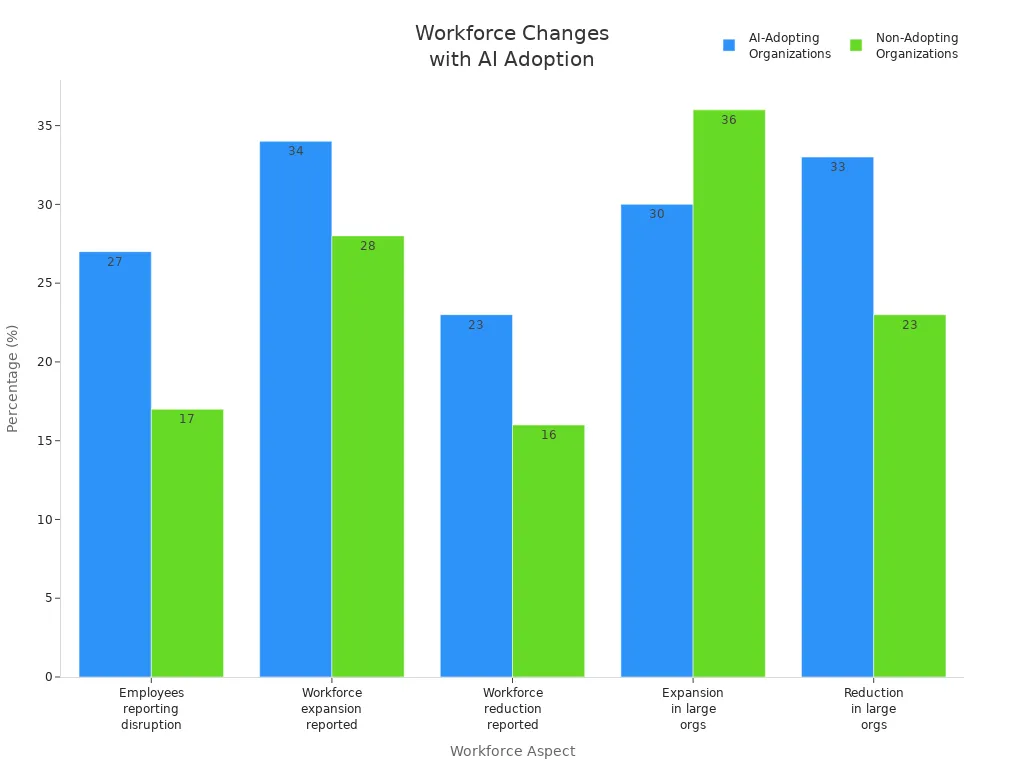
Ai's impact on headcount is clear. You see both expansion and reduction in staffing levels. Employees in ai-adopting organizations report more disruption than those in non-adopting organizations. The survey highlights that ai implementation reshapes workforce dynamics. Smaller organizations show pronounced staffing changes, while larger organizations report a slight trend toward workforce reduction.
| Aspect | AI-Adopting Organizations | Non-Adopting Organizations |
|---|---|---|
| Employees reporting large/very large disruption | 27% | 17% |
| Workforce expansion reported | 34% | 28% |
| Workforce reduction reported | 23% | 16% |
| Workforce expansion in large organizations (10,000+ employees) | 30% | 36% |
| Workforce reduction in large organizations (10,000+ employees) | 33% | 23% |
| Employees concerned about job displacement due to AI | 23% | N/A |
Reskilling Needs
You must prepare your workforce for job transformation. By 2025, 85 million jobs may be displaced, but 97 million new jobs could be created. Employers engage in digitalized processes, and analytical thinking, innovation, and active learning are in demand. Digital skills like big data analytics and cybersecurity are essential for future employment.
More access implies a higher sense of mastery of the technologies. The more complex this becomes, the higher expectation we’re going to have to train ourselves for that.
Cost Optimization with AI
Savings Potential
Ai can optimize costs in your business. Organizations use techniques like hashing and caching to lower ai workload costs. Klarna's example shows that ai can drive cost savings through workflow redesign. You must align ai with your business goals to maximize savings.
Hidden Costs
You need to consider hidden costs when adopting ai. Specialized personnel, ongoing training, infrastructure requirements, integration complexities, and data quality all add to the total cost. Continuous monitoring and optimization are necessary to maintain efficiency.
| Hidden Costs | Description |
|---|---|
| Specialized Personnel | The need for experts who can manage and implement AI systems effectively. |
| Ongoing Training | Continuous education for staff to keep up with AI advancements and operational changes. |
| Infrastructure Requirements | Additional hardware and software needed to support AI systems beyond initial implementation. |
| Integration Complexities | Challenges in merging AI systems with existing workflows and processes. |
| Data Quality and Compliance | Ensuring high-quality data and adherence to regulations for effective AI performance. |
| Continuous Monitoring and Optimization | Ongoing assessment and adjustment of AI systems to maintain efficiency and effectiveness. |
You must plan carefully to avoid inaccurate budgeting, wasted resources, and reduced ROI. Poor data readiness can hinder ai effectiveness, and traditional ROI calculations may not reflect the true impact.
Aligning ai with your business strategy is essential for real business value and cost implications. You must measure outcomes, prepare your workforce, and manage hidden costs to realize ai's impact.
Measuring Actual Value from AI
ROI Challenges
Short vs. Long-Term Value
You face unique challenges when measuring outcomes from ai investments. Traditional roi models work best with predictable costs and direct financial returns. Ai projects often require ongoing expenses for compliance, system tuning, and developer support. You may see benefits like smarter decision-making or time saved, but these gains are harder to quantify. Ai projects need long ramp-up periods and continuous iterations. You must recognize that measuring actual value takes time.
- Longer benefit realization timelines mean you must wait for user training, adoption, and workflow adjustments.
- Ai delivers indirect benefits, such as improved customer experience and decision-making, which are not always easy to measure in financial terms.
- The rapid pace of ai change introduces unexpected costs and benefits, making roi measurement more complex.
- External and internal factors, like market shifts and organizational changes, make it difficult to isolate ai's direct impact.
To measure the true economic value of ai, you should establish a performance baseline. Use the standard roi formula, but include both tangible and intangible benefits. Factor in the time needed for benefits to appear. Tailor your presentations to stakeholders. Executives want strategic benefits, technical teams focus on operational efficiencies, and marketing teams care about customer engagement.
Data Quality Issues
Data quality plays a critical role in measuring outcomes. Poor data can undermine ai effectiveness and lead to inaccurate results. You must ensure your data is clean, consistent, and relevant. If you ignore data quality, your ai project may fail to deliver value. You need to invest in data management and validation before you start measuring actual value.
| Challenge | Impact on Business Outcomes |
|---|---|
| Data Quality Issues | Inaccurate results, reduced effectiveness, wasted investments |
| Resistance to Change | Slow adoption, lower effectiveness, missed opportunities |
| Resource Constraints | Limited ability to compete, slower progress |
| Unrealistic Expectations | Disappointment, misaligned objectives, wasted resources |
The Activity Trap
Misaligned Initiatives
You may fall into the activity trap if you believe that simply adopting ai leads to business value. Many organizations focus on activity metrics, such as the number of tools or pilots, instead of outcome-based metrics. This creates a gap between perceived progress and actual business performance. For example, a U.S. financial firm used many ai tools but had no clarity on the benefits gained. You must define success in business terms before investing in ai.
- Misaligned initiatives waste resources and create confusion.
- Unrealistic expectations can lead to disappointment and misaligned objectives.
- You need to align ai projects with business goals to avoid the activity trap.
Lack of Clear Goals
Clear goals are essential for measuring outcomes. If you lack clear objectives, you cannot track progress or demonstrate value. You must set specific, measurable goals for each ai project. Outcome-based metrics help you see real improvements and avoid the activity trap.
| Metric Type | Description |
|---|---|
| Traditional ROI | Often fails to capture the true value of ai, leading to misconceptions about its effectiveness. |
| Return on Efficiency (ROE) | Focuses on time savings and productivity gains, showing significant improvements over time. |
| Quality of Work Enhancement | Highlights improvements in output quality, which traditional metrics may overlook. |
| Employee Satisfaction and Retention | Indicates that ai can enhance job satisfaction, impacting retention positively. |
| Workforce Capability Expansion | Demonstrates how ai allows individuals to perform tasks that previously required specialized skills. |
Organizational Readiness
Skills and Change Management
Organizational readiness determines your success with ai. You must align ai initiatives with your business strategy. This ensures projects contribute to growth, efficiency, and innovation. Strategic alignment helps you avoid risks like regulatory non-compliance and ethical pitfalls. Ai becomes a catalyst for organizational success when you align it with your goals.
A successful PoC provides the data-driven evidence needed to justify a larger investment. It transforms the conversation from 'We think this will work' to 'We have demonstrated that this works on a small scale.' This allows stakeholders to make a confident, evidence-based decision about proceeding to a full-scale development project.
You need skilled teams and effective change management. Digital skills, big data analytics, and cybersecurity are essential. You must train your workforce and manage change to unlock value from ai.
Governance Gaps
Governance gaps can hinder your ability to measure outcomes. You must create clear processes and structures for ai projects. Strong governance ensures integration within your organization and supports measurement. Each ai implementation should provide immediate value and build capabilities for more advanced applications.
| Component | Description |
|---|---|
| Technology as a platform | Development, use, and deployment of ai to complete business tasks |
| Organization of the project | Process, structure, and integration within the overall organization |
Actionable Advice for Measuring Outcomes
You can use several practical steps to improve measurement and tracking outcomes:
- Establish a performance baseline before starting your ai project.
- Choose metrics that align with your business objectives and project goals.
- Balance leading indicators (predict future performance) and lagging indicators (insights after events).
- Benchmark your metrics against industry standards.
- Track both tangible and intangible benefits, including efficiency, accuracy, performance, and financial returns.
| Metric Type | Description |
|---|---|
| Efficiency Metrics | Assess how ai streamlines operations, reduces time/resources, and minimizes human intervention. |
| Accuracy Metrics | Measure the correctness of ai outputs, such as prediction accuracy in credit scoring. |
| Performance Metrics | Evaluate system uptime, response times, error rates, and user interaction quality. |
| Financial Impact Metrics | Quantify economic benefits, such as ai roi, cost savings, and revenue from ai-enhanced products. |
- Align metrics with business objectives.
- Consider the nature of the ai project.
- Balance leading and lagging indicators.
- Benchmark against industry standards.
Ai stimulates innovation, provides competitive advantage, and enables scalability. Enhanced decision-making offers market advantages and risk mitigation.
Case Studies: Success and Failure in Measuring Outcomes
You can learn from both successful and failed efforts in measuring actual value from ai.
- A retail company used return on efficiency to track time savings and productivity gains. Over time, they saw significant improvements and expanded ai capabilities.
- An insurance firm focused on traditional roi but failed to capture intangible benefits. This led to misconceptions about ai effectiveness.
- A healthcare provider measured quality of work enhancement and employee satisfaction. They found that ai improved job satisfaction and retention.
- A manufacturing business tracked workforce capability expansion. Ai allowed employees to perform tasks that previously required specialized skills.
You must use outcome-based metrics and track both short-term and long-term value. Measuring actual value from ai requires clear goals, strong data quality, organizational readiness, and effective governance. You can unlock true economic value of ai by focusing on measuring outcomes and tracking outcomes at every stage.
Maximizing AI Value in Business
Data Readiness and Governance
Strong Data Foundations
You need strong data foundations to maximize the value of ai in your organization. Clean, consistent, and relevant data supports accurate predictions and reliable outcomes. You should invest in data management and validation before launching any ai project. Leading frameworks help you build trust and transparency in your systems. The table below shows key frameworks for ai governance:
| Framework Name | Key Features |
|---|---|
| Gartner’s AI TRiSM | Explainability, ModelOps, AI application security, privacy |
| NIST’s AI Risk Management | Trustworthy AI characteristics, functions to manage AI risk |
| Singapore’s Model AI Governance | Internal governance structures, stakeholder communication |
| AIGA AI Governance Framework | Organizational practices, operational governance of AI systems |
Privacy and Compliance
You must address privacy and compliance from the start. Regulations require you to protect customer data and follow ethical standards. Strong ai governance ensures your systems meet legal requirements and build trust with users. You should monitor data usage and update policies as laws change. This approach helps you avoid costly penalties and reputational damage.
Outcome-Focused AI Strategy
Aligning with Business Goals
You should align ai initiatives with your business goals to drive business progress. Start by defining clear objectives and measurable targets. Evaluate your current capabilities and identify gaps. Focus on use cases that match your strategic priorities. The following steps help you create an effective strategy:
- Define business objectives.
- Assess current ai capabilities.
- Identify use cases based on impact and feasibility.
- Develop a strategic roadmap with milestones.
- Build cross-functional teams.
- Implement agility for rapid iteration.
- Monitor and evaluate performance.
- Scale successful initiatives.
- Communicate results and learnings.
- Adopt innovation and encourage continuous learning.
You should involve both business and technical stakeholders from the beginning. Establish an ai steering committee and create transparent approval processes. Regular review cycles help you track progress against key performance indicators.
Prioritizing Use Cases
You need to prioritize ai use cases based on business outcomes. Organizations that start with business objectives achieve better results. High failure rates often come from technology-first approaches and poor data readiness. Thorough assessment leads to improved outcomes. The table below highlights benefits of prioritizing use cases:
| Benefit | Description |
|---|---|
| Financial Gains | AI can increase revenue streams and reduce operational expenses. |
| Payback Period | Companies may see payback within 6-9 months depending on scale and use cases. |
| Enhanced Marketing Strategies | AI enables more effective marketing and personalized customer experiences. |
Change Management for AI
Upskilling Teams
You must upskill your teams to unlock the full potential of ai. The World Economic Forum predicts that 39% of core skills will change by 2027. Continuous learning helps your employees stay relevant and adapt to new roles. Skills like creativity, leadership, and critical thinking are becoming more important. Research shows that combining human oversight with ai improves effectiveness and reduces errors. You should provide training and encourage lifelong learning.
Fostering Experimentation
You need to foster experimentation to drive innovation. Start with small pilots to demonstrate value before scaling up. Encourage your teams to test new ideas and learn from failures. Lifelong learning enhances adaptability and supports business progress. Regular monitoring and optimization ensure your ai systems continue to deliver value. You should treat ai initiatives as change management efforts, addressing resistance and building understanding.
Tip: Empower a mix of domain experts and tech teams for effective integration. Focus on governance and ethics from the outset to build trust.
Communicating Value
You need to communicate the value of AI clearly to your stakeholders. This step builds trust and keeps everyone aligned with your business goals. When you show real results, you help your team and leaders see the benefits of your AI investments.
Metrics and Milestones
You should track progress using clear metrics and milestones. These markers help you measure success and spot areas for improvement. When you use the right metrics, you can show how AI improves your business in ways that matter.
Here are some common metrics you can use to track and report AI project success:
| Category | Metrics Examples |
|---|---|
| Efficiency Metrics | Throughput, resource utilization rates, reduction in human intervention |
| Accuracy Metrics | Percentage of correct predictions in data processing or categorization tasks |
| Performance Metrics | System uptime, response times, error rates, quality of user interactions |
| Financial Impact Metrics | ROI, cost savings, revenue generated from AI-enhanced products or services |
| Operational Efficiency | Process times, error rates, automation levels |
| Customer Satisfaction | Response times, service quality, customer retention rates |
| Revenue Growth | New leads generated, upsell rates, contribution to sales |
You should set milestones for each phase of your AI project. For example, you might set a goal to reduce customer response time by 20% in the first three months. You can also track when you reach full automation for a process or when you achieve a specific cost saving. Milestones help you celebrate wins and adjust your approach if you fall behind.
Stakeholder Reporting
You must keep your stakeholders informed with regular updates. When you share results, use data that your stakeholders can verify with their own systems. This approach builds credibility and keeps support strong.
Tip: Use simple visuals and clear language in your reports. Show before-and-after comparisons to highlight improvements.
You can use these methods to communicate value effectively:
- Share comparative analysis that shows AI delivers better results than old methods.
- Address stakeholder concerns directly with evidence of business improvement.
- Invite feedback and questions to keep communication open.
When you report on AI projects, focus on outcomes that matter to your audience. For example, executives may want to see financial impact, while team leaders may care about efficiency or customer satisfaction. Tailor your message to each group for the best results.
You can maintain momentum for AI investment by showing clear, measurable value. Regular reporting and transparent communication help you escape hype-driven cycles and focus on real business growth.
You have seen how AI hype often overshadows real business value. Focus on measurable outcomes and align AI projects with your goals. Keep evaluating and adapting your approach as technology changes. Use these steps to build a foundation for lasting success:
- Set clear objectives for every AI initiative.
- Track progress with meaningful metrics.
- Upskill your teams and foster experimentation.
Take action now. Measure actual value and drive sustainable growth with AI.
FAQ
What is AI hype?
AI hype means people talk about AI as if it can solve every problem. You see big promises in the news and from vendors. These claims often lack proof. You need to look for real results, not just exciting headlines.
How can you measure real business value from AI?
You measure value by tracking clear outcomes. Look for cost savings, higher productivity, or better customer satisfaction. Set goals before you start. Use simple metrics like time saved or money earned.
Why do many AI projects fail to deliver results?
Many projects fail because leaders do not set clear goals. Poor data quality and lack of skilled teams also cause problems. You need strong planning and good data to succeed.
What are hidden costs in AI adoption?
Hidden costs include training your staff, buying new hardware, and keeping data safe. You may also need experts to manage AI systems. Plan for these costs to avoid surprises.
How does AI affect jobs?
AI changes jobs by automating simple tasks. Some jobs disappear, but new ones appear. You need to learn new skills to stay ahead. Many companies help workers reskill for new roles.
How can you avoid the AI activity trap?
You avoid the activity trap by focusing on results, not just using new tools. Set clear goals for each project. Track progress with outcome-based metrics, not just the number of AI pilots.
What steps help maximize AI value in your business?
Start with clean data and clear goals. Train your teams and pick projects that match your strategy. Communicate results to everyone. Keep learning and improving your AI systems.
How do you communicate AI value to stakeholders?
Share simple reports with clear numbers. Use visuals like charts or tables. Show before-and-after results. Invite questions and feedback to build trust.
🎧 Listen to this episode
Want a practical explanation of From AI Hype to Business Value with Kayode Ajayi [MVP-MCT]? This episode breaks down the topic in clear language and shows why it matters for Microsoft 365, Azure, Power Platform, security, AI, and modern work.
Listen to this episode if you want to:
- Understand the key concepts behind From AI Hype to Business Value with Kayode Ajayi [MVP-MCT]
- See how it fits into the wider Microsoft technology ecosystem
- Learn where it can create practical value for your organization
You may also enjoy these related M365 FM episodes:
- From AI Hype to AI Harness Engineering – Building AI That People Can Actually Trust with Alan Buscaglia [MVP] from Gentleman Programming
- Microsoft 365 Copilot Agents: Real Business Value with Steve Corey [MVP]
- AI-First UX for Microsoft Power Platform with Tchesco Ayih [MVP-MCT]
- Secure Azure Networking with Rex de Koning [MVP-MCT]
- Microsoft Security Exposure Management with Uros Babic [MVP-MCT]
Discover more practical Microsoft conversations on M365 FM.
Last reviewed: July 2026.
Who Should Listen
This episode is for Microsoft administrators, architects, developers, security professionals, and business leaders who need a practical foundation before making implementation, operations, or governance decisions.
🎧 You Should Also Listen To
- AI Agents — A strongly related next step for extending this topic.
- Power Platform — A strongly related next step for extending this topic.
- Microsoft Graph Data Connect — A strongly related next step for extending this topic.
Official Microsoft MVP profile: Kayode Ajayi on Microsoft MVP
Apple Podcasts · Spotify · YouTube · YouTube Music
Host: Mirko Peters