 EN
 Deutsch
 Español
 Français
 Italiano
 Português
 Nederlands
 Polski
 Bahasa Indonesia
 Русский
 Українська
 العربية
 עברית
 हिन्दी
 日本語
 한국어
2026-08-11 · Season 2
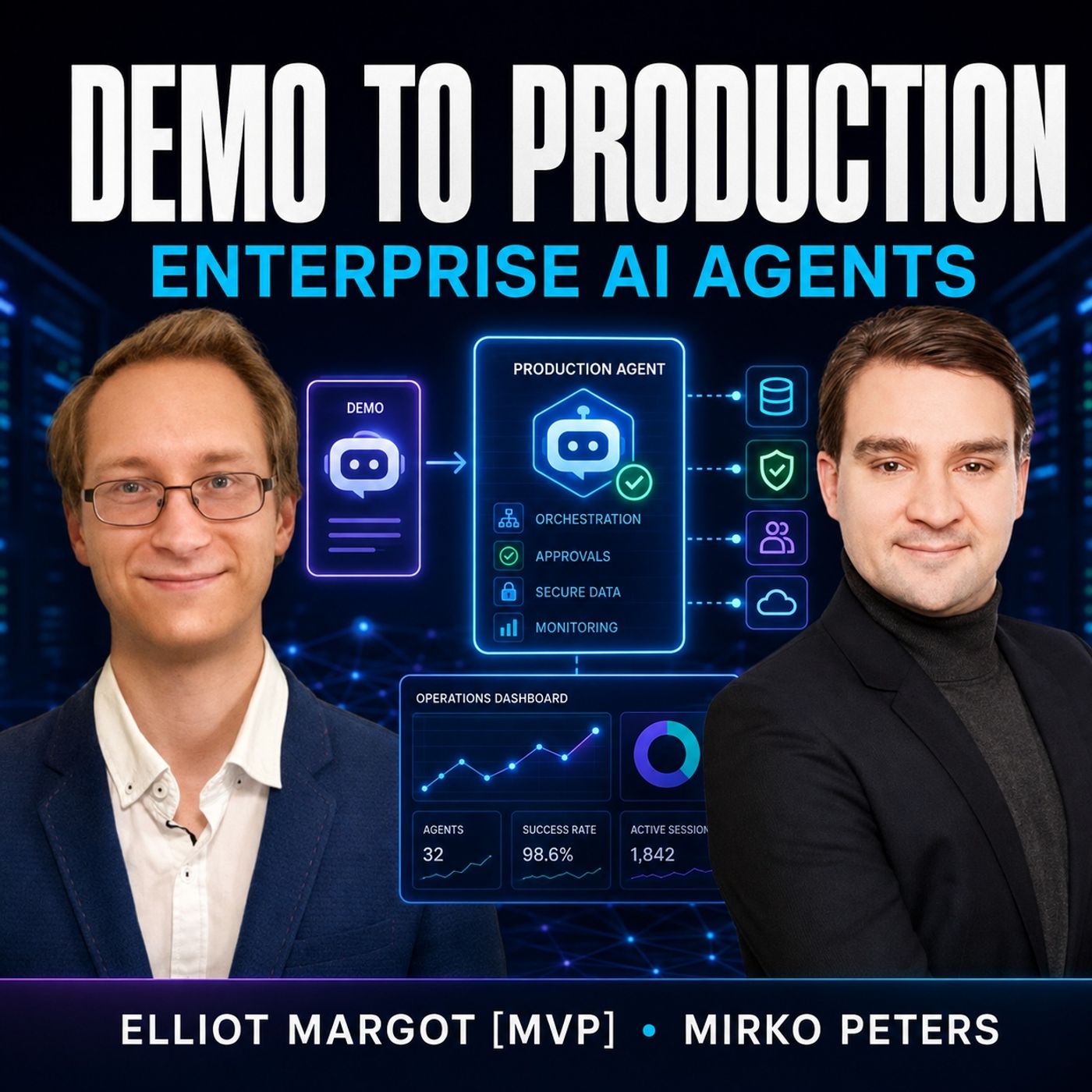
From Demo to Production- Building Enterprise AI Agents That Actually Work with Microsoft Copilot Studio with Elliot Margot [MVP]
Show notes
In this episode of the M365 Show, Mirko Peters speaks with Elliot Margot, Microsoft MVP for Microsoft 365 Copilot and Copilot Studio Team Lead at Witivio. Elliot shares a practical perspective on taking AI from an impressive demo to a secure, governed and genuinely useful enterprise solution. The conversation covers Microsoft Copilot Studio, multi-agent systems, enterprise RAG, MCP, Power Automate, governance, cost control and the human side of AI adoption. ㅤ ㅤ FROM CHATBOTS TO ENTERPRISE AI AGENTS The gap between a chatbot demo and a production-ready agent is much larger than it first appears. An enterprise agent needs a clear purpose, reliable data, carefully scoped tools, sensible fallback paths and a way for people to understand what it is doing. Elliot explains that organisations should not wait for a perfect governance model before experimenting—but they also cannot deploy AI blindly. The strongest approach is to learn by building small, useful solutions while steadily improving guardrails, monitoring and operating models. ㅤ ㅤ GOVERNANCE IS A JOURNEY, NOT A BLOCKER Governance, security and compliance are often the reasons enterprises hesitate to start with AI. Elliot makes the case for a balanced approach: establish the foundations, understand where data goes, apply Data Loss Prevention policies and sensitivity labels, but keep moving. Companies gain the most useful governance insights from real usage. AI evolves quickly, so governance cannot be treated as a one-time project; it requires ownership, continuous learning and administrators who know where to find the right controls across Microsoft 365, Power Platform, Purview and Copilot administration. ㅤ ㅤ SELLING AI THROUGH REAL BUSINESS VALUE ㅤ Executive sponsorship is not only about promising headcount reduction. The better conversation is about improving service, reducing repetitive work and giving teams more time for work that requires judgement and human connection. Elliot uses the example of IT support: even a modest reduction in repetitive Level 1 tickets can create meaningful value. The most convincing AI projects combine a clear business case with a strong “wow” moment that helps people understand what is now possible. ㅤ ㅤ WHY MULTI-AGENT SYSTEMS MATTER A single general-purpose agent can attempt many tasks, but specialised agents can deliver more reliable results. Elliot describes a multi-agent approach where different agents take on distinct roles, such as creating content, reviewing quality, checking user experience, validating requirements or orchestrating a workflow. Instead of expecting one model to get everything right on the first attempt, a multi-agent system can improve, audit and refine its work. This is how AI starts to resemble a coordinated digital team rather than a simple prompt-and-response experience. ㅤ ㅤ RAG, METADATA AND BETTER KNOWLEDGE RETRIEVAL Enterprise AI is only as useful as the information it can retrieve. Elliot explains why metadata is essential for effective RAG implementations. Documents should have clear descriptions, languages, classifications and relevant tags so an agent can retrieve the right source quickly and avoid unnecessary token consumption. A large collection of poorly structured PDFs, duplicate files and outdated versions creates slow, expensive and unreliable answers. Good knowledge architecture means that the current approved information is available to the agent, while old versions are kept out of the production knowledge source. ㅤ ㅤ MCP AND CONNECTING AGENTS TO THE ENTERPRISE Model Context Protocol, or MCP, is becoming an important way to connect AI agents with enterprise tools and APIs. Elliot explains MCP as a structured, discoverable bundle of capabilities that tells an agent what tools are available and how to use them. Instead of treating every API as an isolated endpoint, MCP can help package connections in a more consistent, secure and reusable way. For enterprise AI, this matters because agents need to work with real business systems—not just generate text in a chat window. ㅤ ㅤ COPILOT STUDIO, POWER PLATFORM AND PRODUCTION READINESS ㅤ Copilot Studio opens AI development to more people, but building faster does not remove the need for responsibility. Elliot discusses the growing role of citizen development, prompt-driven building and AI-assisted creation across Power Platform. He also stresses that every production solution must be tested properly. Automated test prompts are valuable, but manual testing remains essential. Do not assume that an agent is ready for production simply because another AI says the workflow looks correct. Human review, scenario testing and clear ownership remain vital. ㅤ ㅤ DLP, PURVIEW AND KEEPING AGENT SCOPE SMALL A strong security model starts with scope. If an agent is meant to summarise Teams meetings, Outlook messages and daily tasks, it should only have access to the relevant services. Elliot recommends separating use cases into appropriate Power Platform environments and applying targeted DLP policies, rather than creating one broad environment with unrestricted access. Microsoft Purview adds another important layer through sensitivity labels and information protection, helping organisations avoid exposing confidential, HR or regulated content to agents that do not need it. ㅤ ㅤ REAL-WORLD USE CASE: THE RFP AGENT One of the most practical examples in this episode is an RFP agent that helps automate procurement processes. The agent supports users from the initial request through preparing documentation, handling supplier questions, analysing proposals and communicating outcomes. Human decision-makers stay involved at the important points, but the repetitive administrative work is dramatically reduced. This kind of solution shows where enterprise AI becomes valuable: it does not replace accountability, but it removes friction from complex processes. ㅤ ㅤ SMALL MODELS, TOKEN CONTROL AND FINOPS Not every task needs the most powerful and expensive model. Elliot explains why organisations need to match model capability to the actual job. A lightweight model can be ideal for summarisation, classification and predictable workflows, while more capable models should be reserved for more complex reasoning. Cost management is not optional in agentic systems. Agents need limits, monitoring and safe escalation paths so they do not get stuck in endless loops, repeatedly calling tools and producing unexpected bills. Good FinOps means understanding consumption, agent usage, model selection and the value delivered by each workload. ㅤ ㅤ THE FUTURE: AGENTS, SKILLS AND AI LITERACY Elliot’s view is that not every business will run huge multi-agent systems, but more employees will use AI agents as part of their normal work. The key skills will be clear communication, AI literacy and the ability to recognise a real business pain worth solving. People do not need to understand every detail of model training, but they do need to understand how to describe a task, choose an appropriate tool, validate the result and work safely with data. The best starting point is often a small flow in Power Automate: test it, monitor it, learn from it and build from there. Listen to the full episode for practical insights on Microsoft Copilot Studio, enterprise AI agents, agent governance, RAG, metadata, MCP integrations, DLP, Power Platform and building AI solutions that work beyond the demo. Become a supporter of this podcast: https://www.spreaker.com/podcast/m365-fm-microsoft-365-azure-cloud-power-platform-ai--6704921/support.
Apple Podcasts · Spotify · YouTube · Deezer
Host: Mirko Peters
Guests
Related articles
- Mastering Enterprise RAG: Why Metadata is the Secret to Better AI Answers
- Scaling Intelligence: Why Multi-Agent Systems Outperform Single Chatbots
- Bridging the Gap: Moving Your AI Copilot from Impressive Demo to Production
Transcript
Read the full transcript
Welcome back to the M665 podcast where we explore the world of Microsoft technologies, talking to people, they building a future of enterprise at e. Today's guest is Elliot Margot, Microsoft MVP for Microsoft C65, co-pilot and co-pilot studio, team lead for Jamstart, co-pilot agents at Vijo and one of the experts helping enterprise is moved to AI from existing demonstration to productive, ready business solution. We'll explore multi-agent architecture, Microsoft co-pilot studio, enterprise rack, MCP integrations, governance security and so on and so on. We hope we get all done. Yeah, if you're building Microsoft co-pilot solutions or wondering how to move beyond simple chatbots into intelligence enterprise agents, this episode is for you. So let's start. Welcome Elliot. Thank you, great intro, love the first time. Yeah, can you tell us a little bit about yourself and your journey into the Microsoft technology? I started about Microsoft. I started very on using Microsoft and everything. As most people have a first computer was also running on Windows and really start working with co-pilot and everything two and a half years ago. Before I got into generative AI, I was already a product owner for insurance chatbots and I really wanted to move into GNII and start implementing and really build solutions. So I switched job and really started doing that. So I started at 27 as a junior consultant. I was a bit of a rough transition but it was a lot of fun and a big steep learning curve and I like learning, I like learning fast. So I put a little bit of my own into it and two years later, here I am a year ago, I started leading the team for all that is integration governance, use case, hackathon, workshops, agent with them as well and famous prompt sounds now that they have so many different names for it. So many different variants but yeah, so that's my little journey through it. Yeah, you working in your company are, I don't know, you leading the Microsoft Jumpstart program. What exactly is Jumpstart? So Jumpstart is pretty wide. It's anything to do, well essentially it's Microsoft official acceleration program. It changed this year, it's called Frontier Accelerator. It's fully funded by Microsoft for eligible enterprise customers. So engagement is organized in essentially five six places. So you inspire co-pilot use to collaborators. You assess the level that's currently in the company, you design solution, then you build them, you do workshops, you do rollouts. No, it's not so much ACM which is nice. Don't like acting as a level one service desk but essentially it's, this part is great. And finally you have a little bit of everything. The team operates with AI native tooling, MCPs and everything that help us be on top and we try to inspire two demos and really bring co-pilot to organizations. Yeah, sometimes I have a little bit problems with the naming convention by Microsoft. Very things to name co-pilot. Sometimes it's a little bit hard to have an overview. But how did you, especially in co-pilot, staff, how did you not get over-vimed with all these updates? I did. There's a lot. But there are ways to co-pilot to find information and so on. I built my own little workflow which sends every day at nine, a little information from anything from, and I have to get it back because it's so big. So it goes from anything from Microsoft co-pilot studio to M365 co-pilot and apps, agents, co-work, front-to-air program, extensibility, SDKs, work IQ, governance, foundry, power platform, and then the entire M365 suite. So like teams, outlook, office apps, fever, loop, and etc. So I would love to share my screen but I'll show you the workflow but essentially every day. That's all you only about. I can invite you to the M365 live stream podcast. So then we can look a little bit more into it. But you work at, I don't know, whitey-bow? Yeah, which, which of you? It comes from the English word width, then width, if you, and then the name, the main name which was all the craze was .io. So it was widthsiv.io and then it changed to VTV. Okay. And it's called AI Solutions for Microsoft 65. The A1 suite for S365. What exactly did you do or what did the company do? So we've got, it's quite large. We mostly do service now, which we also have products. So like products for teams, teams app. We also went into the custom co-pilot. So we have got a few co-pilots. Like my first demo was Bot Murmades and I was like, I told VTV that that would be great if we could have that in the Asian store and sell it to customers. So like a co-pilot agent, which only does diagrams and stuff. So we do have on-shelf products, which we do mostly service custom stuff for, for big companies. Yeah, your company sits in France and you're living in the Spitzerland. Yes. So we got some most of the team in France and we got so few people in Switzerland, including the CEO. So it's, it's being a little bit international of a country. European. Yeah, safe Texas. Joke, joke. So, yeah, there is a topic and a lot of enterprises use AI, I say, yeah, they try to use AI. Why is especially in enterprises, the users of AI, so I say, yeah, hard from your perspective. Because they want to be able to know what goes on with the agents and that's the governance part. And governance is very hard because it's very big. Every different agent you want to implement has a different way to track. You want to be able to find the thing that you can implement and not touch for the next two years, which is, unfortunately, not very realistic because it evolves so quickly. So it's a full-time job for people, for administrators, which system admins, which have to keep up and everything and it's not even their primary job most of the time. So it's very much always staying on top, being able to follow everything that goes on, knowing that nothing is leaked, that the DLP data loss protection prevention policies are solid and in place and that's the hardest thing to put in place. Yeah, I love the governance topic about that. I think a little bit about, when we talk about AI, I try to figure out what I mean, but I think the best question for this is why should companies focus beef on governance and compliance and security before they start? It's a bit, I want to say, ironic. You can't see the results of the governance in place if you don't start. So you can have to start while building it. The best, the companies who learn the quickest are companies who do it themselves and are in scared to, I want to say, get wet a little bit in the pool because it's, as I said, you can't really get information out of it without having data. So governance is important to set up, but if you focus too much on it at the start, you're losing time that you can learn on the job kind of and it's a shame because you can't really learn something without doing it. Yeah, I think that is, yeah, I think a lot of companies doing it, they say, I know it from my companies, I work for, they say, "Oh, then AI, we don't use it because it's not secure and so on." And the other side, I have, we activated for all the people, and don't give a fuck on something like the app's enabling. This is really, really funny, I think. So I think a little bit about, when I go to, as it comes out, I go, I don't know why the yeah, oh, no, I changed, we have two parts, we have the guys they like to use AI and they have the guys, "Oh, would it kill my job? I don't like to use it." And I say, or what, how did you, this is cool, how did you sell the AI to their executive sponsors? It's not easy because you do have the, you've got two facets, you've got the first facets, which is like, it's going to have a good ROI, it's going to improve efficiency, but it's not going to steal jobs. If you want something that's going to do the job, somebody, you're not looking at a salary, you're looking at a little bit more than a salary, because it needs to run the entire time, it's going to, to cost you a lot, and even nowadays with the newer models and like the Chinese models came in, which you can host locally, it still takes a lot of electricity to run. So, the biggest question isn't so much the, the ROI at some point, it's kind of the, the wow effect, and also the, how much time is going to save me? It's a little bit of the ROI, but it's a lot of the wow effect, and that's kind of the, the angle that I push. So let's take, for example, the IT help desk agents, you know, you've got like 50 people, or maybe not 50 people, you've got like five people working ITL desk level one, they take like 13,000 tickets a year maybe, and let me actually do some math on the side, so I don't go something completely crazy. So you've got 10 people and these 10 people do 15,000 tickets. So that's 1,500 tickets per, per user per, per year. So that's quite a lot, a lot of tickets. So if your goal is to say, okay, let's produce that by 10%, so one ticket takes you, let's say, twin, let's be realistic a little bit, it takes you 30 minutes, right? So if 30 minutes, is still about like average wage, let's say like $20. So $20 for a ticket, if you reduce just 15,000 tickets, that's 20 times, don't need, don't need a calculator for that, that's 30,000 per year. So you already have like a little, little good thing, and then it really depends what kind of model you want to use behind, is it, are you okay with winning money, are you okay with optimizing the workforce, so you can take a bigger model, which can give a better quality. And the goal is kind of also to make sure that they understand everything that goes with the executives, understand everything in the back, transparency and trust. Yeah, I find this really, really interesting, Carlos, I use the Microsoft Plurity on my page, and I see I have nearly 30,100 and so on, AI citations, and that means every minute, every minute, it's answered 21 questions, so this is amazing. I don't know, then there's only one minute when we see, or when we think you can answer a question from a client in one minute, you need 21 dudes, did you think we losing jobs with AI, or is it, you get more efficient? I don't think we're going to lose jobs with AI, I think the kind of, as my own opinion, but I think that we're going to replace the workforce with AI was kind of the sales pitch, it wasn't the goal. AI is, as we've seen the trend, it's always getting more and more expensive, it's not getting cheaper at some point, because you still need the hardware to run it, the electricity, the infrastructure, the water, and it's going to make people have more time for things, but it's still going to be expensive, so you need to find the right way to explain that as well, and I think that's also where it's very interesting. Yeah, I think sometimes what we not discuss is with AI, AI can still lose external knowledge, but they don't have the internal knowledge about processing, about, I don't know, about the code from a SaaS company, or how the, I don't know, the refrigerator or the door works, so I think, yeah, people become more efficient, and there, I think there are a lot of people actually outside and say, oh, I run my own company, will, will the agent staff, so why, why does multi agent systems becoming one of the hottest topic in AI, what did you think? So let's do a little example of an agent that builds a powerpoint slide, a powerpoint deck. There's going to be many errors in that, and the first shot, you need to go back in, you need to improve it, it's going to take tokens, it's going to take your time, and you do it once, it takes a bunch of time, you do it twice, it takes last time, you do it a hundred times, it takes almost zero because you automate the process. What if you can have one agent that creates a slide, another that audits the slide, so you have marketing executive, you have a UX designer, you have a developer, you have a product manager, all of these different personalities that look at the slide, give feedback, and it ought to improve. And that's kind of where the multi agent system comes into play in my opinion, it's kind of the self-healing, self-improven system, and I think that's a little bit where we're heading. Yeah, that's interesting, so my question is then, why we have all the specialized agents of dome build, big universal item or brain that's, yeah, no, no, it's all. Because it's easier to sell. I mean, if you're a company that makes only agents for medical, you're going to have to go to doctors, go to hospitals and say, I've got this, I've learned as many hospitals as there are companies, but you make generalist doctors, you'll be able to sell it as a first, maybe input, you make cardiologist, it's going to be very specific, same thing for general LLMs, instead of like specific pre-trained fine-tuned and stuff like that, there's the market, there's just less of a market, so they have to be more expensive, it's more expensive to train, it takes time, it takes efforts, it maybe some also take more compute, and I think that's why general all knowing, well, they say they're all knowing, at least, till they hallucinate, kind of sells better. Yeah, yeah, I have, use the medical, I have a really cool example, there was a company, Ambus, they started as a company that helps people in doctors, nurses, and so on, and now they have all the studies and find, yeah, anomalies like, okay, in the studies, all the people have, I don't know, it acts, and they're the black pressure, they're going down, when people, this is really cool, I think, yeah, so, but, I think a little bit about it, and one thing to do, this is really cool, it's orchestration, what orchestration patterns have proven most successful from your perspective? It really depends, but I think the biggest factor is being able to communicate, well, what you want, being able to describe exactly what you want, the workflow you want to design, and being a good, good communication person, that was not good communication, but being able to express yourself in direct and straight manner without being ambit usable, what you want, that's the best orchestration that you can have, it doesn't matter if you use crew or a line chain or something else, as long as you don't describe what you want, what you want to do, the tasks of every single agent in your workflow is useless, you go to the top right and you press bin, yeah, when we talk about AI, we all talk about large language, how good they are, how good they are, compare it, and so on, but there are some basics, I think, machine learning, and one topic, it's a rock, so how will you explain rock, and how did you see the development of rock, especially when we talk about agentic rock? That's a very wide topic, but you can think of rock as, you've got a library of books, each book has a title, it has a specific color, and then you start adding what we call meta tags, meta information, so you start adding a tag, like science fiction, themes, the stuff like that, and you start building a little bit of an information base about what it's about, so that way the agent when you ask, where is the, well, a question about HR, like when is my next holiday? It knows that it needs to go get the book about HR, and kind of that one it doesn't go into operations or something like that, and that's probably the easiest way to describe it, but the evolution of rock has, in my opinion, not done leaps, but it improved and everything, but still you go find the H1, you go find the header 2, header 3, you look for keywords in something, maybe there's some indexing that is done before, notably like with the metadata and stuff like that, if you go to my website and talk to my agent, it's able to like guide you through the pages and everything, because I pre-did the indexing and stuff like that, but I'm not sure I can answer your question quickly and still have time for everything else. Yeah, this was cool overview, but what did you think, how important are metadata and how handled you ride? I didn't understand the answer. How important is metadata and how to handle it's ride? metadata is key, because if you don't, let's take, let's go into co-piles to you. If you take a co-piles studio and add SharePoint based, knowledge based, you add PDFs which are full text, doesn't have any headers, doesn't have any information, if you go into the settings and play around a little bit, you can see that there are specific settings that you can add, select its index better. So for example, you can add a new column and put description, you can add a new column and put language, and with those parameters, it's able to, if somebody speaks with it in Chinese, simplify Chinese, it's able to go to the right document that's already in Chinese, it doesn't have to translate it and re-translate it behind. So it's important, not only for quick retrieval, but also token optimizations, so optimizing your costs and everything long-term. So good data, good output, bad data, bad output, through STPG. Yeah, it's, yeah, it's a particular regulator for a bad data, I think, it works very well. So I think about, you know, an X-L version, 13, Vellarin, I don't know, X-approved, how can we handle a versioning effectively? The most simple thing is you crushed the old version. But if you want to have a history and everything, that's not the right place to put everything, if you put everything into a rag place where you're going to do the rag, it needs to be the thing that's you're ready to go to production. So if you've got a V19 and a V12, sort of V19 and a V20 of the documents in your production rag environment where you can go to get information, you really need to have the V19 somewhere else and the V20 really in your production place. Again, it could get the 19 and put out the information or the 20 and you're kind of taking risk and also the agent is going to look at both and go, oh, this is newer and it's going to consume more tokens and your costs are going to go up again. So really good data management is key. Yeah, and I think when we talk about rag, what role do you chunking play? I want to say chunking is great, but it doesn't always get the right information depending on how your data is made. So if you take like 150 pdf, it's going, I don't know, different chunkings have different ways. Maybe it takes every third word, maybe it takes every second paragraph, and it misses like the key thing in the middle because it skipped something. Some real found of like having good metadata, tagging your information well, having a little description like in this pdf, you will find the HR policy about absences and sick leave, and then the other one says you will hear you will find absences and maternity leave. And that way you have keywords in your description, which can match easily and then it goes, it knows it goes here. But yet, I'm not a big big fan of chunking documents. Yeah, keywords. So one of the hardest keywords is actually MCP, so I have repeated from Google sometimes, MCP, MCP. Well, Joke, MCP comes one of the most discussed AI standard. What is MCP? What is MCP? So to put it simply, you've got multiple APIs, so you've got multiple endpoints you can call. For example, let's take your fridge. Let's go into reality. Your fridge has multiple levels. So you go level one, level two, level three, level four, and you can go into any of the levels and pick yogurt for Americans you can pick out eggs, who we keep them outside, maybe now with this heat, and so on. An MCP would enable an agent to instead of you plugging everything at once and having to scan every level at once, it goes, okay, I've got all the levels that are available, and I know exactly where to find things. I don't have to look again every time through everything. Yeah, and why is MCP so important for enterprise AI? Because it's something that is that for groups, multiple APIs, multiple levels of the fridge, and you can just plug it into something instead of having to plug every single level at one time. So it's just a bundle of tools you can call different refrigerator levels and really just have something that's secure, authentified instead of again, authentifying every single level. It's like having a camera in front of your fridge with facial recognition, so it will open for you instead of having one every level and going, can I take this yogurt out and goes, it's not you, but you already opened the fridge. So a lot of people don't understand the different tradition between our traditional APIs and MCP. What does the real define? So the real difference is traditional API, you don't necessarily have a description for it. So it doesn't know what synates when to call it, how to use it. If you were to make multiple APIs for writing emails, you would maybe have one to draft an email, another one to send an email. So you would have to explain how to use them. In the description, you can put, for example, use HTML to draft the email, don't use m-, don't forget the accents, maybe not very valid in English, but you're able to bundle your information well so that the agent knows how to use the tool effectively and really customize it a lot more than you could just do with one single endpoint. And again, it's bundled already, it's fixed, so it's easier to plug and play. I think one topic, it's not the sexiest in the world, but a lot of companies have to talk about governance, security and trust in AI systems. So when we start with governance, what governance showed organization established before they employing AI agents? Microsoft agents? Yeah, Asian 365 license. But seriously, without that license, you'd like to lose security information and stuff like that, which is critical. Being able to take an hour before you start deploying agents and familiarize yourself with admin 365, the co-pilot interface, where your data goes, purview, clarity, all that kind of ecosystem, at least being familiar with it, knowing which look, information, preferably connecting your favorite AI agent to Microsoft and CPLern. So that's so you can ask it quickly, where do I find this information and goes, find it and goes, you can find it here. And that will save you a lot of time in the long run, so kind of preparing yourself mentally and preparing the terrain for everything that comes afterwards. Yeah, yeah, yeah. Okay, we are on the bad topics, so let's talk about the most, at the most tightest topic in data loss prevention, VLT. How can we handle this, the co-pilot's to you? So it's power platform, the LPs that you set up for the environment itself. So for example, what I recommend is if you're going to have a co-pilot agent that goes outside of Microsoft, so for example, those HTTP requests, you pass through an app, which in that app only is allowed to use this or that. And it can't decide to go query MSN weather or like try to send many payloads to your bank, but something that could be dangerous. Maybe you want to remove a MailChimp, if it's not in your scope, really keep the scope small, so that you're not able to use things that you shouldn't be able to. So if your use case is an agent that helps your productivity by summarizing your day from teams, your meetings, your emails, then you only leave teams, outlook. And I forgot the third one, but the point is there, you really put a small scope to it, so that it can't be out. And if you've got another use case, you create new environments, and you create new DLP for it. Let me drop a tool in the conversation, Microsoft Viewer. Absolutely, that too. But that's more global DLP than just co-pile Studio DLP, which is some power platform, but absolutely, PerView is key, making sure that you're just really dumb, but keeping your sensitivity labels on documents. If you've got something that's classified secret or confidential, maybe you don't want your agents to have access, like HR docs, personal HR documents, have them well classified and stuff like that. Yeah, yeah. Today, I have a really good day, because I have guests before. He built the master over, and the other topic I really, really love is it's the EGR you work for. Can you or doesn't ring a bell? Or it's ITER? I don't know how pronounced it right. Do you mean Shell? The company? Yeah. Yeah. Okay, no, no, I haven't worked for them yet. Okay, okay, then I was wrong, wrong, wrong, for my, yeah, for my research, the server for this. But you also have a multi-tenant agent for generality, did I hope you're right? Yeah, so multi-tenant agents are kind of fun, especially for big holding companies where they have like maybe like a holding company and then multiple little little subsidiaries. And yeah, no, those are those are absolutely fun, especially when it comes to finance and stuff like that, where they have to report everything up and you have to make sure that the agent understands everything and is able to enter the right information or update the right information. And when you've got one holding company with like 150 subsidiaries, it gets very much quick and intense very quickly. Yeah, Microsoft has this power platform and everyone is now a developer. We call the citizens of the developer. Yeah. How would it you think the citizen development has changed our development and especially AI development? I think that there are two things, a little bit back, you were able to ask, 20p2 or you LLM, how do I build this? Help me build this and you will tell you, oh, yeah, first you have your trigger, you go when an email arrives, resume the email with like a coparist to do that you invoke and then send me a message and team saying, you got an email, this is what it's about, it's not urgent or it's urgent. Three steps, very quick. Now it goes a little bit further, where people aren't really building their own flows anymore, where they log in with Azure Key, CLI and you're able to build the flows with Cod or with VS Code with GitHub Copilot and it goes and plans, you want to do this? So I understand the scope and I'm going to build it for you and it goes into your tenants, your environment where you're accessed, where you're the owner of it. It's like a personal developer environment and it's able to say, okay, I'm going to build it for you, it builds it and most of the time you need to re-log correct a few things, add connections, but it gets much easier to build something on literally no code solution because you're not really building it anymore, you're just saying what you want to build and it's like vibe coding but kind of more vibe building if you get my drift. It's like, yeah, I think I don't like the word, but the prompt engineering was one of the other houses job for, I don't know, three years and now everyone should do it, but what from your perspective, what makes, I say, why code it? AI app, how did you check if it's a manufacturer, you have your checklist or what do you do? No, it really depends on the use case on what it's supposed to do, but automating the tests. So you've got like, for example, a big file where you just send a bunch of prompts and look at the outputs and also, and I guess I can't stress this enough, but manually testing the things you build is key to building something that is stable. If you just trust AI to monitor AI without you ever checking, that is how, like for example, the latest GPD model gets out of their sandbox and starts going to hug and face and hug and their face and stuff like that. It's very much important that you check what goes on with what you build. It's not, oh, I built it, that GPD or cloud or or get up copilot, so agent tells me it's fine, it runs, it's going to work in production, I trust it, I'm not going to do anything. Testing manually is very important, so that you can say yes, it's going to work and when you say yes, you are 100% sure that it will work. Awesome, awesome. There's one thing I see, it's the RFP agent. Can you tell a little bit about this? Absolutely, so RFP agent is an agent that automates purchases from 2 to 50k, so the user says what they want to buy, it redacts the RFP proposal, the documentation for it, and it sends the emails. After that, the suppliers respond, you receive the offers, the questions and so on, and you get everything analyzed with the GPD model, different GPD models specialized for different things. The user just has to look at what comes in, the offers, the questions, response to the questions, of course the question is already, here's the proposed response by the AI, and you just modify it a little bit, press send, sends the response, and until the deadline of the RFP, on the deadline you select the supplier winner, if you want to organize meetings to like discuss the offer as you can, and then you select it, emails go out, you were selected, you were not selected, and that's it. Yeah, over and I think it's really cool you become with the RFP agent and of the official Microsoft customer success story. Yes, that was my first project actually. So here was a big first project. Yeah, yeah, yeah. What have you learned on the side, have you had done this project? Power Automate can there be very tricky. That's the first thing I learned from loops to variables to compose actions to data manipulation, at the start I would use AI builder to kind of help me manipulate data, and then I got really into Power FX, and for those who do anything on the Power platform, Power FX is great to help you optimize flows, it's much faster, and it's also a lot cheaper. So it's just being able to manipulate data well, and I really love Jason now. Yeah, I hope the programming language, not the kid. No, not the person. Yeah, sorry. Yeah, when they look a little bit into the future, what did you think is the co-party studio, or I use more AI Foundry, will it cancel a lot of jobs and what skills I should deliver, then I know it was my job. How to build skills? That is the number one skill you should be able to do, and it's something that has never changed in humanity, I think, communication. Being able to communicate clearly, being able to say what you want to do, being able to, doesn't matter if you can draw like little diagram and stuff, as long as you're able to put it on paper, or in prompt, now in prompt box, to actually explain what you want to do. Communication is key. If you're not good at communication, it's going to be very hard for you to communicate effectively with the agents, what you want to do, and so on. Explain the use case you want to be able to build, that will improve efficiency, your job, and everything. And yeah, except that, AI Literacy is very important as well, not necessarily understanding how the model works and able to explain what goes on behind, but being able to use it. So being able to understand what an MCP is, what the skills are, able to trigger your workflows automatically, stuff like that, that really helps you a lot. Like my project manager, we got project managers, but I like to have a little AI project manager always by my side that does, for example, all the annoying things, like trying to find a meeting time with people. So are you available at that time? No, I'm available at that time. Oh, how about this time? And you get like, sometimes you get like 15 emails switching between you two. And I was like, yes, automate this, it's automated. So all this annoying things being able to kind of be entrepreneurial as well. And seeing, okay, that's a pain. And I really want to be able to improve this. And I really like the four piece. So like the four pieces with your pain and everything. So like the four piece in marketing, our product price, place and promotion, but it's more product price, pain and promotion for AI. So what you find the pain, you find the price, you find the right, sorry, you find the right product to build it in, you find the pricing and then you promote it. But everything goes from the pain and that's very much like entrepreneurship. Yeah, I know. But yeah, yeah, there's something you say is good. And shame on me, I never have used Copying Studio yet. I'm an AI Foundry guy. So there's something, a lot of new stuff like work, IQ, Copying agents and waters, skills and so on. What happened here? What's going on? So before work, IQ, you had like graph, and I'm sure a lot of people know of graph, graph is the API, you can query on the tenant. And it was, again, a single API, it wasn't packaged, it wasn't application intelligence. And work IQ kind of came and was like, we got MCPs, we got everything packaged nicely for AI is just plug and play. And that's what's going on. It's going and making the train AI ready for everything. Awesome. So I, I, I'll sometimes I, lose, I am a little bit overwhelmed with all these new Copilets, updates, what I do is only I say, okay, hey, Copilot, pet me in all the new, I photo, look, look at my link, look at my YouTube and make me 50 minutes. So yeah, I am really interesting, or I think it's really interesting in the future. Did you think will every business operate multi-agents? No, but I think every agent will at least operate one agent. And if not every business, at least part of the employees will use AI to help them in the day to day. And a lot of people still don't use AI in their daily life for starting to get used to it even now. And it is a good way to one see the capabilities, see what's the fun little bit, go, okay, create me a montage of my of my date for this weekend, I took pictures, user, user something to create sounds, etc. And you can have a lot of fun with it while learning. But people really need to get to get used to it, I think. And you don't need to go with Opus 5 or like the most expensive M-dash to actually get something out of it. Small agents like GPT 4.1 can already do quite a lot of summarizing and stuff like that. You don't need large language models always, small language models also very useful. If it's a little word flow where you need to summarize your emails coming in, you don't need to use something which costs like 15 or 20 dollars per token per million token. You can use GPT 5 mini, 5.15 mini, etc. I'm just get something small going, where it costs like I think confoundery was like 55 cents per million token. So yeah, really being able to know what you want to do, adapt it. And I think in the future, it's going, people are really going to use it a lot more. And especially agents are starting to email each other. I don't know if you've ever seen this, I'm starting to see it at work, especially for the meeting thing. And yeah, it's pretty funny because AI agents are organizing our calendar and just informing you, yeah, you got a meeting tomorrow. All right, cool. Thank you. Yeah, yeah, more destopness getting so expensive in the last time. I think more cordons, it's oh damn fuck, I have spent so many money. So I have two accounts on Azure, a one account, a sponsor or a star bank account with 150,000 Azure credits. And the other was 5,000, I say, okay, I think for cybersecurity, I have built a tool what should explain why the cybersecurity issues came from. So it's been up, I think, thousands, three hundred companies with need each penny, employees per company. And I have, I think I have there was not, I have take Claude, but not the newest version. And it's worked so hard. And after it's, after sometime is like, oh, your tokens are gone in two days, 250,000, yeah, okay, Microsoft, hey, it's okay. But yeah, this was really hard. And then I have tried my own small, small language model. And let's more only, I think, six to no, to euro, I have spent so this is so amazing as a small or I say, I think the word, I don't like the word small language model, I like the more the word special language model because yeah, it's doing so, so great jobs. And especially in AI fondly, have we also, I don't know, I never was ago, I'm sorry for this, I'd better prepare, but is there also an option to use small language models in Copa? It's the way you got GPT 4.1. So you've got three billing levels in Copa studio, you've got default standard and premium. So like default is like 4.1. And then premium is like Opus or GPT 5 reasoning. And then standard is like GPT 5.5 chats or Sonnet 4.6. And yeah, you need to kind of juggle everything, make me sure you get the right model for a heavy workflow and stuff like that. And I think the, and on token consumption, I think the biggest mistake is kind of telling your agent to never call me, always try to do it until the end because it can like loop infinitely trying to do something. And I don't know if you've ever had this, but I woke up one morning with my 100 franc bill, which is like $800 on a Monday morning, right when I woke up. So yes, because I made that mistake to like, oh, it's fine, this is a simple workflow, we can do it easily. Yeah. So auto learning, auto healing and being able to say, I'm stuck in, in, in, in sends you an email or something, I'm going, you need to take a look at this, I'm stopping here because I'm like finding errors or something. This is a great way to, to not have those early morning bad days. This is a great, great way to start the morning with this kind of bill. So yeah. So okay, Microsoft supports reimburse me, but yeah, I love it. But I'm a co-pilot studio. How, how, when we talk about consumption and, and, and, yeah, the, the price is behind it. We have a lot of companies have a sea of all. How can we make him more happy? Is there any fine ops? fine, and co-pilot? You do have a lot of the Finops option in co-pilot studio, in co-pilot as well, in Foundry as well. It's kind of the, I think now you need agent 365 to do it. I haven't kept up to date too much lately with it. I'm waiting until it's a little bit more stable and more features come out to actually read everything, because it's still an evolution. But, yeah, you got, you got quite a few, quite a few tools. I think he got Finops in, in M365, in 365 admin. But then again, I really like to have a delegated app or an app registry, which is connected to, user subscription and everything where you're able to look at the information, get it directly live, query it also with an agent. That was actually was my, my last demo was AgentLands, where it's like connected to the whole cost management, so the billing subscription and everything, and was a reader for the user resource graph. So, and also the, the, the co-pilot packages. So, you're able to like list all the agents, see what they consume, see how many people are using it, and stuff like that. So, it's a little project I have now, unfortunately, kind of stalled because I don't have enough time for it, but it's something I really want to do for start of September and have it open source. You're going to need agent 365 subscription, because say, PIs are what you need it for, but so it's come to help you kind of interact with your, your environment, your GLP and stuff like that. So, kind of have everything in one place instead of going to clarity, preview, admin, this, admin, that, team's admin, co-pilot, admin, center, and so on. Really cool. What was the project? And then, yeah, the first project become a showcase. So, Microsoft had you a little bit fixed on the showcase stuff, or? Yeah, I like, well, with David Warner and his little community and with also the others, of course. But, no, I really liked, so it was the first Microsoft community I kind of found, and they accept me for demo. So, I'm very loyal in that way. And plus, I like to do demos behind the screen also, also in person, but it's much easier to kind of get to know how to do demos, how to talk behind the screen. So, for anybody listening, actually, wants to do demos. How do you recommend the platform community always enjoys having people do cool demos? Yeah, I think this is really, really, really cool. So, I have an every session, a rapid fire round. So, I ask short questions, and then you give more short answer. Ready? Let's go for it. TOR energy things during the development of a new agent. Gossi. When you have to talk to real people, teams or outlook? Teams. Your favorite co-pilot feature. Direct line integration. Oh, good. Your favorite power platform capability. Oh, that's the Uda Sardin. HTTP calls triggers on parot made. When the missbusters come to you and say, "Eliot, you are a part of the show, which miss will you bust?" That you cannot reduce AI agent tokens more than you can. You can reduce them a lot. Yeah. You're living in Switzerland. So, what's better? Shokunet or KS fondue? Oh, cheese fondue all the way. When Microsoft, I say, "Saturday night, I come to you and say, "Okay, "Eliot, you get all the money and resources to build the next feature on a co-pilot, studio. What will it be?" That the agent build itself. Okay. Are the skills and everything that really, you want to say the workflow and it builds it by itself on a whole other new level. It creates the skills. It goes and finds in other repos. It takes what's open source, subsorbs it and gives you a proposition. And the biggest lesson you have learned from Enterprise AI. It's hard to get people on board until you understand what motivates them. When you meet your younger yourself, I say, 20 years or so, what will he surprise most about you today? But I have access to internet. Unregulated on to net. Yeah, so cool for this. So, let's go to the closing and tell us a little bit about your your next project. You plan, you do a little bit deeper as before. After this podcast, I'm taking a long break. Well, it's a long break. But my next project is the agent, the agent in M365, a co-pilot chat, where it's able to help you manage the agents in your tenant for an admin. And so far, that sits taking a well-deserved break during the summer. That's one of your projects. Okay, finally, who showed the next guest here on the M365 event podcast? And what question showed I ask him, her, you don't afraid of? Do I get areas of expertise of the people? Sorry. Are areas of expertise of the people? Next people? Yeah, what secret question show? I ask you, you don't like to ask him. I don't like being mean. But I think a good question to ask is, how do you differentiate the different AI services? So like between agent builder, co-pilot studio, Foundry, like DSDKs and libraries, which are available. How do you pick which one to build on? And that's always a difficult one. What, what, what guest did you expect for this? That is a good question. Maybe, I don't know if you've already had Raffsahn on the call? Raffsahn, hi, oh, yeah, who's saying of? No, no, I had asked him some times, but I don't get in, actually, but I try it again. So I can say, Elliot, as a good guest you for you. Yeah? Yeah, so, yeah, Elliot. Thank you so much for joining me on Yemsa 65 Podcast and sharing your experience, especially in co-pilot, how you build multi-agent architecture, enterprise, and governance, and MCP integrations. Yeah, I think that's was really cool because we have also heard some real world experience, and not all the, yeah, the fantasy stuff. So thank you so much to being here. Thank you, Mirko, and if I may just have one last word, build little flows and parotemates to start and bring it up because you've got some great AI capabilities in parotemates. If you know how to do calls, HTTP calls, if you know how to integrate prompts, integrate them directly in your flows, analyze the things, try it, see how it goes out, send yourself messages in teams, don't get your building admins on your back, be slow, be cautious, but do enjoy, do test it, and that is all. Yeah, yeah, cool. So I think all the people find the links from you in the show notes, and yeah, thank you so much for being here. It was a real pleasure. I really enjoyed it. Thank you for having me. So much, my, all my face. It was really great. Thank you so much. Thank you very much for having me, Mirko. Have a great evening.