 EN
 Deutsch
 Español
 Français
 Italiano
 Português
 Nederlands
 Polski
 Bahasa Indonesia
 Русский
 Українська
 العربية
 עברית
 हिन्दी
 日本語
 한국어
2026-01-27
Low-Code Scalability Risks: Why Explainability Matters

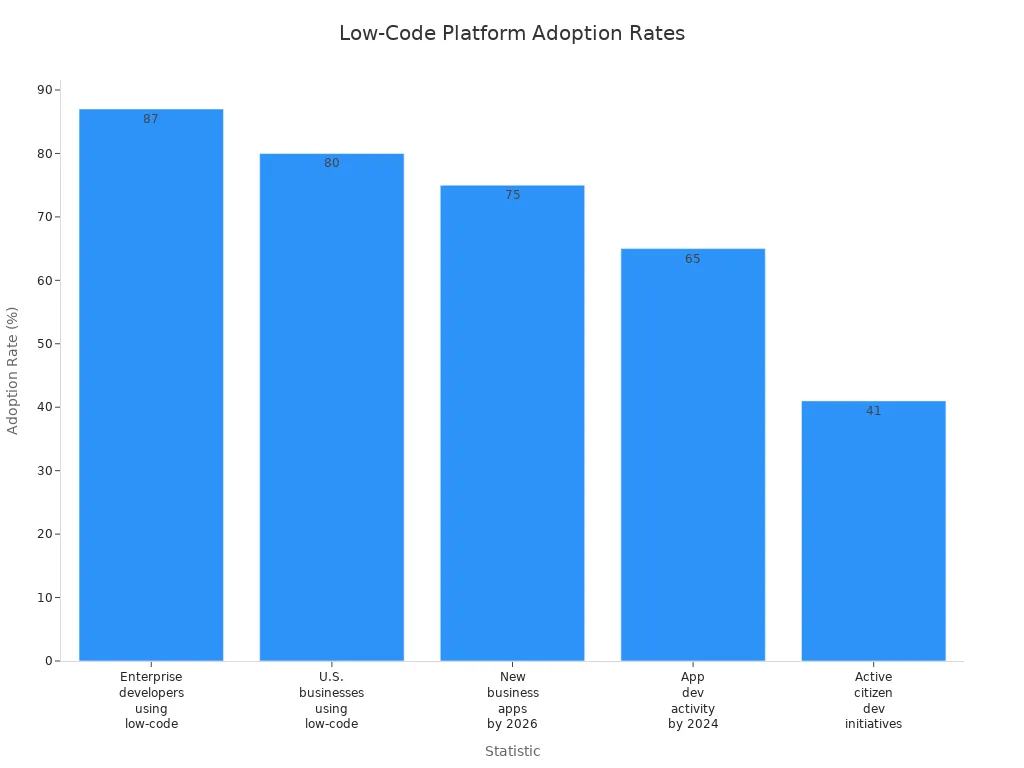
Organizations increasingly adopt low-code development platforms to streamline their processes. Recent statistics reveal that 87% of enterprise developers utilize these tools. Notably, 80% of U.S. businesses have embraced low-code solutions, and by 2026, 75% of new business applications will likely rely on such technologies. This rapid growth underscores the importance of navigating the explainability frontier, as organizations must ensure clarity and governance in their automated processes to mitigate risks and enhance scalability.
Key Takeaways
- Low-code platforms empower non-IT users to create applications quickly, fostering innovation without heavy reliance on IT departments.
- Organizations can achieve faster development and cost savings by adopting low-code solutions, allowing them to respond swiftly to market demands.
- While low-code offers many benefits, organizations must be aware of risks like security vulnerabilities and scalability limitations.
- Explainability in low-code development enhances user trust and accountability by clarifying how decisions are made within applications.
- Implementing strong governance frameworks is essential for managing low-code development, ensuring compliance and security.
- Training leaders in low-code initiatives equips them with the skills needed to navigate challenges and drive successful outcomes.
- Continuous monitoring and auditing of low-code applications help identify risks and maintain reliability in automated processes.
- Future trends indicate that low-code platforms will increasingly integrate AI, improving usability and scalability for organizations.
The Rise of Low-Code Solutions

Understanding Low-Code Platforms
Low-code platforms have emerged as a transformative force in the software development landscape. These platforms allow users to create applications with minimal coding, utilizing visual interfaces and pre-built components. According to a recent survey by Gartner, by 2026, 80% of application development will be driven by non-IT users. This shift highlights the democratization of application development, enabling business users to innovate without heavy reliance on IT departments.
Key features of low-code platforms include:
- User-Friendly Interfaces: Drag-and-drop functionality simplifies the design process.
- Scalability: These platforms adapt easily to evolving business needs.
- Integration Capabilities: Seamless connections with existing systems via APIs enhance functionality.
- Automated Testing: Built-in testing features help identify issues early in the development cycle.
Benefits and Risks
The adoption of low-code solutions offers numerous advantages for organizations. They enable rapid application development, allowing businesses to respond quickly to market demands. The benefits include:
- Faster Development: Low-code platforms facilitate quick project creation, keeping pace with changing business needs.
- Cost Efficiency: Reduced coding and testing time lead to significant savings.
- Increased Collaboration: These platforms foster better communication between business and IT teams, enhancing productivity.
However, organizations must also be aware of the potential risks associated with low-code development. A recent study revealed that 75% of IT leaders express concerns about security vulnerabilities, including weak authentication and data privacy risks. Other risks include:
- Scalability Limitations: Nearly 47% of IT leaders worry about the platform's ability to handle growth.
- Vendor Lock-In: Proprietary technologies can complicate data migration, with 37% of leaders acknowledging this challenge.
- Compliance Issues: Ensuring applications meet regulatory standards can be difficult, especially when built by non-expert developers.
In various industries, low-code platforms are gaining traction. KPMG’s research indicates notable deployment areas, including CRM, e-commerce, and HR functions. For instance, in the financial services sector, a major insurance company reduced the development time for a policy administration system from 24 months to just 6 months, resulting in substantial cost savings and improved processing rates.
As organizations navigate the complexities of digital transformation, understanding both the benefits and risks of low-code platforms becomes essential for long-term success.
Scalability Issues in Low-Code
Limitations of Low-Code
Organizations face several challenges when scaling low-code solutions, particularly in large environments. As user demand and data volume grow, applications built on low-code platforms often struggle to handle increased workloads efficiently. Here are some key limitations:
- Limited Performance for Enterprise Workloads: Applications designed for small-scale use may not meet the demands of enterprise-level operations.
- Data Volume Challenges: Managing large datasets can strain low-code applications, especially those not designed for heavy data processing.
- Integration Complexities: Integrating low-code applications with existing IT infrastructure, particularly legacy systems, can present considerable challenges. Custom integration tasks may require technical expertise that citizen developers might not possess.
- Vendor Lock-In: Organizations may become heavily dependent on a specific low-code platform due to its proprietary frameworks. This dependency complicates any potential transition to other platforms.
Additionally, integration challenges can lead to performance issues, such as throttling and unpredictable latency, which directly affect the scalability of low-code applications. These platforms often struggle with large data volumes and high-frequency syncs, limiting their ability to adapt to complex business needs.
| Limitation Type | Description |
|---|---|
| Lack of Control and Customization | The abstraction of underlying code restricts control over application structure and behavior, complicating the implementation of specific functionalities. |
| Vendor Lock-in | Organizations may become dependent on a specific platform, making migration to another platform difficult and costly. |
| Integration Complexities | Integrating low-code applications with existing IT infrastructure, especially legacy systems, can be challenging due to unique requirements and lack of standard APIs. |
| Security Vulnerabilities | Low-code platforms may introduce security risks that need to be managed carefully. |
| Scalability and Performance Bottlenecks | The simplified building blocks of low-code platforms can limit optimization and performance tuning necessary for large-scale applications. |
| Version Control and Collaboration Issues | Low-code platforms may lack robust version control systems, complicating collaboration among multiple developers. |
Balancing Speed and Quality
While low-code platforms enable rapid application development, organizations must balance speed with quality. The allure of quick deployment can lead to increased technical debt. Rapid software introduction often results in quick fixes and shortcuts that create complicated dependencies requiring future technological work.
Organizations can measure the impact of low-code development on project delivery timelines and defect rates through various methods:
- Compare development times with and without low-code platforms.
- Assess the number of IT requests handled post-implementation.
- Evaluate productivity improvements in IT output.
- Measure the time taken to clear custom app development requests with low-code versus traditional methods.
- Examine the quality of IT output before and after low-code implementation.
Generative AI tools can enhance coding productivity, with reports indicating up to 55% increased productivity. However, these benefits may not always translate to real-world scenarios, especially when integrating AI-generated code into complex existing systems. Organizations must remain vigilant to ensure that the speed of development does not compromise the quality of the final product.
Ultimately, organizations must recognize that true scalability in low-code development hinges on maintaining a delicate balance between speed and quality. By prioritizing both aspects, they can create robust applications that meet their evolving business needs.
The Explainability Frontier
Explainability's Role in Decision-Making
Explainability plays a crucial role in decision-making processes for organizations utilizing low-code platforms. It allows teams to trace the origins of errors in AI decisions, which is vital for accountability. Here are some key aspects of explainability's impact:
- Error Identification: Organizations can pinpoint the source of mistakes, enabling effective root-cause analysis to prevent future issues.
- User Trust: Transparency in AI decision-making fosters user acceptance. When users understand the rationale behind decisions, such as loan approvals or rejections, they gain confidence in the system's fairness.
- Empowerment of Business Users: Low-code platforms enable business users to manage logic directly. This accessibility, combined with explainability, ensures organizations maintain visibility and control over their decision-making processes.
As organizations scale their automation efforts, clear processes become essential. They must ensure that all stakeholders understand how decisions are made. This clarity not only enhances trust but also supports effective collaboration between business and IT teams.
Risks of Lack of Explainability
A lack of explainability in low-code solutions can lead to significant risks. Organizations may encounter several challenges, including:
- Trust Issues: Users may develop skepticism towards AI systems due to the black box phenomenon, where the inner workings of AI remain opaque.
- Poor Decision-Making: Unclear AI operations can result in poorly informed decisions, misaligning outcomes with business objectives.
- Regulatory Compliance Challenges: Insufficient explainability can complicate compliance with industry regulations.
The table below outlines specific risks associated with a lack of explainability:
| Aspect | Evidence |
|---|---|
| Validation Challenges | Participants reported difficulties validating tool outputs that lacked clear reasoning, necessitating extensive manual validation. |
| Project Risks | The absence of explainability introduced safety and financial risks, with undetected errors leading to production failures. |
| Stakeholder Communication | The lack of clear explanations complicated interactions with stakeholders, making it difficult to justify AI-generated designs. |
Organizations must prioritize true explainability to mitigate these risks. By fostering transparency and clarity, they can enhance decision-making processes and ensure compliance with regulatory standards.
Strategies for Governance and Explainability

Implementing Governance Frameworks
Effective governance frameworks are essential for managing low-code development, especially in large organizations. These frameworks help balance innovation with control, ensuring that citizen developers can create applications securely and compliantly. A structured approach includes establishing a Low-Code Centre of Excellence (LCCoE) to oversee citizen-developed applications. This center ensures that applications remain secure, compliant, and maintainable.
Organizations should consider the following key components when implementing governance frameworks:
- Establish Clear Policies: Define standards for application development, data access, and security requirements.
- Role-Based Access: Implement permissions that align with organizational roles to enhance security.
- Security Measures: Apply robust security protocols to protect sensitive data and ensure compliance with regulations.
- Continuous Monitoring: Regularly monitor applications to identify performance issues and security concerns.
- Regular Reviews: Continuously improve the governance framework based on feedback and changing needs.
By adopting these strategies, organizations can effectively manage low-code development at scale. They can also ensure audit and compliance defensibility, which is critical for maintaining trust and accountability in automated processes.
| Metric | Description |
|---|---|
| Policy Compliance Rate | Percentage of systems, applications, or processes that meet defined policies |
| Mean Time to Remediation | Average time required to address policy violations or security issues |
| Audit Finding Frequency | Number of governance-related findings in internal or external audits |
| Developer Productivity Impact | Measures of how governance activities affect development velocity |
| Risk Reduction Metrics | Quantitative measures of how governance reduces organizational risk exposure |
Training for Leaders
Training plays a pivotal role in preparing leaders to oversee low-code initiatives effectively. Organizations must equip their leadership with the necessary skills and knowledge to navigate the complexities of low-code development. Effective training programs should focus on both technical and domain expertise, as highlighted by various industry sources.
Key elements of successful training programs include:
- Foundational Training: Programs should emphasize the importance of training both technical and domain experts as foundational for low-code adoption.
- Structured Approach: Building a Low-Code Center of Excellence (CoE) involves phases of Start, Structure, and Scale, ensuring leaders understand their roles and responsibilities.
- Hands-On Learning: Simulation-based learning is crucial for preparing leaders in technology-driven initiatives. This approach allows leaders to engage with real-world scenarios and challenges.
Organizations like OutSystems provide extensive training resources, including tutorials, webinars, and certification programs tailored for both developers and leaders. These resources help ensure that leaders are well-prepared to guide their teams through the citizen developer imperative.
By investing in leadership training, organizations can foster a culture of accountability and innovation. This investment not only enhances the effectiveness of low-code strategies but also empowers leaders to make informed decisions that align with organizational goals.
Future Trends in Low-Code Development
Innovations in Explainability
Recent advancements in low-code development platforms have significantly improved explainability. These innovations empower non-technical users to understand and utilize complex systems effectively. Key innovations include:
- Generative AI Integration: This technology enhances explainability and usability, making it easier for users to navigate low-code environments.
- Automated Code Generation: This feature simplifies the development process, allowing users to focus on application logic rather than intricate coding details.
- Intelligent Assistance: Real-time guidance and recommendations help users make informed decisions during development.
- Real-Time Feedback: Users receive immediate corrections for errors, improving application reliability and user confidence.
Furthermore, the integration of artificial intelligence (AI) and machine learning (ML) into low-code tools focuses on user-centered design. This approach democratizes AI, enabling users to train and deploy models without needing extensive programming knowledge. However, existing explainability features often lack interactivity and user-centered modules, which developers must address to enhance user experience.
Predictions for Scalability
Industry experts predict significant changes in the scalability of low-code platforms over the next five years. The following table outlines key predictions:
| Year | Prediction |
|---|---|
| 2024 | 80% of non-IT professionals will develop IT products/services, with over 65% using low-code tools. |
| 2025 | 70% of new applications will utilize low-code/no-code technologies, up from less than 25% in 2020. |
| 2026 | 70% of new business applications will use low-code/no-code technologies. |
| 2027 | The low-code platform market is projected to reach $36.43 billion. |
| 2029 | Low-code platforms will power 80% of mission-critical applications globally. |
Despite these optimistic forecasts, many businesses express hesitations about low-code development due to concerns about long-term scalability. Flexibility and security remain significant issues that need addressing. As organizations increasingly rely on low-code solutions, they must ensure these platforms evolve to meet complex enterprise needs.
Organizations must prioritize explainability and governance to scale low-code development successfully. The table below highlights critical challenges and focus areas:
| Key Takeaway | Description |
|---|---|
| Explainability | AI Copilot systems must interpret natural language accurately and provide clear outputs. |
| Scalability | Performance issues arise with complex requests or large datasets, impacting user experience. |
| Customization | Customizing AI-generated components for legacy systems remains limited. |
| Governance | Strong governance frameworks ensure compliance and security in low-code environments. |
Experts recommend the following steps to improve explainability:
- Ensure data transparency by investing in clean, accessible data.
- Bolster AI literacy through targeted training for users.
- Continuously audit AI models to identify risks and maintain reliability.
These strategies empower organizations to build scalable, transparent, and accountable low-code solutions.
FAQ
What is low-code development?
Low-code development allows users to create applications with minimal coding. It utilizes visual interfaces and pre-built components, enabling non-technical users to participate in application development.
What are the main benefits of low-code platforms?
Low-code platforms offer faster development, cost efficiency, and increased collaboration between business and IT teams. They empower organizations to respond quickly to market demands.
What are the risks associated with low-code development?
Risks include security vulnerabilities, scalability limitations, vendor lock-in, and compliance challenges. Organizations must address these issues to ensure successful low-code implementation.
How can organizations ensure explainability in low-code solutions?
Organizations can enhance explainability by establishing clear documentation, implementing governance frameworks, and providing training for users. Transparency in decision-making fosters trust and accountability.
What role does governance play in low-code development?
Governance frameworks help manage low-code development by balancing innovation with control. They ensure applications remain secure, compliant, and maintainable, reducing risks associated with citizen development.
How can leaders prepare for low-code initiatives?
Leaders should invest in training programs that focus on both technical and domain expertise. Hands-on learning and establishing a Low-Code Center of Excellence can enhance their effectiveness.
What future trends should organizations watch in low-code development?
Organizations should monitor innovations in explainability, generative AI integration, and predictions for scalability. These trends will shape the future of low-code platforms and their adoption.
How can organizations measure the success of low-code initiatives?
Organizations can assess success through metrics such as policy compliance rates, developer productivity impact, and audit finding frequency. These indicators help evaluate the effectiveness of low-code strategies.
🎧 Listen to this episode
Want a practical explanation of Low-Code Scalability Risks? This episode breaks down the topic in clear language and shows why it matters for Microsoft 365, Azure, Power Platform, security, AI, and modern work.
Listen to this episode if you want to:
- Understand the key concepts behind Low-Code Scalability Risks
- See how it fits into the wider Microsoft technology ecosystem
- Learn where it can create practical value for your organization
You may also enjoy these related M365 FM episodes:
- Will Copilot Studio Replace Low-Code Developers?
- Why Low-Code Is Becoming the Enterprise Development Standard
- Power Apps Vibe Code vs Low-Code: Which Fits Your Team?
- No-Code vs Low-Code vs Pro-Code: Which Should You Choose?
- Infrastructure as Code - Simply Explained
Discover more practical Microsoft conversations on M365 FM.
Apple Podcasts · Spotify · YouTube · YouTube Music
Host: Mirko Peters