 EN
 Deutsch
 Español
 Français
 Italiano
 Português
 Nederlands
 Polski
 Bahasa Indonesia
 Русский
 Українська
 العربية
 עברית
 हिन्दी
 日本語
 한국어
2026-07-19 · Season 3
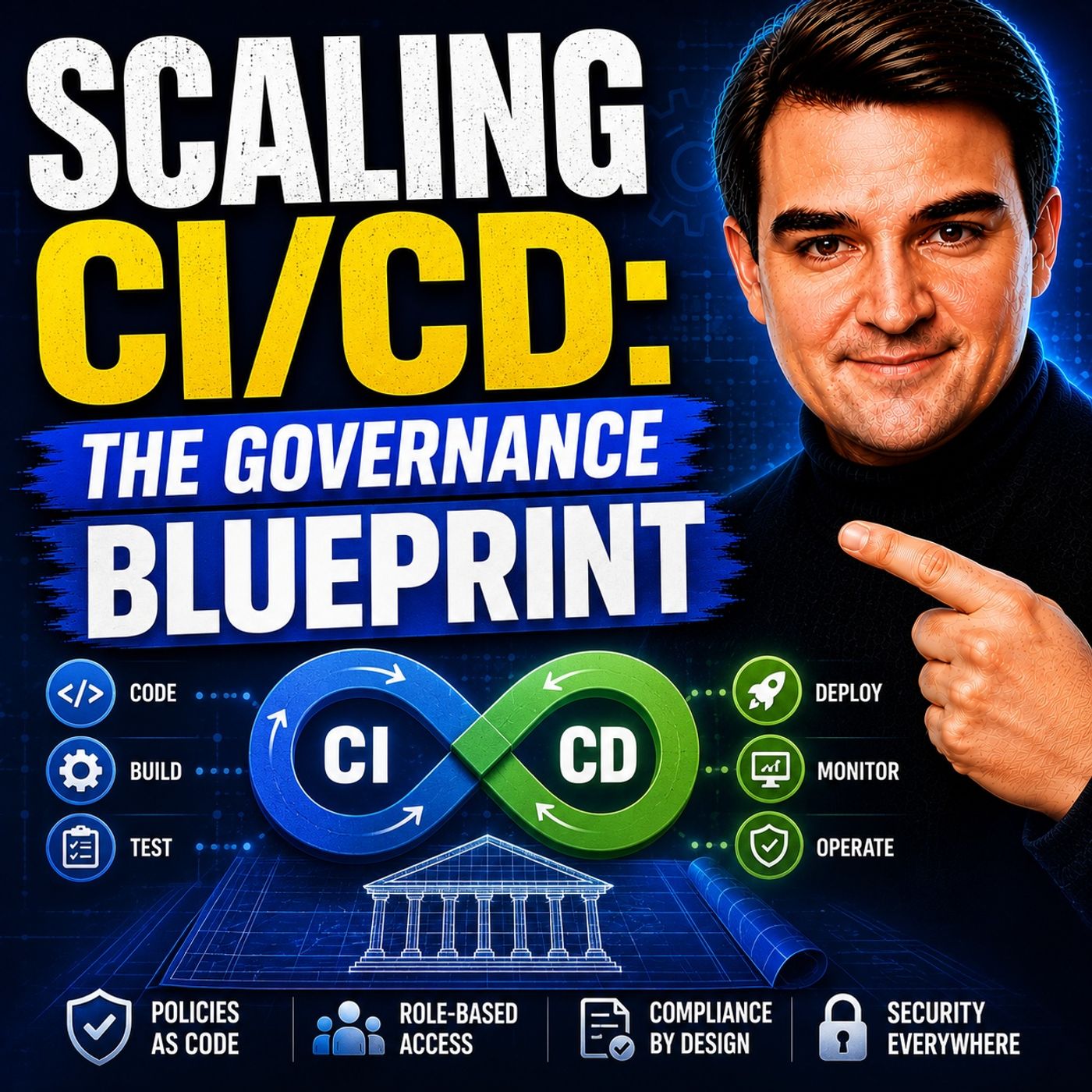
Scaling CI-CD: The Governance Blueprint
Show notes
modern platform governance works differently. Rather than enforcing compliance through documentation and manual reviews, governance is embedded directly into templates. These templates automatically include:
- Security scanning
- Dependency validation
- Approval gates
- Secrets management
- Naming standards
- Audit logging
Because these controls are built into the platform itself, development teams don't need to remember every policy. The safest path also becomes the easiest path. GOLDEN PATHS A major concept introduced in this episode is the Golden Path. Instead of giving developers blank pipeline templates, organizations provide opinionated deployment paths that already include best practices. Golden Paths define standard approaches for:
- Building applications
- Running automated tests
- Performing security validation
- Deploying through environments
- Rolling back failed releases
Most services can successfully use only a small number of Golden Path templates, while exceptional workloads extend rather than replace the standard model. This dramatically reduces onboarding time and ensures consistency across engineering teams. RING-BASED DEPLOYMENTS Safe deployment at scale requires limiting the blast radius of every release. The episode introduces Microsoft's Ring Deployment model. Instead of deploying directly to every user, releases move progressively through increasingly larger audiences. Typical deployment rings include:
- Ring 0 – Internal engineering teams
- Ring 1 – Pilot users
- Ring 2 – Broad production
Each promotion depends on predefined success criteria including deployment success, latency, error rates, business metrics, and overall system health. Only after a ring meets its objectives does the deployment continue to the next stage. CANARY RELEASES While ring deployments target groups of users, Canary Releases gradually increase traffic to a new application version. Instead of exposing everyone immediately, perhaps only 1% of requests use the new version. Observability platforms continuously compare:
- Error rates
- Response times
- Business KPIs
- User behavior
If performance remains healthy, traffic gradually increases. If problems appear, traffic immediately returns to the stable version. This minimizes deployment risk while providing real production feedback before a full rollout. OBSERVABILITY AND AUTOMATED PROMOTION Deployment governance depends on reliable measurement. Observability provides:
- Distributed tracing
- Centralized logging
- Performance metrics
- Health dashboards
These measurements feed automated promotion gates that determine whether deployments satisfy predefined quality thresholds. Instead of requiring manual approval for every promotion, policies evaluate real production metrics and automatically decide whether deployments may continue through the release pipeline. This dramatically reduces deployment latency while maintaining high confidence in production quality. PLATFORM AS A PRODUCT One of the strongest messages throughout the episode is that internal platforms should be treated like products. Platform teams should measure:
- Developer satisfaction
- Adoption rates
- Time to first deployment
- Self-service success
- Golden Path usage
If engineering teams actively choose the platform because it simplifies their work, governance becomes nearly invisible. The platform succeeds not because people are forced to use it, but because it removes friction from software delivery. IMPLEMENTING THE BLUEPRINT Successful platform transformations happen gradually. Organizations typically begin by identifying the largest deployment pain point before introducing a single Golden Path and a small platform team. As adoption grows, reusable templates, automated governance, observability, ring deployments, and policy-driven promotion gradually become the standard operating model. Leadership support is critical because platform engineering requires cultural change as much as technical implementation. Teams move from owning individual pipelines to participating in a shared delivery ecosystem that improves reliability, security, and developer productivity. KEY TAKEAWAYS Scaling CI/CD isn't about choosing a better pipeline tool. It's about designing a repeatable operating model. Organizations that standardize deployment through reusable templates, Golden Paths, platform governance, ring-based deployments, automated promotion gates, and strong observability can dramatically reduce cognitive load, improve developer productivity, lower operational costs, and strengthen security. The most successful platform teams don't build infrastructure that developers are forced to use—they build products that developers genuinely want to use. By making governance invisible, embedding best practices into templates, and continuously improving the developer experience, organizations create delivery platforms that scale from a handful of teams to hundreds without sacrificing speed, quality, or compliance. Become a supporter of this podcast: https://www.spreaker.com/podcast/m365-fm-microsoft-365-azure-cloud-power-platform-ai--6704921/support.
Apple Podcasts · Spotify · YouTube · YouTube Music · Deezer
Host: Mirko Peters
Related articles
Transcript
Read the full transcript
Your automation is breaking, it isn't happening obviously, it isn't happening all at once. But it is happening in the way that matters most, silently, across dozens of teams. Each one solving the same problem differently. You have seen this before, a team automates a process and it works beautifully, it works so well that 50 other teams wanted to. They ask for the code, you copy the Yamo, they modify it just a little bit. Now you have 50 variants of the same pipeline. Each one drifts further from the original, each one becomes harder to maintain, this is the moment you realize a hard truth. Automation without structure isn't efficiency. It is just technical debt moving at a higher velocity. The assumption was simple, automate everything and you will go faster, more pipelines, more deployments, more control. But the reality is different, pipelines brawl, Yamal hell inconsistent controls across hundreds of teams, you see security gaps where one team handles secrets completely differently from the next. The support load becomes so heavy that your platform engineers spend all day answering the same questions, they hear the same thing from slightly different teams. How do I deploy this the way you want me to? What separates world class delivery from fragile automation isn't the tool you choose, it's the structure you build. This episode is about moving from individual pipelines to a governed platform that actually scales. Why enterprise automation fails at scale? The pattern is predictable. It is so predictable that you can watch it happen in slow motion, a team automates a process and it works. The process is now repeatable, deployments that used to take hours now take minutes. The team is happy, everyone starts asking why can't we all do this so the approach gets shared, one team adopts it. And another, by the time the 10th team gets their hands on it, the original pipeline is unrecognizable, each team customizes it for their own context. The first team adds a security scan, the second team removes it because they think it is too slow for their use case. The third team pins it to a specific version while the fourth team leaves it open because they want the latest updates. The fifth team adds approval gates, the sixth team bypasses them for hot fixes, you now have 50 pipelines, they look the same, but they aren't, they are variants on a theme. Each one has its own logic, its own exceptions, its own way of thinking about what a deployment even means. Toolsprull comes next. Some teams use Azure DevOps because the organization standardized on it, others use GitHub actions because their code already lives there. A third group uses Jenkins because it was running in the data center before anyone thought about the cloud. A fourth team uses GitLab because they migrated once and don't want to move back. You have the same deployment problem solved five different ways across five different platforms. Security gaps appear because there is no consistent approach to anything. One team stores secrets and Azure Key Vault. Another uses GitHub secrets. A third team hard codes them in an Azure storage account for testing and never removes them. Approval gates exist in some pipelines and not in others. Some teams have automated security scans while others skip them because they conflict with their build process. You can't enforce the standard because there is no standard to enforce it. There is just precedent, fragmented, conflicting, precedent. The support load explodes. The platform team spends all their time answering variations of the same questions. How do I set up approval gates? What's the right way to handle secrets? So I pin this action to a commit asher. Each answer is contextual. Each context is slightly different. The cost stays invisible until you actually measure it. You see duplicated effort across teams solving the same problem. You see slower deployments because inconsistent pipelines mean inconsistent debugging. You see higher incidence rates because controls are applied randomly. An organization with 50 teams and 50 custom pipelines costs more to maintain than an organization with 50 teams and one governed platform. The root cause isn't laziness. It isn't bad tooling. It is not that your teams don't care about best practices. The root cause is a missing operating model. There is no clear decision about what governance means. There is no structure to enforce it. There are no templates that make the right choice the easy choice. Without structure, teams optimize locally. Each choice makes sense in isolation. But together, they create fragility. The cognitive load problem. Fragmentation creates a problem you won't see on a dashboard. It lives in the heads of your engineers. Every person touching a pipeline has to manage a constellation of decisions. They have to figure out the version control strategy. They have to decide on artifact naming. They have to navigate environment promotion and approval gates. They have to handle secrets and credentials in a governed platform. These are constants. They are part of the operating model. Everyone knows how they work. But in a sprawled environment, they are variables. Each team invents their own answer and each answer is slightly different. When an engineer moves from team A to team B, they can't assume anything. The Yammer looks familiar, but the logic is different. The secret management is different. The approval rules are different. This is extraneous cognitive load. It is mental effort spent on infrastructure instead of the product. You aren't thinking about the feature you're building. You're thinking about the mechanics of how to deploy it. You are forced to learn new conventions because the last team's rules don't apply here. The data shows that when teams spend more than 20% of their time fighting infrastructure, they stop shipping features. They are just managing complexity. And when you're managing complexity, you aren't solving hard problems. You're just context switching between different deployment models. The platform team feels this first. They end up answering the same questions from 50 different contexts. They get asked about approval gates. They get asked about security scans. They get asked about naming conventions. But because every team is doing something different, the answers are always contextual. The answer depends on what that specific team already built. So the platform team spends hours researching and writing documentation that only applies to one group. By the time Friday rolls around, another team asks the same question in a slightly different way. And the documentation doesn't fit. The platform team stops building the platform. They become a support desk for the fragments that escaped into the wild. This isn't a documentation problem. You could write a thousand-page guide on best practices and it wouldn't change the reality on the ground. The documentation would just be a map of the chaos. It's an architecture problem. The system is asking too much of people. It expects every engineer to understand every variation. It expects every new hire to learn local quirks instead of one universal standard. When cognitive load is high, delivery slows down, not because the tools are slow, but because making decisions takes longer. And then, burn out follows. The solution isn't more automation. More automation in a fragmented system just makes the fragments move faster. The solution is fewer decisions, standardize the choices. Embed them into the platform. Make the right way, the default way. This allows teams to focus on their product instead of reinventing the deployment model for the hundreds of times. And this is where platform governance comes in. The cost of decentralization. The cognitive load problem has a financial shadow. It's a cost problem that executives understand immediately, and it's usually large enough to justify a complete reorganization. Decentralized CI/CD looks like autonomy. Teams feel free. They choose their own tools. They optimize for their own context. It feels like you're enabling speed, but in reality, it's expensive. It starts with tooling costs. When every team runs its own stack, every team needs its own licenses. You're paying for Azure DevOps pipelines. You're paying for GitHub actions runner hours. You're paying for Jenkins plugins and artifact storage. Essentialized platform negotiates volume pricing and spreads that cost across the whole company. Decentralized teams don't do that. They negotiate separate contracts or they use free tiers that break when they try to scale. 50 teams with 50 tool stacks is never cheaper than 50 teams sharing one platform. It is significantly more expensive. Infrastructure costs make it worse. Essentialized platform scales horizontally. You provision enough runners to handle the peak load of the entire group. You use auto scaling and caching to stop doing the same work twice. You optimize for utilization. Decentralized teams provision for their own individual peaks. Team A needs five runners at 3pm every day. So they keep five runners sitting idle for the other 23 hours. Team B provisions, six runners because they expect to grow. Team C provisions 10 because they aren't sure what they need. Across 50 teams, you might have 250 runners doing the work of 50. That is a five times multiplier on your infrastructure bill. And because these are small, isolated clusters, they can't use advanced optimization. Essentialized platform can shift load between teams, but a decentralized landscape is stuck. The people costs are the highest of all. In this model, every team needs DevOps expertise. You need someone who understands how to build pipelines and troubleshoot failures. You need someone to manage secrets and service connections. At scale, that's the equivalent of one full time DevOps engineer per team. 50 teams means you need 50 people with those specific responsibilities. Essentialized platform only needs one platform team. A group of five to eight people can serve 100 product teams. They aren't taking away all the responsibilities. They are just removing the routine decisions. The product teams still own their pipelines, but they don't have to be infrastructure experts. The math is brutal. One platform team supporting 50 groups costs less than 50 groups hiring 50 engineers. Then you have the governance costs. Every team has to implement its own compliance checks. Ordered trails are scattered across different tools. Security standards drift because there is no way to enforce them. The compliance team has to audit every single pipeline separately. The security team can't roll out a new requirement to everyone at once. They have to go door to door team by team. Centralized governance means you do one audit. You do one implementation of security standards. You make one change and it propagates to everyone. The research is clear on this. Decentralized models cost 30 to 50 percent more per unit of delivery than centralized platforms. That includes the tools, the infrastructure, the people and the governance. Most enterprises don't measure this until it's too late. By then, they've already built the chaos. The risk of ungoverned pipelines cost and cognitive load are invisible problems until they blow up, but risk is different. Work blows up first. When teams own their own CI/CD, governance becomes optional. Nobody explicitly says they want to skip the rules, but without an enforcement mechanism or a clear standard to follow, governance just becomes a suggestion. Suggestions never survive contact with a deadline. Security risks show up in very specific, provable ways. If you use GitHub actions, you are pulling code from the GitHub marketplace, which means you are running someone else's code inside your pipeline with full access to your secrets and repositories. This practice says you should pin actions to specific commit SHAs rather than version tags because a tag is just a pointer that can move. The person maintaining that action can push a new commit and move the tag at any time, and suddenly your pipeline is running different code than it was yesterday. When governance is decentralized, some teams know this and others don't. Some teams understand the risk, but skip the step because tracking commit charges annoying, while others might only do it for their most critical actions. This turns your organizational security profile into a lottery. When a third party action eventually gets compromised, your total exposure depends entirely on which specific teams pinned their code and which ones didn't. You can't audit this globally, so you have to go to every single team one by one to find the holes. Compliance gaps always show up in the audit trail. In a governed platform, every single deployment is logged with details on who approved it, when it happened, and why it was necessary. Everything is tied to a work item and is fully searchable. In a decentralized landscape, approval gates exist in some pipelines, but are missing in others, leaving logs scattered across multiple disconnected systems. If a regulator asks you to show who approved a specific change to production, you won't be able to answer without spending weeks digging through fragments. Data protection usually fails silently. You find secrets stored in environment variables instead of a dedicated manager, or passwords committed to repositories for testing that never got removed. You see database credentials and build logs and API keys in manifests. In a governed platform, the team enforces secrets handling at the template level, so teams can't accidentally commit a secret because the structure doesn't allow it. In a decentralized system, secrets handling depends entirely on team discipline and maintaining that level of discipline is expensive. Deployment risk increases because there are no consistent rollback procedures across the board. Some teams export their artifacts before they deploy, while others don't, and some have a documented plan while others just wing it. You might have one team running Canary releases, while the team next to them goes straight to 100% production. When something breaks, the time it takes to recover isn't consistent because it depends entirely on what that specific team decided to do that day. Incident response slows down because every team has built their own unique debugging environment. They use different monitoring tools, different log systems, and different runbooks. When a deployment causes an incident, the response team has to learn the specific teams tooling before they can even start troubleshooting the actual problem. An incident that should take 30 minutes to resolve ends up taking three hours because two and a half of those hours were spent just learning the infrastructure. The real cost comes when a breach happens. It isn't a matter of if but when. And data leaks or credentials are exposed, your organization has to prove that you had controls in place and were following best practices. If you have consistent approvals, audit trails, and security scanning enforced at the platform level, you can actually prove your case. You can show regulators and lawyers exactly what controls were active and defend your actions. If you don't have that, you are vulnerable. You aren't just vulnerable to the breach itself, but to the massive legal liability that follows it. This is where platform governance changes the entire game. What platform governance actually means. The problem with governance is the word itself. When people hear governance, they immediately think of control, restrictions, and someone in an office saying no to their progress. That isn't what platform governance is. Platform governance is actually the opposite of control. It is freedom engineered directly into your infrastructure. Old governance was reactive. You set a policy, someone broke it, and then you audited them and wrote a stronger policy. Someone found a loophole, so you added an exception and then handling those exceptions became a second layer of governance. Eventually, the whole system became an obstacle that people just tried to navigate around. Platform governance is proactive. Instead of forbidding bad things, it makes bad things impossible by design rather than by restriction. A governed platform provides specific things out of the box, like standardized pipeline templates that every team uses as their starting point. They use them because the template is easier than building from scratch, not because they are forced to. These templates have security checks baked in, automated approval gates between environments, and consistent secrets handling that happens at the platform level. The key is that these features are baked in. They aren't bolted on, they aren't optional, and they aren't just a suggestion. When you build a template, you embed the controls inside the code. A team takes that template and adds their own logic to fit their specific context, but the core steps like the build and the security scanning are not customizable. They are part of the fundamental structure, and they run automatically every time. A team can't skip a security scan because they forgot to add it to their workflow. The scan is already there as part of what it means to use the template, and it runs whether they explicitly call for it or not. This creates a very clear ownership boundary. The platform team owns the templates and the policies, which defines what must happen. The product team's own the logic inside those templates, which defines how it happens for their specific app. They can customize and extend the work, but they cannot remove the core structures. This boundary is the entire model. It isn't a constraint, it's a liberation. Product teams can stop thinking about governance entirely because they don't have to worry if they set up approval gates or secrets handling correctly. Those decisions were made once at the platform level and solved for everyone at the same time. Governance scales through automation instead of human review. A policy engine enforces the rules that the platform team writes once in code, and those rules apply to hundreds of teams instantly. When a rule needs an update, like a new security scan or a changed approval requirement, the team updates the template and the change propagates everywhere. In a decentralized model, the compliance team has to send an email to 50 different teams to explain a new requirement. They spend months answering questions, helping with implementation and following up with teams that ignored the email. They spend half a year rolling out a change that takes five minutes in a centralized model. The inversion is now complete. In a fragmented system, governance is expensive, slow, and usually imperfect. In a governed platform, it is cheap, fast, and consistent. It isn't overhead anymore, it's the foundation. The big insight here is that governance only works when it feels like freedom. When a team uses a template because it removes work from their plate and stops them from having to think about deployment mechanics, that is freedom. They are finally free to focus on their actual product instead of their pipeline. When a security control is embedded so deeply that the team doesn't even have to think about it, that isn't control. That is safety that doesn't require constant vigilance. When you can deploy a new security requirement to 200 teams in minutes through a template change, that isn't bureaucracy. That is leverage. This is the true meaning of platform governance. It doesn't mean we're watching you. It means we've removed the hard parts for you. The controls and standards are all there, but they are invisible because they are just how the platform works. The structure that makes this possible is the ring-based deployment model. The ring model, why it matters. A ring is fundamentally simple. It is a cohort of users or environments that receives a change in sequence, with validation between every single step, not everyone at once. Sequence, validation, then the next group, ring-0 is your internal team. The people actually building the system, they have a high tolerance for risk because they understand the architecture deeply. And they know how to troubleshoot or roll back if things go sideways. They get rapid feedback because they are actively monitoring and testing the changes they just made. Ring one is your early adopters and pilot users. This is real business context. It is not a lab or a controlled test environment. It is actual people doing actual work. The feedback here is structured because you are watching specific metrics instead of just hoping nothing breaks. When a business unit volunteers to pilot a new feature, they are using it in production with real data, real workflows, and real load-bound ring two and beyond is broad production. The full population. At this stage, the tolerance for risk is zero because the blast radius is enormous. If something breaks here, thousands of people know about it immediately. Each ring has entry criteria, tests pass. Policies are compliant, the deployment succeeded. The previous ring did not explode, and each ring has exit criteria. Metrics stay within bounds, no high severity incidents occur. User satisfaction is acceptable, and usage looks exactly like what you expected if you meet the criteria you move to the next ring. If you don't, you pause. You investigate and fix the issue in the current ring before you even think about expanding. The ring model isn't new. Microsoft has been using this for decades, literally decades, Windows deployment rings, Defender Signature updates, the Microsoft 365 apps roll out. When a new version of Windows is built, it doesn't ship to a billion devices on day one. It goes to the Windows inside a ring first, then to a small percentage of commercial devices, then a larger percentage, and finally to everyone. Every step is measured. Every step has exit criteria. Google uses rings for infrastructure. Amazon uses them for service deployments, matter uses them for app updates, the pattern is universal because it works. But here is the shift. Cloud native platforms make rings much easier to implement and measure than they used to be. Before the cloud, running a separate environment for ring zero meant buying and provisioning separate hardware, ring one meant another set of servers, and ring two meant your production servers. That involved capital expense and long lead times. You had to commit to the infrastructure before you even knew if the ring model made sense for your team. When it makes rings cheap, you spin up environments on demand, you scale them independently, and you tear them down when you are finished. The friction of creating separate environments has completely disappeared. The measurement improved too. Before the cloud, checking if ring zero was healthy, meant logging into a server and checking logs manually. Ring one meant checking another set of logs by hand across different tools. By the time you had enough data to make a decision, weeks had already passed. Cloud platforms integrate logging and metrics natively. You query ring zero performance in seconds and compare it to ring one immediately. You get dashboards that show the progression automatically. The decision to promote to the next ring is data driven, not a gut feeling. Rings reduce the blast radius, that is the core inside. If something breaks in ring zero, 50 internal users know about it. They understand the context and can provide feedback, so the damage is bounded. You fix it and then move to ring one. If something breaks there, maybe a hundred users know about it. It is still bounded and still manageable. But if you shipped directly to production without rings, if you went from the team tested it, to everyone uses it. And something broke. 10,000 users would know about it immediately. An incident that should take two hours to fix would take two days. You would be operating in crisis mode. Every deployment would feel risky, so teams would become conservative and your deployment frequency would drop. Rings change the psychology of deployment because the blast radius is smaller at each step. You can actually take risks. You can deploy more frequently and try new things. Most things work. And the few things that don't work get caught in ring zero or ring one before they ever touch the whole organization. But rings only work if you measure them properly. Defining ring success metrics. The instinct when building a ring strategy is to measure the technical surface. Error rates, latency, availability. Did the system stay up? Did it perform? These metrics tell you if the infrastructure works. But they don't tell you if it is safe to expand. You can have a system with zero errors and perfect availability in ring zero. But that is an internal team of 50 people in a known environment with predictable load. That same system might completely fail under the load profile of ring one or it might work perfectly. You simply don't know because the context is different. Ring one has a thousand users instead of 50. Real business data instead of test data. And peak loads at different times of day. The metrics that matter aren't absolute. They are comparative. You need metrics that compare ring and against ring and minus one in the same time period. With the same business context, normalized for load differences. The core metrics look like this. First, deployment success rate. How often does the deployment complete without an error? In ring zero, you might tolerate failures because the team can troubleshoot. In ring one, failures are less acceptable. But less acceptable isn't a number. You have to define it. Maybe ring one requires 95% successful deployments. While ring two requires 98%. Incident count and severity matter more than raw error rates. Ring zero might generate five incidents a day in normal operation. While ring one might generate one, ring two should generate fewer than one on average. But the incident needs context. Is it a page load latency spike or a data corruption bug? The latency spike in ring one might be acceptable, but a data corruption bug is an automatic rollback regardless of which ring you are in. Next is key workflow latency. Measure the P95 latency for critical user parts, not the average. The P95, because the user who hits the 95th percentile is the one who is about to call support. In ring zero, that P95 might be three seconds. In ring one, it should be similar. If the latency in ring one is noticeably higher, something changed. Maybe it is the load. Or maybe it is a performance regression. You need to understand which one it is before moving to ring two. Then you have error rates by component, not a single error rate for the whole system. But component level data. The art service might be throwing errors while the payment service is fine. You need granularity because a ring one decision depends on context. An error in the notification service might not block you from moving to ring two. But an error in the payment service absolutely does. Business metrics matter just as much. Look at the time it takes to complete a critical process. In ring zero, your users are the development team. So they don't represent real usage patterns. In ring one, you have actual users doing actual work. Measure how long it takes them to complete a key workflow. If you are rolling out a new checkout flow, measure the checkout success in ring one and compare it to the baseline in production. If the ring one conversion is significantly lower, you have a problem that technical metrics alone will never catch. Don't forget user satisfaction in the pilot ring. This isn't just about NPS. It is about direct feedback. Our users complaining, not just about bugs, but about usability. They will tell you if the feature actually solves the problem they thought it would solve. A feature can be technically flawless and still miss the mark on the thing that matters most to the business. Finally, look at governance metrics. Policy violations, unapproved connector usage, access control drift, and audit log completeness. These aren't success metrics in the traditional sense. They are health metrics for the governance layer itself. Are the controls working? Are teams staying within policy? Are we capturing complete audit trails? The ring decision framework is simple in concept. But it is complex in execution. If all metrics are green and no high severity incidents occurred, you promote to the next ring. But you must define green explicitly, not subjectively. If your threshold for latency is that P95 must not increase by more than 10%. Then measure it, compare it, and decide. If metrics degrade, you pause. Do not rationalize. Do not hope it improves at scale, pause. Roll back if you have to. Fix the issue in the current ring and then re-evaluate. The whole point of using rings is bounded risk. If you skip ring one because you are optimistic about ring two, you have eliminated the only control you actually have. This requires a specific team structure to implement and maintain. The platform team operating model. A platform team is not a DevOps team. That distinction matters because it changes everything about how you staff the team, how you structure it, and what you measure. A DevOps team traditionally owns the infrastructure. They manage servers. They deploy applications. They troubleshoot production issues. They are responsive. When something breaks, they jump in and fix it. They are on call. They are reactive. A platform team owns the delivery system, not the deliverables. The system itself, the templates, the policies, the automation that enables hundreds of teams to deploy safely without requiring platform engineers to be involved in every deployment. They are product focused. They are proactive. Their job is to make the hard parts invisible. This requires different roles. A platform product owner who owns the roadmap and the outcomes. Not just build this feature, but what is the biggest friction point for product teams right now and how do we remove it? They run user research. They talk to teams. They measure satisfaction. They make decisions about what to build based on data, not on what the platform team feels like building. Platform engineers who actually build the templates and the automation. They are infrastructure focused, but product minded. They understand yaml and policies and service connections, but they also understand that their code is consumed by hundreds of developers who do not have time to learn infrastructure deeply. Every line of template code has to earn its existence by making something easier or safer for the people who use it. A security and compliance lead who embeds guardrails into the platform from day one. Not security as an afterthought. Not we will add a security scan later. Security as a first class design constraint. What controls do we need? What policies do we need to enforce? How do we encode them into templates so that teams cannot accidentally violate them? This role often bridges internal security and the platform team. They translate security requirements into platform capabilities. An adoption lead who trains teams, writes documentation and runs champions programs. The best platform in the world is worthless if nobody uses it or worse if people use it wrong because they did not understand it. This role is often overlooked and when it is adoption stalls. Training and documentation are not nice to have. They are core to the platform. The platform team treats product teams as customers. Actual customers, not subordinates, not teams they oversee. Customers. This means they have to earn adoption the same way a SaaS company earns adoption. Make the product better. Respond to feedback, measure satisfaction, iterate. If teams do not want to use the platform that is a product problem, not a disciplined problem, decision rights are explicitly clear. The platform team owns the templates and the policies. That is non-negotiable. Product teams own their pipeline logic within those templates. They customize. They extend. They make decisions about their own delivery. But they cannot remove the core controls. This clarity prevents the kind of negotiation that becomes exhausting. Can we skip the security scan? No, it is part of the template. But can we add this custom build step? Yes, go for it. The platform team does not approve every deployment. That is the entire model. They are not a gate. They are not a bottleneck. They provide tools and guardrails that make safe deployments the default. When a team deploy is, the platform has already enforced the security checks. The approval gates are already there. The audit trail is already being captured. The team does not wait for the platform team. The platform team is not even involved. This model scales through templates and automation, not through headcount. A platform team of five to eight engineers can serve 50 to 100 product teams. Not because they work 80 hour weeks, but because they work once and the work propagates to everyone through automation. Update a template once. 200 pipelines update automatically. Deploy a new policy once. It applies to every team. Headcount does not grow linearly with the number of teams served. That is the leverage point. Success for the platform team is measured differently than for traditional engineering teams. Not by features shipped or bugs fixed. By outcomes, time to first deployment for new teams, adoption of golden paths, deployment frequency across the organization, developer satisfaction with the platform. These metrics tell you if the platform is actually working, if teams are faster, if teams are happier, if they are adopting what you have built, the templates themselves are where the magic happens. Golden path pipelines. The template is an abstraction. What actually gets built, what developers interact with is the golden path. A golden path is an opinionated, well supported way to build and deploy a service. The keyword is opinionated, not blank, not here is a yaml file fill in what you need to open it up. Here is how we have decided to do this. And it handles 80% of your use case out of the box. This is the difference between a template library and a golden path. A template library is a collection of components. You pick which ones you want, you assemble them, you are still making decisions. You are still solving the same cognitive load problem. A golden path is a decision made for you. Or more precisely, a decision the organization made that you inherit, you do not assemble, you extend. The core structure is already there. The path includes standard build steps. File, test, scan for security vulnerabilities, scan dependencies, build an artifact. These are not optional, they are part of what it means to follow this golden path. Standard deployment stages, dev test staging production, same across every service. Standard approval gates, who can approve promotion between stages. Standard rollback procedures. How to undo a deployment if something goes wrong. When you follow a golden path, you get all of this. You do not have to decide, should we run tests? The path already decided, you do not have to decide what security scans do we need. The path already decided, you do not have to decide who can approve production deployments. The path already decided. What you do decide is the logic specific to your service. Your build commands, your test suite, your deployment configuration, your health checks, you customize within the path, you extend the path, but you do not rewrite the path, teams can modify golden paths, they can request exceptions. We need a different build step because our tech stack is unusual. Just take a little bit of the amount to enter Tokyo's. Okay, the platform team reviews the request. If it is genuinely unique, you get an exception. But exceptions are tracked. If three teams request the same exception, the platform team reconsider the path. Maybe the path was not as universal as they thought, maybe it needs to evolve. This creates a feedback loop. The golden path is not sacred. It is not handed down from on high. It is a starting point that teams can shape through usage and feedback. The research on this is clear. 70 to 80% of services can be deployed using just two to three golden path templates. Not because all services are identical, they are not. But because the deployment mechanics, how you build tests, scan, approve and deploy are remarkably consistent. The variation is in the application logic, not in the delivery pipeline. The remaining 20 to 30% need customization. Maybe they use an unusual tech stack. Maybe they have specialized performance requirements. Maybe they are data pipelines instead of web services. But even those services start from a baseline, they do not start from scratch. They start from a golden path designed for a different use case and they modify it rather than inventing from blank. Starting from a known good baseline rather than from zero is a dramatic difference. A team that starts with a blank YAML file spends weeks figuring out the right structure. The team that starts with a golden path spends a day adapting it. The difference compounds across the organization. Golden paths reduce decision fatigue. New teams do not spend weeks figuring out how do we do CI/CD here? They follow the path. They get to work on their application. The decisions are made. The structure is there. This is where the model moves from abstract governance into concrete reality that teams actually use. Template-driven governance. Templates aren't just a way to deliver code. They are the governance. That's the shift in thinking that changes how you actually build a platform. When you bake a control into a template, it becomes invisible. It isn't a rule that a manager has to enforce or a policy that an auditor has to check. It's just how the system works. It's structural. It is part of the very fabric of what happens every time someone uses that template. Think about security scans. You need SAS scanning for your source code and dependency scanning to catch compromised libraries. If you're building images, you need container scanning too. In this model, the template runs these scans automatically during the build stage. A developer doesn't sit there and decide whether to run them. They are part of the template. They run. The results come back. The build either passes or it fails based on what the scan found. This is a massive departure from a policy that says, "Team should run security scans." A policy is just a suggestion. People forget. They skip steps when a deadline is screaming at them. They don't always understand why the scan matters or they just do it wrong, but an embedded control isn't optional. It runs every single time. There is no negotiation and no exception. A team can't ship code that fails a scan because they'd have to physically remove the scan step from the template to bypass it. And they can't do that. The template is locked. They don't have right access. Even if they did, that change would trigger a code review where the platform team would see it and stop it. The same logic applies to production approvals. Starting from dev to test might be automatic, but moving from staging to production requires two approvals from specific roles. The template defines exactly who can sign off. These aren't manual checks that someone might forget to do. The pipelines simply won't move to the next stage without those digital signatures. The approvals are structural. Naming conventions work the same way. You don't want to hunt for artifacts or guess environment names. These rules aren't buried in a PDF somewhere hoping people follow them. They are enforced by the code. The template generates the names based on your rules. If an environment isn't named correctly, the pipeline fails. It's that simple. Promotion is also standardized. A service doesn't just jump from a developer's laptop straight into production. It has to flow through a sequence. Build, test, staging, and then production. The template enforces this path. You cannot deploy to production without going through staging first. The gates are built into the logic. Because the template is versioned, the platform team can add a new security scan or change an approval step and tag it as a new version. Making pipelines stay on their old version so nothing breaks unexpectedly. New pipelines start with the current version. This means the team doesn't wake up to a broken build because of a change they didn't see coming. Everything lives in source control. If someone wants to update the template, they submit a pull request to the platform team. It gets reviewed, it gets questioned, the history is visible to everyone. You can see exactly who changed what and why they did it. The real power here is leverage. The platform team updates the template once and that change can reach hundreds of teams automatically. There is no manual rollout and no please update your pipeline's emails. The next time a team triggers a build, they get the fix. If they're pinned to an old version, they get a warning. They can upgrade when they're ready. The teams actually like this because it removes the mental load. They don't have to think about approval gates or figure out which security scans are required this week. They don't have to worry about naming conventions. The template handles the how so they can focus on the what. It's governance that doesn't feel like governance. It doesn't require discipline. It requires nothing. It just works. But how this looks in practice depends on the tools you're using. Azure DevOps ring implementation. When you move from the theory into actual Azure DevOps configuration, these rings map directly to environments and multi-stage YAML pipelines. This is where the abstract ideas become the actual infrastructure your teams use every day. In Azure DevOps, you set up environments as specific objects. Ring zero becomes an environment called dev canary. Ring one is staging pilot. Ring two is production. Each one is a target for your deployment and each one has its own set of guardrails. The approval requirements get stricter as you move closer to the customer. For dev canary, you might have auto approvals. No one needs to sign off on the deployment to an internal canary environment because speed is the priority there. The team is iterating and testing. They're moving fast. Extra overhead would just slow them down so the environment lets them push code without a human in the loop. Staging pilot is different. It requires one approval, a designated person from the platform team, or a senior lead reviews the request. They make sure the change looks right and verify that the work items are linked. Once they hit approve, the deployment moves forward. Production is the final gate. And it requires two approvals. This is where you enforce the separation of duties. The person who wrote the code cannot be the only person who approves it for production. You need a second set of eyes. These two approvals act as a deliberate speed bump to stop accidental deployments or unreviewed changes from hitting your users. Beyond just people clicking buttons, each environment has automated checks. These are policies that look at the data before the deployment can proceed. As your monitor checks can query your observability data to see if the error rate is too high or if latency is spiking. If the service looks unhealthy and staging, the check fails. The gate stays closed. You don't go to production if staging is on fire. Policy as code checks also verify compliance. They look to see if the required security scans are present in the artifacts and ensure the solution meets company standards. These checks stop any deployment that would violate your governance rules before it even starts. Tracability is also baked in. Every deployment must be linked to a work item, whether that's a feature request or a bug fix. That work item is the source of truth for why the change exists. If someone asks six months from now why a specific version was deployed, the audit trail is right there. You don't have to guess. The Yannel pipeline itself handles the sequencing. You have stages for build, test and each of the rings. Ring one only runs if ring zero was successful. Ring two only runs if ring one is healthy. These aren't suggestions. They are logic statements in the code. If the condition isn't met, the stage does not run. Period. Service connections are scoped to each environment and the permissions get tighter as you move toward production. The dev canary connection might have broad permissions to create or delete resources because the team needs to experiment. But staging pilot has fewer permissions and production has the bare minimum. It can deploy artifacts and update config but it can't just create new infrastructure on its own. The setup prevents massive accidents. A team playing around in dev canary can't accidentally delete a production database because their service connection literally doesn't have the permission to touch it. The separation is enforced at the identity level. Even if someone tried to hard code a production reference into their script, the system would block it. Finally the audit logs capture every single move you know who approved the release, when they did it and which commit hash was involved. Everything is connected and everything is searchable. If you're dealing with an incident or an audit, you can reconstruct the entire history of the system in minutes. GitHub actions does the same thing but the mechanics look a little different. GitHub actions ring implementation. GitHub takes a different path to reach the same goal. As your dev ops gives you environments as a built-in feature but GitHub is different, you have to build your rings yourself by combining environments, protection rules and reusable workflows. The outcome is the same but the mechanics, they're distinct. Rings and GitHub map directly to the environments in your repository settings. You create three of them. Ring zero, ring one and ring two. Each one is a deployment target with its own set of protection rules. Ring zero might have almost no protection. Ring one requires specific people to review and approve the promotion. But ring two, that's where things change. You might require multiple reviewers plus a mandatory wait timer. Even if someone is standing there ready to click yes. The deployment to production cannot happen immediately after staging is approved. Branch restrictions add another layer of control. You can set it up so ring two deployments only happen from your main branch or specific release branches. This means you can't deploy to production from a feature branch because the system prevents it structurally. The real power starts with reusable workflows. Instead of every team writing their own deployment logic, the platform team maintains a single deploy to ring workflow. It's simple. The input is just the service name, the version and the target ring. The workflow handles the rest. It checks out the code. It validates the deployment. It runs pre-flight checks and records the results. Everything is standardized and everything is consistent. The orchestration workflow that the product teams actually use is straightforward. Build, test, deploy to ring zero, then you wait for the automatic checks to pass. If they do, you move to ring one and wait for human approval. If that succeeds, you move to ring two. The workflow defines the sequence once and every team follows it. Environment secrets are scope to specific rings. Your database credentials for ring zero are different from ring two and your API keys are different as well. The workflow can just ask for a secret called database URL, which one it actually gets depends on where the job is running. Ring zero jobs get the ring zero database, while ring two jobs get the production database. This stops credentials from leaking and forces a clean separation without making teams manage a dozen different secret names. You can also make the workflow talk to external systems before it promotes code. It can query your monitoring API to check error rates in ring zero over the last hour. If those rates are low, the promotion to ring one is approved automatically. If errors are up, the promotion is blocked. You've moved from a human staring at a dashboard to an automated system using objective data. The decision is faster, it's consistent, and it's all documented in the logs. But this flexibility has a trade-off. GitHub actions doesn't enforce these guardrails for you. You have to build them. You have to write the workflow and configure the protections yourself. If you don't, there is nothing stopping a team from deploying straight to production on a Friday afternoon. That's why the platform team is so important here. They write the reusable workflow and they maintain it. The product teams use it without changing it. They can't skip security checks because they don't have the permission to modify the code. The platform team owns it and every change goes through their review. This open structure also lets you build more complex logic. That monitoring query can be as advanced as you want. You could compare current metrics against historical baselines or even use machine learning to predict issues as your DevOps can do this too. But GitHub makes it feel more natural to extend. The platform you choose doesn't change the core operating model. You have to standardize the mechanics. So the outcomes and automate the promotion. The tools are different. The principle is the same. Canary releases, the advanced pattern, ring deployments are staged, rollouts to specific user cohorts. Canary releases take that same model. But they apply it to traffic percentages instead of user groups. The distinction is subtle, but the consequences are massive. In a ring deployment, you define your populations. Ring zero is your internal team. Ring one is a pilot business unit. Ring two is everyone else. You move in a sequence. You monitor the health of ring zero. And if the data looks good, you deploy to ring one. Then you monitor ring one. And if that stays stable, you finally open the gates for ring two. A canary release in words that unit. Instead of saying, this specific group gets the new version, you say 1% of all traffic gets the new version. Everyone stays in the same environment, the same infrastructure, the same database, the same backend. But the traffic router directs 1% of requests to the new version, while 99% stay on the stable version. You can do this through a service mesh, feature flags or load balancer logic. The how matters less than the what. You monitor that 1% with extreme focus error rates, latency, business KPIs. This data comes from real production traffic. It isn't a simulation. These are real users, real load patterns and real edge cases that your test environment never saw. If the canary looks healthy after a few hours or days, you turn the dial. 5%, 10%, 25%, eventually you hit 100. But if the metrics degraded any point, the traffic router snaps back instantly. 1% goes back to the stable version. Everyone else stays on the stable version. The incident is bounded. The power here is that you aren't making a binary choice. It isn't everyone stays or everyone goes. You are incrementally proving that the new version is safe. Each percentage increases evidence. The more traffic flows without an incident, the more confident you become. The metrics that matter in a canary are different because the risk is different. You aren't comparing ring zero to ring one. You are comparing the new version directly against the stable version. Error rate is your first signal. If the new version's error rate climbs even 5% higher than the stable version, something is wrong. You roll back, you investigate, you fix it. Latency is just as important, but it's more nuanced. Some slowdown might be okay if it's in a path that doesn't matter. If a reporting query runs 5% slower, nobody cares. But if your payment flow latency jumps 10%, your customers will notice. The threshold depends on the change. A refactor in the request path should have zero latency regression. A new feature that adds processing might be tolerated up to 10% for basic flows. But it should be zero for critical ones. Business KPIs matter more here than in a ring. The canary is testing against your production baseline. If you ship a new checkout flow and the conversion rate drops 3% in the canary, that is your data. Maybe the flow is better, but users need time to learn it. Or maybe the flow is just confusing. Canary metrics tell you which one it is. Implementing this requires infrastructure most enterprises just don't have yet. You need traffic splitting. A service mesh like Istio can do this, a platform like LaunchDarkly can do this. A sophisticated load balancer can do this. But you can't do it without them. You have to root traffic algorithmically, not manually. You also need automated health evaluation. The monitoring system shouldn't just collect data. It should evaluate it. The system compares the canary against the stable version. If it sees degradation beyond your limit, it reverses the traffic split automatically. No human intervention. The rollback is instant. The blast radius was already bounded by that tiny percentage of traffic. Research shows that canary deployments reduce incident blast radius by 80 to 90%. Compare that to a big bang release. In a big bang release, you ship to everyone at once. Something breaks. Everyone is affected. Thousands of thousands of users are stuck and the organization goes into crisis mode. In a canary release, you ship to 1%. Something breaks. 1% of users are affected. You notice immediately you roll back and the incident is over before most people even knew it started. Canary is work best for high-risk changes. A new algorithm, a massive refactor, a feature touching a critical path. These are the moments where the risk is real. For low-risk changes like config updates or cosmetic tweaks, a ring deployment is simpler. And it's usually enough. The difference between a ring and a canary is the difference between regional risk and proportional risk. Rings compartmentalized by population. Canaries compartmentalized by percentage. Both reduce the blast radius. Canaries are just more granular. Observability has a governance requirement. The canary pattern I just described, the splitting, the evaluation, the rollback. It can't exist without a specific foundation. Most enterprises treat this as optional. It's called observability. This is not the same thing as monitoring. Monitoring is what you have when you collect data into dashboards. You have alerts, you get a notification when error rates spike. Someone logs in and looks at a chart. Monitoring is reactive visibility. You know something broke because an alert fired. Observability is different. It's the ability to ask questions about your system that you didn't anticipate when you built it. Distributed tracing lets you follow one single request through your entire stack. Which service is touched it? Where did it spend time? Where did it fail? You can answer these questions in real time. Even if you didn't set up specific instruments for them in advance, metrics collection captures the signals. Distributes, latency percentiles, resource usage. Structured logging lets you search millions of entries to find the five that actually matter. This difference is vital because governance at scale depends on measurement. You can't even run ring deployments without observability. Ring zero is healthy, but how do you actually know? You need to query the error rate for ring zero over the last four hours and get an answer in seconds. Then you query ring one for the same window and compare them. That comparison is your decision point. If ring zero has zero point five percent errors and ring one has one percent, something changed. You have to understand why before you promote anything to ring two. Canary releases demand this in real time. You've sent one percent of traffic to a new version. Your system needs to evaluate that one percent against the ninety nine percent baseline constantly. Not once an hour, not once a day, near real time, second by second. If the canary's error rate jumps from zero point three percent to two percent in five minutes, the system has to catch it. It has to evaluate the threshold and trigger a rollback in seconds. You can't do that if you're waiting for someone to log in and check a dashboard. The detection has to be automated. The evaluation has to be programmatic. Most enterprises have monitoring. They have the dashboards and the alerts, but they don't have the infrastructure to ask arbitrary questions at high speed. They have snapshots of a moment in time. Observability requires continuous, queryable streams of data. It lets you reconstruct behavior and correlate signals across the whole stack. Building this is a platform investment. It isn't something individual product teams should own. The platform team sets up centralized logging, so data from hundreds of services flows into one place. They build the metrics infrastructure. They implement the tracing, so transactions are visible end to end. They create the dashboards per ring, so you can see exactly what each population is experiencing. This infrastructure is expensive, the licensing, the storage and the compute costs add up. But you pay that cost once and spread it across hundreds of teams. If every team tried to build their own stack, the cost would explode. And if you have no observability at all, your rings and canaries become unreliable. You end up promoting changes based on income data. You start trusting that things worked just because nobody complained, rather than because you actually verified it. Observability is what makes governance trustworthy. It is the foundation. And once it's in place, you can finally implement the last piece of the model. Automated promotion gates. A promotion gate is a policy. It automatically decides if it's safe to move your code from one ring to the next. This isn't a human decision point disguised as automation. It's an actual algorithmic decision. The gate reads the metrics your observability tools have collected. It compares them against the thresholds you've defined. Then it either opens allowing the promotion to move forward or it closes. If it closes, the promotion is blocked. The change stays exactly where it is. In practice, it looks like this. You define a policy. If the error rate in ring one is under 1% and latency has increased less than 5% compared to the baseline in ring zero, then automatically promote to ring two. The gate evaluates this logic continuously. Ring one is running. Observability is gathering data. The automated gate queries those metrics in real time. If the error rate is 0.8%, and the latency increase is only 3%, both conditions are met. The gate opens. The deployment proceeds to ring two without any human involvement at all. But if that same gate detects the error rate creeping toward 2%, the logic reverses. The condition is no longer met. The gate closes. Deployment to ring two is blocked. The change stays in ring one. The team gets a notification that something isn't right. You investigate. You fix the issue. Once the fix is live and the metrics improve, the gate conditions are satisfied again, and the promotion proceeds automatically. Defining these gates requires precision. Policy as code means you have to write the logic explicitly. You use YAML or J-SUN to specify exactly which metrics matter, what the acceptable thresholds are, and how long the evaluation window should be. You aren't writing vague guidelines. You're writing logic that a system can execute. Error rate should be low is a guideline. Error rate must be less than 1% evaluated over the last hour, with at least 1000 requests sampled is a policy. This precision serves two main purposes. First, it makes the process reproducible. The same metrics checked against the same thresholds will always produce the same outcome. There is no ambiguity. There is no, well, it looked okay to me from a tired engineer. The gate either passes or it fails. Second, it makes the process auditable. You can look back and ask exactly why a change moved from ring one to ring two. The answer is right there in the code. These were the conditions. These were the metric values at the time. The conditions were met, so the promotion happened. The decision is documented. The logic is transparent. The logic gates don't remove human judgment from deployment decisions. They remove human judgment from routine approvals. If you've defined a gate that says "promote" when the error rate is below 1%, then once that happens, the gate should just open. You don't need a person to log in, check a dashboard and manually click a button. That is work that shouldn't require human attention. Complex decisions still go to humans. If the metrics are technically in bounds, but you're worried about roll out timing because of a holiday weekend, that's a human call. The gate can't make it. Automated gates handle the routine. Humans handle the exceptions. The result is velocity without sacrifice. In traditional governance, promotions require manual approval. Someone has to review the data. Someone has to make the call. That takes time. Even in organizations where people are fast, there is still latency. An engineer finishes work in ring zero. They submit for promotion to ring one. They wait an hour or maybe a day for an approval. Then they wait all over again for ring two. With automated gates, the moment the conditions are satisfied, the promotion happens. There is no waiting. There is no human bottleneck. The deployment flows to the next ring immediately, but this is the critical part. The deployment only flows if the metrics justify it. The safety criteria are met. The blast radius is controlled. Automation doesn't mean being reckless. It means reducing friction for safe decisions while keeping safety non-negotiable. This is where the model shifts. It stops feeling like an orchestrated release and starts feeling like continuous delivery. The difference between CD and CD. There are two phrases that sound identical but mean completely different things. The distinction between them determines whether your organization is delivering fast or just delivering. Continuous delivery is an automated pipeline that can release to production at any time, but it requires a human to actually make the final decision. The pipeline is ready. The code is tested. The deployment is validated. Everything is prepared. But the final step, shipping it to users, requires a person to click a button and say yes. Continuous deployment is an automated pipeline that releases to production without any human approval as long as the metrics are green. The moment the data indicates safety, the deployment flows to production automatically. There is no human decision point. There is no approval gate. The decision is entirely algorithmic. Most enterprises should aim for continuous delivery, not continuous deployment. This distinction matters because it shapes how you think about governance, speed and risk. Continuous delivery gives you the speed benefits without removing human judgment from the biggest release decisions. Your deployments happen in minutes instead of days. The moment ring one metrics are healthy, the change is ready for ring two. But ring two is production. These are real users and real business impacts. A human decides when to pull the trigger. Maybe they wait until the morning when the business is less critical. Maybe they coordinate with marketing for a specific launch. They might want to ensure backup systems are running or they might just want one last moment to review the change. This human judgment is valuable. Not every decision can be turned into a metric. Business context matters. Competitive context matters. The existence of unknown unknowns matters. An engineer who has been doing this for 15 years has a type of patent recognition that no algorithm can capture. That judgment is worth keeping. Continuous delivery preserves it. This deployment removes that human approval gate entirely. If the error rate is below the threshold and latency is acceptable, the deployment just happens. There is no waiting for an approval. The promotion gate evaluates the metrics, sees they are green, and the change reaches production without anyone stepping in. This only works if your observability is perfect and your rollback procedures are bullet proof, you have to measure everything. You need the ability to detect problems within seconds, not minutes. You need absolute confidence that a rollback will work every single time. Most organizations aren't there yet. Their observability is incomplete. The rollback procedures have failure modes. They have dependencies that make rollbacks complicated. For those organizations, continuous deployment is dangerous. Ring deployments enable continuous delivery naturally. Ring zero and ring one are fully automated. No human approval is required. The metrics are evaluated, the gates open, and the deployment proceeds without any friction. The momentum builds. But ring two is different. Ring two is production. Ring two requires a human click. The human approval for ring two is lightweight. The metrics are already green. The change has already been validated in ring zero. It has been running in ring one for hours, or maybe even days. All the health indicators point to safety. The approval isn't a deep, comprehensive review. It's not, should we ship this? It's, are you ready to ship this? The decision is essentially already made. The approval is just a gate that acknowledges responsibility. Someone is signing off. Someone is saying, I reviewed the metrics. I saw the change and I'm confident enough to release it. This model speeds up your deployment velocity while keeping the human element where it actually matters. Teams get speed. Organizations get judgment. The release doesn't wait for bureaucracy, but it doesn't proceed blindly either. This becomes even more important as you scale. The next level of complexity happens when you move beyond traditional services and into the hybrid world where low-code platforms and traditional development start to converge. Power platform, ALM and ring deployments. The governance principles we just covered. Staged rollouts, metrics and template controls apply to everything. But when you move to power platform, the mechanics change because the platform itself is built differently. This is low-code. You aren't deploying compiled binaries. You're deploying solutions. Your targets are environments connected to dataverse and your developers range from seasoned pros to business users who have never written a line of code. Your governance model has to account for that reality. A power platform ring deployment looks like a traditional CIS or CD ring, but it operates on different assumptions. You still progress from dev to test, then UAT and finally production. Each stage is a distinct power platform environment with its own database. The flow isn't code moving through a pipeline. Its solutions, packaged containers of apps, flows, tables and configurations, moving from one environment to the next. The distinction between unmanaged and managed solutions is critical here. In dev, solutions are unmanaged, which means developers work directly in the environment to build apps and modify tables. The solution acts as a container, but you can change components directly without using the solution interface. This flexibility is intentional because dev is an exploration space where you need speed. Once you move to test, UAT or production, solutions become managed. A managed solution is read only. If something needs to change, you don't touch it in the target environment. You go back to dev, update the solution and re-import it. This constraint is intentional because it enforces discipline and ensures every change is reviewed before it ever reaches production. Governance and power platform works differently because the control points are different. Instead of branch policies, you use data loss prevention policies. DLP policies control which connectors can talk to each other. You can decide that business connectors, the one-stouching sensitive data, can't be used in the same flow as non-business connectors. This prevents data from leaking because a flow literally cannot pull customer data and send it to a public service if the policy forbids it. Security roles define access at the dataverse level. You control who sees which tables and which environments a maker can access. A business user might have permission to build in a departmental environment, but stay locked out of production. A data steward might see sensitive tables, but have no right to edit them. This role structure maps directly to your ring progression. Dev roles are permissive while production roles are restrictive. Environment variables replace hard-coded configurations. Instead of embedding a specific API URL into a flow, you use a variable that changes based on the ring. In test, it points to the test API, and in production, it points to the production API. The logic of the flow stays exactly the same, but the configuration adapts to wherever it's running. Power platform pipelines now provide ring promotion natively. You configure a pipeline with stages from dev to production and the system shows you exactly what's changing. You move the move and the managed solution is exported and imported automatically. Connections are reestablished to the right endpoints and configuration is updated without manual intervention. For complex organizations, these solutions integrate with Azure DevOps or GitHub. You export the solution unpacked into source control for versioning and review and then package it back up for deployment. This hybrid approach gives you the audit trails of traditional DevOps combined with the speed of a low-code authoring experience. The fundamental shift is that power platform governance must account for citizen developers. These users aren't writing YAML or managing infrastructure, they are building business logic in a visual interface. Governance cannot require DevOps expertise, so it has to be embedded in the platform itself. DLP policies protect data without the developer needing to understand security architecture. This is why a center of excellence is essential. This isn't a traditional team of infrastructure engineers. It's a cross-functional group that manages environment strategy, defines DLP policies and creates templates. The COE bridges the gap between business and technology to ensure that governance actually enables innovation instead of blocking it. Governance for low-code and citizen development, citizen developers are now building business critical apps without any IT involvement. A business analyst learns power apps and creates a tool that changes how their team processes requests. It works, so they build another. Then they build a flow that connects to a backend service. Suddenly, a business expert is touching systems that actually matter to the company. This is happening everywhere. It's the promise of low-code democratizing development. You let the people who understand the business build the tools they need. But the risk is that these experts are building systems without the discipline that professional teams have spent years learning. Governance for low-code is different because you can't code review a power app. There is no pull request or text-based logic to inspect. The maker is clicking buttons and configuring flows in a visual designer. Since you can't put controls on the code, you have to put them on the environment. You control which environments a developer can use and which connectors are available to them. These constraints happen at the platform level, making them invisible to the maker. They don't see a list of rules. They just see what is possible within their workspace. DLP policies are your primary tool here. By defining which connectors can work together, you prevent the most dangerous mistakes. A business connector touching sensitive data cannot coexist with a personal cloud storage connector in the same flow. This makes it structurally impossible for a well-meaning employee to accidentally leak customer data. Your environment strategy separates risk through topology. A sandbox environment is for experimentation with low governance and high freedom. A departmental environment has more rules ensuring a developer and finance can't accidentally connect to HR systems. Enterprise environments run the mission-critical apps with maximum governance and strict change control. A citizen developer doesn't need to read policy documents to navigate this. They navigate it through where they are allowed to create. You don't tell them they can't use a connector. You just make it unavailable in their environment. You don't tell them to follow an approval process. You put them in an environment that triggers approvals automatically. Solution-based ALM adds another layer of enforcement. This must be packaged, versed, and moved through rings from dev to production. The citizen developer doesn't manage these mechanics manually because the center of excellence has automated the process. The developer creates the app and the structure handles the export and promotion. The COE also provides templates so nobody has to start from a blank screen. They provide reference apps, reusable approval flows, and dataverse tables that are already compliant with company rules. These templates set developers up for success by giving them a known good baseline to build on. The philosophy here is to enable rather than block. Instead of saying no custom connectors, you show them the review process for requesting one. Instead of saying "Ask permission", you tell them to build in the sandbox and show them how promotion works. Citizen developers follow governance when safe behavior is the default. When the platform itself is the enforcement mechanism, you don't have to worry about people remembering the rules. The structure creates the discipline for you. If this changed how you think about low code, follow me, Miracopieta's on LinkedIn, and if you want more of this. Give a review, it helps more people find it, share this with your team. Especially if you're dealing with these governance challenges right now. Scaling across the portfolio. The governance model we've been discussing works for one platform and one tech stack. It's a solid foundation. But in a large enterprise, you aren't just managing one thing. You're likely managing dozens of different systems at the exact same time. You have a monolithic app that's been running for 15 years. You have a microservices architecture built on Kubernetes just last year. There are power platform solutions handling business logic, Python pipelines feeding your data and machine learning models retraining every month. On top of that, you have terraform managing your infrastructure. Every single one of these needs to ship reliably. They all need governance and they all have to live together in the same organization. The common mistake is building a separate governance model for every team. The Python developers use one process while the Kubernetes team uses another. Power Platform has its own center of excellence and infrastructure as code follows a different approval workflow entirely. Within two years, you have total chaos. You end up with different metrics, different definitions of ready and different ways to escalate when things break. When an incident finally hits multiple systems, it becomes a coordination nightmare because nobody agreed on how to respond. The solution is to unify your principles while letting the implementation stay flexible. Every system, whether it's a cloud native service, a data pipeline or an AI model, shares the same core needs. They all need to prove a change is safe before it goes live. They all need to limit the damage when something fails. They all need audit trails for compliance. The principle is universal, but the mechanics have to change because the systems are different. This is where your platform team shifts from one central group into a federation. You have a core platform team that owns the shared essentials. They handle the logging, the identity management, the secret storage and the policy frameworks. These are the common denominators that apply to everyone. On top of that core, you build domain aligned teams. The data platform team owns Python pipeline governance and data quality metrics. The cloud native team manages Kubernetes, container images and service mesh policies. The power platform team handles environments and DLP rules. The AI team focuses on model validation and retraining workflows. Each domain team owns its own rings and its own templates. For the data team, ring zero might be a staging cluster, while ring one is a limited production scope. Their metrics are specific to data, like freshness and lineage integrity. Their templates enforce things like SQL, Linting and data contracts. The cloud native team defines rings for Kubernetes. Ring zero is a test cluster and ring one is a canary deployment getting 5% of the traffic. Their metrics focus on service health, like error rates and latency. Power platform rings are environment based, moving from dev to test to production. Their metrics track app performance and flow reliability. Even though the tools change, everyone is operating under the same rules. Every system uses rings. Every system measures outcomes. Every system has approval gates that match the risk. The real complexity happens at the boundaries. Imagine a power app that pulls data from a pipeline. The data team updates the pipeline, the format changes and the power app breaks. Usually neither team thinks they own the problem. But in this model, the ownership is clear. The data team owns the pipeline and the power platform team owns the app. When a cross-domain issue hits, they share the response. They run a shared incident command and a shared review afterward. The goal is to bake those lessons back into the governance model so the same failure can't happen twice. Finally, the platform team as a whole looks at the big picture. They track deployment frequency and recovery times across every domain. They measure how satisfied developers are with the governance itself. These high-level metrics show if the federation is actually working or if one domain is starting to slow everyone else down. This is how you scale to hundreds of teams and thousands of apps. It's not about one team doing all the work. It's about creating a structure that is repeatable. The principles stay the same even as new domains plug in. Growth doesn't mean you have to reinvent the rules. It just means applying the same model to a new context. Deployment platform success. A federated platform only survives if you can prove it's actually working. You have to measure whether the structure produces better results than the messy alternative. Dora metrics are the starting point. Deployment frequency shows if you're shipping more often and lead time tells you how fast ideas reach the user. Change failure rate, track stability, while recovery time shows how quickly you fix things when they break. These four metrics are the industry standard because they work for everything from legacy to home. You can improve your Dora scores by deleting all your governance. You'd ship everything instantly. Your frequency would skyrocket and lead time would drop. But your failure rate would explode and you'd spend all your time in chaos mode. The metrics look better on paper. But the organization is actually worse. To get the full picture you need platform specific metrics to see if you're helping or just getting in the way. Start by looking at the time to first deployment. When a new team joins, how long does it take them to get their first version into production? In a world without templates, this takes weeks. Engineers have to figure out branching, write pipelines from scratch and stumble over edge cases. In a govern platform, they just pick a golden path template and deploy. If it takes days instead of weeks, your platform is an accelerator. If it still takes a month, you're adding friction. You also need to track the adoption of your golden paths. Don't force people to use them. Just watch if they choose them because they're better. If 70% of teams adopt a template within a year, you've solved a real problem. If adoption stays at 30%, your template is either too restrictive or it doesn't fit how people actually work. The low adoption is a signal that you need to iterate. Next, look at the self-service completion rate. This measures if teams can get what they need without waiting on a ticket. In a good model, developers provision their own environments and onboard their own services through a portal. If 85% of these tasks happen without a human involved, your automation is winning. If it's below 60%, your team is still a bottleneck for routine work, then there's the human element. PlatformNPS asks a simple question. Would you recommend this platform to a team mate? If the score is high, the platform isn't enabler. If it's low, the team see you as an obstacle. You should also track how much time developers spend on infrastructure versus actual product work. If they're spending more than 20% of their time fighting the platform, you failed. The whole point of the platform is to take that burden away, not make it heavier. Finally, you have to connect this to the business. Does the platform speed up how fast you launch new features? Does it reduce the cost of downtime? Does it make each deployment cheaper? The research is very clear on this. Organizations that measure their platform success improve two to three times faster than those that don't. They aren't just better at measuring. They're better at improving the platform itself. Because when you have data, you stop guessing and start making decisions based on evidence. The biggest mistake is measuring activities instead of outcomes. Don't count how many pipelines you build or how many teams signed up. Those are just numbers. Instead, measure what those pipelines actually allow the business to do. Focus on speed, safety and developer happiness, the activity doesn't matter. The outcome is everything. These dashboards shouldn't be hidden away. They need to be visible to leadership, product teams and the people who control the budget. Transparency creates accountability. The platform team has to earn its keep by showing measurable value every single day. That's how you get the investment you need to keep growing. Once you have these measurements in place, you finally have the data you need to build a roadmap that takes you from where you are to where you need to be. Implementation roadmap. The model you've learned, federated teams, golden paths, ring deployments and automated gates looks perfect on paper, but in reality, it's a sequence. You can't jump to fully automated gates if you don't have observability. You can't expect teams to use golden paths if those paths don't exist yet. The roadmap is how you translate strategy into steps without breaking the organization. Phase one, assessment, months one to three. You aren't building yet. You're measuring, inventory every CICD system you own. GitHub actions, Azure DevOps, Jenkins, GitLab. Count the pipelines, are there hundreds, thousands, look for the patterns and look for the chaos. Interview the people running them, what frustrates them, what takes the most time, what breaks every single week. Measure your current state against door metrics like deployment frequency and lead time. Measure developer satisfaction separately. How much of their week is spent fighting the pipeline? This assessment is uncomfortable because it exposes inefficiency, but you need the data. It's your case for investment. Phase two, core platform, months three to six. Now you build, but you build narrow, set up the shared infrastructure that every team needs. Central logging, metrics collection, secret management, a shared runner pool, this infrastructure is expensive to duplicate. But it's cheap to share. It isn't opinionated about templates yet. It's just the foundation. Create two or three golden path templates. Don't try to cover everything. If 70% of your services are Java microservices, build a Java template. If power platform is critical, build a power platform, ALM template. These templates are opinionated. They encode your governance. And they make the safe choice, the default. Phase three, pilot, months six to nine. Select five to ten teams to be your design partners. Don't just take volunteers who are desperate for help. Choose teams that represent your diversity. A web team, a data team, a legacy monolith team. Give them the templates and support them directly. Don't send them documentation. Sit with them. Build together. Understand what works and what doesn't. Collect feedback ruthlessly. If the template doesn't fit, you need to know why. Is the use case an outlier? Or is your template too rigid? Iteration is uncomfortable. But by the end of phase three, your templates have survived contact with reality. They are better because they've been tested in the real world. Phase four, expansion, months nine to twelve. You move from five teams to 50. This is where adoption programs matter, training, champions networks, office hours. Don't assume people will figure it out. The difference between adoption and rejection is whether teams feel supported. Invest in Slack channels, runbooks and guides written in plain language. Phase five, full rollout, months twelve to eighteen. The platform becomes the standard path. Legacy systems migrate. Holdouts have to justify why they're building outside the platform. By now the value is proven. Faster deployments, reliable releases, developers prefer it because it removes the burden. Phase six, continuous improvement, ongoing. You don't stop. Measure outcomes, identify friction, evolve the templates. The platform that solves your problems in month eighteen will be incomplete by month twenty four. That isn't a failure. It's success. You're only enhancing it because adoption exceeded your expectations. The core philosophy is simple. Don't build perfect. Build useful. Get feedback. Improve. Repeat. Most organizations fail by trying to design the perfect platform in isolation. By the time they launch requirements have shifted, teams have found workarounds. Adoption stalls. Start small, build in public. Let real use it shape the platform. It's slower at the start, but it's much faster at the finish. The organizational shift, implementing this model requires something you can't code. It's a shift in how teams think about ownership. For years the assumption was, we own our pipeline. We make the decisions. If it breaks, we fix it. This autonomy feels like freedom. In reality, it's just distributed burden. The new model inverts that assumption. We use a shared platform. Our logic is ours, but the mechanics are shared. The security is non-negotiable. The templates are standard because they've been proven to work. This feels restrictive at first. But it's actually freedom, just freedom with guardrails. The resistance is real. The platform doesn't support my use case. Maybe it doesn't, but is that use case common enough to justify a parallel system? Or is it a five percent outlier that deserves a conversation? The platform teams job is to listen. If multiple teams have the same need, it goes in the template. If one team is unique, that's where exceptions exist. Exceptions are expensive. So they attract. When they become common, the template evolves. Champions are vital in this transition. Identify the power users who already believe automation saves time. Inlist them as evangelists. Give them early access. Let them experience the benefits first. Peer-to-peer conversion is always more credible than a mandate from the top. Leadership alignment is the other half. If leadership values speed but not safety, teams will find ways around governance. They'll build shadow platforms. They'll ship things without testing because the business needs it now. If leadership values both, the message is clear. Governance isn't the enemy of velocity. It's the mechanism that makes velocity sustainable. And the shift is also about identity. Platform teams aren't traditional ops teams. They are product teams that build infrastructure. This distinction changes everything. They don't maintain systems that people are forced to use. They build products that teams choose to use. That mindset drives an obsession with usability and support. The platform team measures developer satisfaction. Like a product team measures customers. They iterate when the feedback shows they're off track. They drive adoption by making the platform so useful that choosing it is the only rational move. This is uncomfortable for old school central teams. Those teams were gatekeepers. They owned the infrastructure and they control the access. In the new model, they become enablers. Their job is to reduce barriers, not create them. They make safe behavior the default. Teams that can't make this mental shift will struggle. Resistance also comes from sunk cost. Teams have spent years on their current pipelines, starting over feels like waste. The reframe is this. The platform isn't asking you to throw away your learning. It's asking you to stop duplicating solutions. Your expertise doesn't disappear. It informs the platform. Six to 12 months in, two groups emerge, the adopters and the holdouts. The adopters are shipping faster. Their deployments are reliable. Their on call shifts aren't chaotic. The holdouts see this. They see one team going home at 5pm while they're dealing with incidents at midnight. That creates momentum, not enforcement, momentum. The organizational shift is the hardest part because it requires people to change who they are. You move from owner of my pipeline to member of an ecosystem. That's a loss of control. But it's a gain in results. Teams get to ship faster. They get to focus on products instead of plumbing. They get to sleep at night. The shift is real. Making it happen requires leadership, patience and a relentless focus on outcomes over compliance. The model behind the model. Scaling CI/CD isn't a tool problem. It's a structure problem. The governance blueprint is deceptively simple. Standardize through templates, measure with observability, gate with policies, scale through automation. Ring-based deployments reduce your blast radius. Canary releases validated scale. Automated gates remove the toil. In this model, the platform team operates as a product team. Developers are the customers. Satisfaction and adoption matter more than features shipped. This model works for traditional apps, cloud native services, power platform solutions, data pipelines and AI models every domain. Not because one tool fits all contexts, but because the principles are universal start with one golden path. Measure the outcomes. Expand gradually. The model scales because the structure repeats. Your next step is to assess your current state. Where is the biggest friction? Start there.