 EN
 Deutsch
 Español
 Français
 Italiano
 Português
 Nederlands
 Polski
 Bahasa Indonesia
 Русский
 Українська
 العربية
 עברית
 हिन्दी
 日本語
 한국어
2026-07-29 · Season 2
The Death of the Chatbot: Why Your Dataverse Strategy Is Broken
Show notes
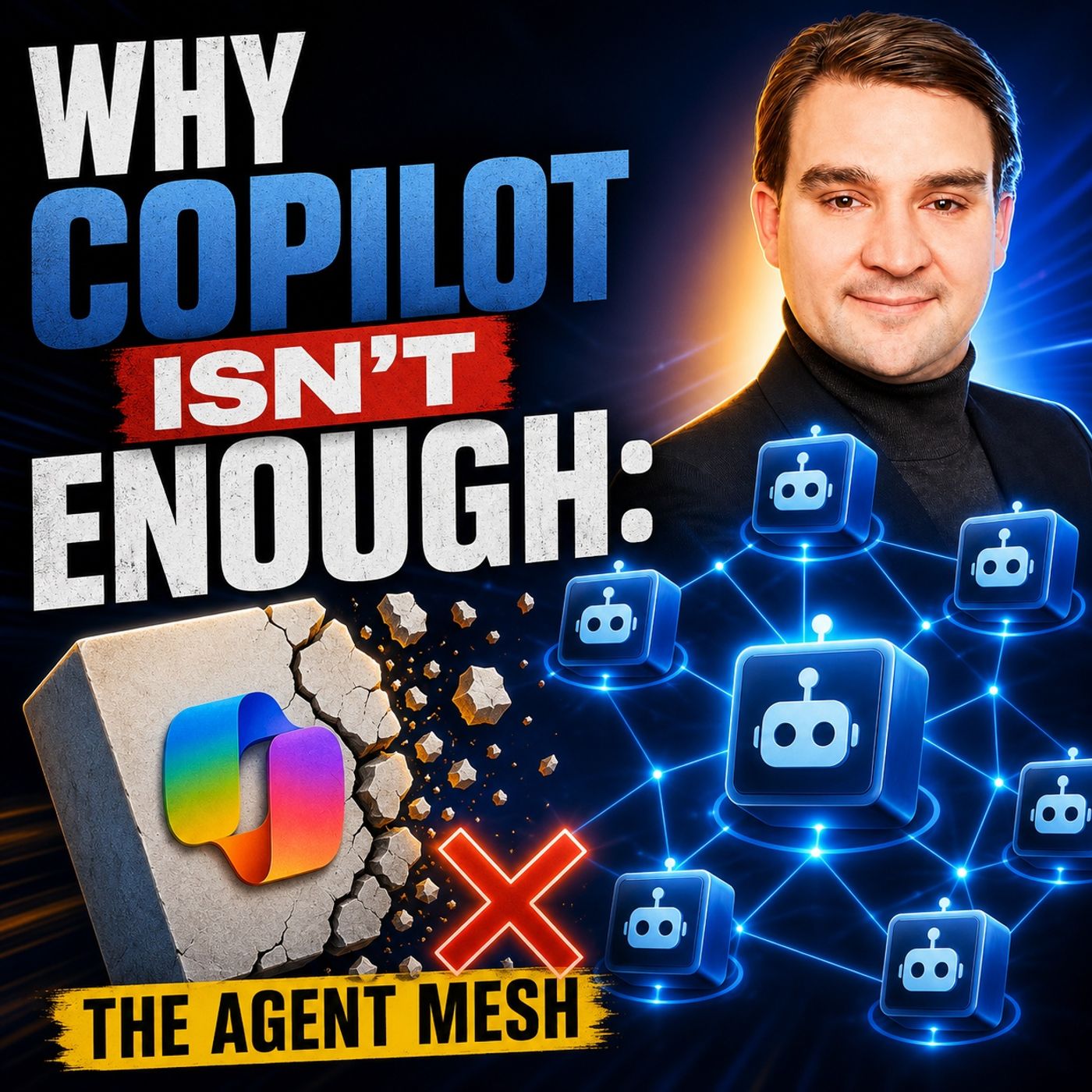
Microsoft Copilot has transformed how organizations interact with AI, making conversational experiences more accessible than ever. But while chat-based AI delivers immediate productivity gains, it does not provide the architectural foundation required for enterprise-scale autonomous agents. As organizations deploy more AI solutions across departments, they quickly encounter governance challenges, identity issues, fragmented integrations, and uncontrolled costs. Copilot is an excellent interface—but it is only one layer of a much larger AI ecosystem. AGENT IDENTITY, GOVERNANCE, AND SECURITY FOR ENTERPRISE AI One of the biggest challenges in enterprise AI is identity. Many organizations still allow AI agents to operate under shared service accounts or even employee credentials, making auditing nearly impossible. Every autonomous agent should have its own dedicated identity, least-privilege permissions, and complete traceability. Combined with centralized governance, organizations gain full visibility into who—or what—accessed sensitive data, ensuring compliance with standards such as GDPR, SOC 2, and industry-specific regulations. FROM RAG TO ONTOLOGIES: BUILDING AGENTS THAT UNDERSTAND BUSINESS CONTEXT Traditional Retrieval-Augmented Generation (RAG) systems retrieve documents and generate answers based on matching text. While useful, they rarely understand how a business actually operates. Agent Mesh architectures replace document-centric reasoning with ontologies that model customers, products, suppliers, policies, and business relationships. Instead of searching for words, AI agents reason over structured knowledge, dramatically improving accuracy, consistency, and decision-making across the enterprise. THE AI LANDING ZONE: CENTRALIZED CONTROL FOR AGENT MESH Scaling dozens or even hundreds of AI agents requires more than good prompts. Organizations need a dedicated AI Landing Zone that combines identity management, governance policies, model gateways, observability, cost controls, and centralized approval processes. Every model request flows through a governance layer where security, regional compliance, budget limits, and policy enforcement are applied automatically. This approach transforms isolated AI projects into a standardized enterprise platform capable of supporting large-scale autonomous operations. AGENT 365, OBSERVABILITY, AND FINOPS FOR RESPONSIBLE AI Managing AI at scale requires complete operational visibility. A centralized control plane such as Agent 365 enables organizations to inventory agents, monitor usage, assign ownership, retire unused "ghost agents," and analyze every model invocation. Combined with comprehensive observability and FinOps practices, businesses can optimize token consumption, enforce budgets, detect abnormal behavior, and maintain continuous compliance while significantly reducing operational costs. THE FUTURE OF MICROSOFT AI: FROM COPILOT TO THE AGENT MESH The next generation of enterprise AI is no longer about individual chatbots—it is about interconnected, governed, autonomous systems working together. Organizations that invest early in Agent Mesh architectures, centralized governance, ontology-driven reasoning, secure identities, and AI operating platforms will be able to scale hundreds of intelligent agents safely and efficiently. The future belongs to businesses that treat AI not as a feature, but as enterprise infrastructure capable of supporting continuous automation, intelligent decision-making, and long-term digital transformation. Explore more on M365.FM
- Full episode page with transcript, key takeaways and FAQ
- THE DEATH OF THE PROXY: Architecting Dataverse for the Agent Fabric
- The Death of the Pipeline: Why AI Agents are Replacing Traditional
- More AI & Copilot episodes on M365.FM
- Best of AI & Copilot: the most-listened episodes
Become a supporter of this podcast: https://www.spreaker.com/podcast/m365-fm-microsoft-365-azure-cloud-power-platform-ai--6704921/support.
Apple Podcasts · Spotify · YouTube · YouTube Music · Deezer
Host: Mirko Peters
Related articles
Transcript
Read the full transcript
Most organizations today have made the same bet. They've implemented co-pilot or built a chatbot or deployed some flavor of AI assistant that lets employees ask questions and get answers back. It works, employees use it, it feels productive, but here's what they don't see yet. That initial success is masking a structural problem. The problem isn't that co-pilot is bad. The problem is that chat is incomplete. Treating AI as a series of isolated conversational interfaces, one agent here, another tool there, a workflow somewhere else, feels fast because you're shipping individual pieces, but as you add more agents, more integrations and more autonomy, the hidden costs start appearing governance-debt. You've got agents borrowing human identities because nobody set up proper identity infrastructure. You've got models being called directly by every team because there's no central gateway. You've got data moving across regions and clouds with no policy enforcement. You've got agents still running two years after their original project ended, consuming tokens nobody's paying attention to. You've got no way to answer the question, which agent accessed this data and when. This is the moment most organizations realize that chat isn't a platform. It's a feature sitting on top of a missing architecture, the shift from co-pilot to agent mesh, from chat to agent fabric, requires building four structural layers that most organizations skip. You need a traceable identity plane. You need a reasoning layer that understands business logic instead of guessing at documents. You need a governance hub that centralizes policy enforcement and you need observability that lets you trace every action back to its source. Without these layers, you're not scaling AI. You're scaling risk. The co-pilot illusion. Let's be clear about what co-pilot is because the confusion starts here. Co-pilot is a feature. It's an incredibly useful feature. A conversational interface layered on top of a language model. It feels like you're building an AI platform because it's easy to stand up, easy to show results with and easy to get executives excited about. You spin it up on a Friday, show it to your team on Monday and suddenly everyone's talking about AI transformation, but a feature is not a platform. A platform is what you need to actually run agents at scale. A platform is the infrastructure that lets you deploy govern monitor and retire dozens or hundreds of agents without creating chaos. Here's the seduction. In isolation, co-pilot works beautifully. One team builds an agent for customer support. It integrates with their knowledge base. It handles routine questions and it escalates complex issues. Everyone's happy. Token consumption is low. Nobody's asking hard governance questions and the team ships fast. Then another team wants an agent. Then another suddenly you've got a support agent, a finance agent, a sales agent, and a recruiting agent. They're built in different places. Some in co-pilot studio, some in Azure AI, some in Foundry. Each team chose their own approach because there was no central architecture to guide them. And that's when the seam starts showing. The support agent is borrowing the IT manager's identity because nobody defined what an agent identity should look like. The finance agent is calling Azure OpenAI directly because there's no gateway. The sales agent is accessing data from multiple regions without any policy enforcement. The recruiting agent is still running on the same credentials the original builder set up three years ago. Nobody knows which agent is consuming the most tokens. Nobody knows which agent has access to which data. Nobody knows what happens if one of them starts behaving badly. This is the scaling problem that co-pilot doesn't solve. When you're running one agent, governance feels optional. When you're running 50, governance becomes survival. And by then your retrofitting controls onto a system that was never built to support them. The real cost isn't in the technology. It's in the organizational chaos. Finance runs their own model access because IT was too slow, marketing integrates their own tools because they couldn't get on the central catalog. Sales builds agents that move data across clouds because nobody enforced regional policies. And when compliance comes knocking with a question about which agent accessed this customer record, you don't have an answer. You can't trace it. You can't audit it. You can't even shut it down without breaking the process it was supporting. This is governance debt. You're borrowing control against future certainty that you won't have it. The hidden assumption underneath co-pilot, the one nobody voices but everyone makes, is that chat interfaces are governance enough that if employees can ask questions and get answers, that's platform behavior. But chat has no identity layer. Chat has no policy enforcement. Chat has no reasoning about business logic. Chat is stateless. Each conversation is isolated with no understanding of the full context. Chat scales to chaos remarkably fast. The move from co-pilot to agent mesh isn't about replacing co-pilot. It's about building the architecture that co-pilot should have been sitting on top of from the start. And that architecture starts with the problem most organizations don't even know they have. The moment your first agent logs in, you need to answer the question of who, or what is actually logging in, the identity problem. That question has a name. It's called identity. And identity is where most agent architectures fall apart. Here is what happens in practice. A team builds an agent. It needs to access data, call APIs, or trigger workflows. So someone asks a simple question, what account should this agent use? The answer is usually whatever is easiest, a shared service account, a developer's personal login. Sometimes they just use the identity of whoever creates the agent and leave it that way forever. The thinking is simple, the agent needs to do work so you give it credentials that let it do work problem solved. Except the problem isn't solved, it's hidden. The moment you do this, you create an accountability void. An agent running under a shared service account looks exactly like a human running under that same account. When that agent accesses customer data at 3 AM and moves it somewhere it shouldn't, your logs will show that the account access the data. But you cannot see that an agent did it. You cannot trace the decision back to the logic of the system. You cannot understand what it was trying to do. You cannot even prove it was an automated system and not the person whose credentials it's using. Now, scale that problem. You have 30 agents running under five shared accounts. One of them is accessing financial records without authorization, which one? When? Why? The audit log shows the account name and nothing else. The person who owns that account is confused because they don't remember authorizing that access. The developer who built the offending agent left the company months ago. You are stuck trying to reverse engineer a crisis by looking at a timestamp and a shared password. This is when regulators start asking hard questions. GDPR says you need to know who accessed personal data. ASOKI2 says you need to demonstrate access controls. HIPPA says you need to prove that only authorized systems touched health information. Your audit trail shows a service account. It doesn't show an agent. It doesn't show intent. It doesn't show whether the access was a legitimate task or a massive mistake. You cannot pass an audit with that. But there is a deeper structural reason identity matters. Agents are not passive tools. They are autonomous systems. They make decisions. They execute actions. They access data. And when something goes wrong, you need to know more than just what happened. You need to know why it happened. You need to trace back through the decision-making chain to see what data it saw, what policies it followed, and what its reasoning was. If the agent is hiding behind a human identity, that trace is broken. You lose the distinction between what a person authorized and what an agent decided to do on its own. The solution is what EntraID calls an agent ID. It is an identity object in your directory, just like a user or an app registration, but it is built specifically for agents. Each agent gets its own identity. Each agent has its own permissions, scope to exactly what it needs. Each action is logged under the agent's own name instead of being borrowed from a human. When that finance agent accesses a record at 3am, the log shows exactly which agent did it. You can trace the event back to the configuration, the permissions and the approval chain. You can ask if this agent was authorized to touch this data and the answer is a clear yes or no. That isn't just compliance. That's control. The moment you have traceable identities, the model changes. You can audit what agents are doing. You can enforce lease privilege so each agent gets only the permissions it requires. You can revoke access instantly if an agent misbehaves. You finally understand the full chain of accountability from who created the agent to what data it touches. Without it, you're flying blind, the reasoning floor, identity solved one problem, but it didn't solve the problem you actually hit when you try to make an agent useful. That problem is thinking. Here is a scenario that plays out in organizations every day. A team builds an agent to answer questions about company policy. Someone asks, what is our revenue recognition policy? The agent processes the question, searches through documents, finds something relevant and generates an answer. It looks right, it sounds confident. The person who asked the question reads the answer and acts on it. Six months later, that decision cost the company money because the agent was wrong. What actually happened? The agent found a document. It searched for text related to revenue and policy. It stitched together fragments that seemed to match the words in the question. It generated something plausible. But it had no idea if the answer was correct because it wasn't thinking about revenue recognition as a business concept. It was matching text patterns. This is what happens when you build agents on top of Ragn. Retrieval augmented generation is a technique where you take a question, search a document store for passages and feed those to a model. The goal is to ground the answer in your actual data instead of letting the model hallucinate. In theory, this solves the hallucination problem. In practice, Ragn just changes the shape of the hallucination because Ragn is document-centric. It treats your knowledge base as a pile of text chunks. When someone asks the question, the system searches for words that look relevant and hands them to the model. Then the model tries to guess what the question means and builds an answer from the fragments it was given. But text fragments are not meaning. They are just words. An agent that answers a policy question by retrieving a document is not understanding the policy, it is pattern matching against text. It doesn't know that revenue policy connects to sales processes, accounting systems, contract terms and regional regulations. It doesn't know which policies contradict each other or which one takes precedence in a specific case. It doesn't know the business logic underneath the words. So it hallucinates. Not in the way people usually think. It isn't making up facts from thin air. It is doing something much more dangerous. It is taking real text fragments and assembling them into something that sounds coherent but has no relationship to how your business actually works. The gap here is the gap between finding text and understanding context. The solution is what Microsoft calls fabric ontologies. And it is a completely different way of thinking about how agents reason. Instead of treating your knowledge as a document store, you treat it as a model of your business. You define the entities that matter. Customer, order, product, root, asset. You define how they relate to each other. You define the rules that govern them. A customer places orders. Orders contain products, products belong to categories. Root service regions, assets break down and need maintenance. Then when an agent needs to answer a question, it doesn't search for text. It traverses that model. When asked about revenue policy, the agent understands revenue as a concept connected to orders and products. It understands policy as a rule set connected to contract types and regions. It can reason across those relationships instead of guessing at text fragments. The difference is structural. Rags says, find the words that match. Ontologies say, find the entities and relationships that matter. With Rags, an agent is just a sophisticated search and copy machine. With ontologies, an agent becomes something that actually reasons about your business. This is where the thinking happens. The governance debt accumulates. Identity and reasoning only matter if you can actually manage what you've built. But for most organizations, that's where the architecture breaks down. Here is what typically happens. You've solved the chat problem, you have agents working. Identity is starting to make sense. But now you have three different teams that all want to build agents. They all need to connect to models. They all need policies. They all need logging. And each team does what makes sense to them. The support team goes directly to Azure OpenAI because they need fast answers and don't want to wait for central approval. So they set up their own keys and monitoring and cost tracking. The finance team uses co-pilot studio because that's what they already know and they use it to build out their own version of workflow automation. The data team experiments with open source models because they want more control which leads them to spin up their own separate infrastructure. Nobody coordinated. Nobody asked for permission. Nobody followed a standard. And suddenly you have a problem that identity and reasoning alone cannot fix because you have no idea what is actually running. This is shadow AI. It isn't malicious. It's just what happens when governance doesn't exist at the point where decisions get made. Teams need to ship. They need to move fast. Central processes are slow. So they go around them. They configure their own model access. They set up their own approval workflows or they just skip them entirely. They implement their own logging or they don't log anything at all. The result is that your organization now has multiple control planes. Or more accurately, it has no control plane. The support team's direct integration has no relationship to what finance is doing in co-pilot studio and the data team's open source setup has no connection to either of them. You have three different teams using three different models with three different sets of tools and policies and there is no governance layer that understands how they relate. If the data team's model needs to access data that the support team is currently monitoring, there is no central policy to say whether that's even allowed. You have compliance risks spread across three different systems with no way to manage it. And then there are the costs. When you don't have centralized visibility, you cannot measure. Each team is consuming tokens against their own budget or a general cloud spend that nobody is tracking anymore. The support agent might be calling an expensive model for every single question when it could use a cheaper one for routine queries and the finance agent might be running duplicate logic that the data team already built. The recruiting agent might be fetching data from three different sources when one unified source would work but nobody knows. Nobody can see, nobody can optimize. A poorly optimized agent using an expensive model with inefficient prompts can easily burn $50,000 a month and you won't find out until the cloud bill shows up. By the time you see the bill, the agent has been running for six months and the team that built it has already moved on to the next project when you finally asked them to optimize the costs, they just shrug because they were never given the tools to measure consumption in the first place. This is the financial consequence of distributed governance. You are paying for invisibility but the real problem is deeper than cost. It's compliance. Compliance requires a single, traceable answer to one question which systems accessed what data and when. With three independent teams running independent setups, that question becomes impossible to answer. The finance team's logging goes to one place the support teams go somewhere else. The data team isn't logging at all. If a regulator asks if an agent accessed a sensitive record, you don't have a way to search across all three systems at once and you don't have a standard for what access even means or how it gets recorded. You cannot pass an audit with that. This is what people mean by governance debt. You are borrowing against future control. You are accepting the chaos now in exchange for the ability to ship fast. You're trading short term speed for the long term certainty that you won't be able to govern what you've built. An unlike financial debt, governance debt compounds. Every new team that stands up their own system makes the problem worse. And every month, you delay centralizing governance makes the eventual cleanup work much larger. Eventually, you hit a wall, a compliance failure, a security incident, a cost overrun, you cannot explain. And at that point, you have to go back and rebuild everything you should have built from the start. The way out starts with a single question, what if governance happened first? What a landing zone actually is. To understand the solution, we need to reframe what a landing zone actually means. Most people hear the term and think infrastructure, networking, cloud subscriptions, the plumbing. And yes, a landing zone includes those things. But if that's what you think a landing zone is. You're looking at it backwards. A landing zone isn't primarily about networks. It's about how AI operates in your organization. It's the operational model that prevents the problems we just talked about. The identity collapse, the reasoning gaps, and the governance debt. It is the framework that says, this is how we build agents here. This is who controls access. This is what gets logged. A landing zone is the moment your organization stops treating agents as one of projects and starts treating them as a managed capability. It is the shift from teams building their own fragmented infrastructure to the organization having a standard way agents get built, deployed, and retired. That shift matters because standardization is how you scale safely. That standard has three layers. The first is the identity plane. This is where you solve the accountability problem. Every agent that runs in your organization gets a traceable identity, which is an agent ID registered in your directory just like a user account, but built for autonomous systems. That identity carries permissions scoped to exactly what the agent needs, including which data it can access, and which specific models it is allowed to use. When that agent acts, the action is attributed to the agent itself rather than being borrowed from a human account, so the audit trail stays clean. The second layer is the governance hub. This is centralization. It is the single place where all approved models live, all tools are catalogued and all approvals flow through. When a team wants to build an agent, they don't go configure Azure OpenAI directly. They request access through the hub. When they want to add a tool, they don't integrate it independently. They submitted to the catalog where it is reviewed and approved for everyone. If policies change and you need stricter data, residency rules, you update the policy once in the hub, and it applies everywhere. One place, one source of truth. Without the hub, you have distributed control that looks like governance, but is really just decentralized chaos. With the hub, you have the control plane that the support team, finance team, and data team all operate under. They aren't competing for access to different models or defining their own rules. They are all operating within the same framework with the same visibility. The third layer is the data plane. This is where ontologies live. It is the structured model of your business, including the entities and the rules that govern how those entities connect. It isn't stored in three different places by three different teams. It is centralized and versioned. When a new agent gets built, it doesn't have to figure out what a customer is or how customers relate to orders because those definitions already exist. The agent inherits that understanding it reasons over the ontology instead of trying to make sense of disconnected data sources. That is how you scale consistency across dozens of agents without them constantly contradicting each other. These three layers work together. Identity makes agents accountable. The governance hub makes decisions centralized. The ontology makes reasoning consistent. Individually, each one solves a structural problem. But together, they form the architecture that lets you deploy hundreds of agents without creating chaos. And this is the key shift. You aren't building infrastructure to support isolated chatbots anymore. You're building a platform and AI operating system. It's a foundation that any team can build on without having to recreate governance or identity every single time. That is what a landing zone actually is. It isn't just plumbing or a checklist. It is the moment your organization moves from experimenting with AI to operating AI responsibly at scale. The model gateway pattern, the identity plane and governance hub are foundational but they only work if you actually control how agents access models and most organizations don't. What typically happens is this. An agent needs to call Azure OpenAI or Anthropic. Someone generates an API key. They embed it in the agent's code. The agent calls the model directly. No intermediary, no filtering, no policy check, just agent to model. This feels efficient. The agent gets what it needs without extra layers. There's no latency penalty from rooting through a gateway. There's no extra service to operate. The team ships fast. But you've lost control. When every agent connects directly to models, you have no central way to enforce policy. One agent might be calling an expensive model when a cheaper one would work. Another might be sending data to a region that violates your compliance requirements. A third might be consuming tokens at a rate that nobody noticed until the bill arrived. Each agent is making independent decisions about which model to use and what data to expose. There's no enforcement. There's no visibility. There's no way to say no. This is where a model gateway comes in. A gateway is a single entry point for all AI traffic. Every agent that needs to call a model doesn't call it directly. The agent calls the gateway. The gateway then decides which model to root the request to based on policy. Think of it like a border checkpoint for AI traffic. What does the gateway do? At minimum, it handles authentication. Every request comes with credentials identifying which agent is making the request. The gateway validates those credentials against the agent's permissions. This is the identity layer you built in the landing zone, now enforced at runtime. When agent can't call a model, it doesn't have permission to use. But authentication is just the entry point. Once you have that checkpoint, you can add policy enforcement on top. Here's where it gets powerful. Let's say your organization has a policy. No customer data leaves the US region. An agent is built to process customer support tickets. It's configured to use a model that runs in Europe. Without a gateway, that agent calls the European model directly and sends customer data across the ocean. You find out six months later when an auditor asks where your customer data goes where the gateway that request hits the checkpoint. The gateway evaluates the policy. This agent is asking to call a European model. This policy says customer data can't leave the US. The gateway blocks the request and re-route it to a US-based model instead. Policy enforced, no data violation, no surprise audit failure. The gateway also handles cost attribution. Every model call goes through a single point. You can track which agent called which model, how many tokens it consumed, and what the cost was. Instead of discovering in your cloud bill that you're spending $50,000 a month on model calls, you have real-time visibility. You can see that one agent is responsible for 90% of the spend. You can optimize it. You can set budgets and alerts. You can route expensive queries to cheaper models or cache results to reduce redundant calls. Without a gateway, that visibility doesn't exist. You have 10 agents calling 10 different models with no way to aggregate the picture. The gateway also enables logging. Every call gets recorded, which agent called the model when? What was the input? What was the output? This creates an audit trail for compliance. It creates evidence if something goes wrong. It creates the visibility you need to understand what your agents are actually doing. And here's the scaling inside. With a gateway, you govern it the gateway, not at the application level. You don't have to reconfigure every agent every time policy changes. You update the policy once in one place. The next request hits the gateway and the new policy applies, one change, everywhere. This is why the gateway is essential. It's the enforcement layer that makes your governance hub actually work, the ontology layer. The gateway solves the control problem, but there's still one layer missing. Control over what agents access isn't the same as control over what agents understand. Let's go back to the data itself. Most organizations store their operational knowledge in two places. They have a data warehouse, tables and columns, schemas and joins, the relational model that's been the backbone of business computing for 40 years. And they have documents, PDFs, wikis, emails, contracts, the unstructured stuff that people write. When an agent needs to answer a business question, it usually has access to one or the other. Either it's running a query against your warehouse or it's searching documents or it's doing both independently and trying to reconcile the results. But neither of those is a business model. Neither one captures what your business actually is. Your business isn't a schema. Your business is a set of relationships. You have customers. Those customers place orders, orders contain products. Products come from suppliers. Suppliers have lead times. Customers have credit limits. Orders that exceed a customer's credit limit need approval. Some suppliers are marked as high risk, which affects how their orders are handled. Orders that go to certain regions trigger different compliance rules. A delayed shipment to a VIP customer is a priority incident. A routine delay to a standard customer is normal. None of that lives in a table. None of that is a document. All of it is business logic. All of it is meaning. An ontology is how you encode that meaning. Think of it as a map of your business. Not a map of your data, a map of your actual business. Entities. Customer. Order. Product. Supplier. Region. Acid. Each one exists as a concept. Each one has properties. A customer has a name, an account number, a credit limit, and a payment history. An order has an order number, a date, a customer, products, and a status. But here's what makes an ontology different from a spreadsheet. Relationships matter. A customer places orders, an order contains products. A product comes from a supplier. A supplier operates in regions and asks it belongs to a location. An order goes to a location. A location has inventory. Inventory of a product comes from a supplier. When you map these relationships explicitly, something changes. An agent doesn't have to guess at meaning anymore. It doesn't have to infer that a customer is high value by looking at aggregate spending numbers. The ontology can tell it directly. The ontology can say this customer has a VIP flag. When a VIP customer's order is delayed, this matters more. The agent reasons across the relationships instead of guessing at patterns. This matters because business logic lives in relationships. A standard query of your warehouse might tell you that a customer hasn't paid their invoice in 60 days. An ontology can tell you not just that, but the context. What region are they in? What's the payment term for that region? Are they a long-standing customer? With a history of late payment and what was their last interaction with support? All of that is implicit in the relationships. The agent doesn't have to construct it from disconnected facts. And when the agent needs to make a decision, the ontology acts as a constrained layer. In a normal data warehouse, an agent can pull whatever it wants and do whatever it wants with it. In an ontology, the agent understands what paths are valid. A marketing agent can see customer spend patterns. A security agent can see access logs, but neither one should be able to see data that's outside their scope. The ontology enforces that implicitly through the relationships it defines. If a path doesn't exist in the ontology, the agent can't traverse it. This is how hallucination gets prevented at a structural level. When an agent is reasoning over an ontology, it's not pattern matching against documents or guessing a table relationships. It's traversing an explicit model of your business. Every relationship has been intentionally defined. Every entity has been carefully modeled. The agent doesn't have creative freedom to interpret data in ways the business doesn't intend. It operates within the constraints of how you've defined your business. And here's the scaling insight. When you add a new agent to your organization, it doesn't have to rebuild the ontology. It inherits it. The same customer entity, the same VIP flag and the same relationships between order and product and supplier. 10 agents, 50 agents, 100 agents. They all reason over the same business model. They all make decisions using the same definitions. Consistency is structural, not achieved through training or documentation or hoping everyone remembers how things work. The shift from chat to fabric, identity, reasoning, governance, the gateway and the ontology. Up until now, we've looked at these as individual layers, but these pieces only matter when they combine, when they merge, they change the fundamental nature of what an agent actually is. That shift is from chat to fabric. Most people think chat is the full picture. You ask a question. The agent processes it, you get an answer, then you repeat the process, but in reality, each of those conversations is isolated. The agent has no memory of what you asked two minutes ago, no context carries forward. Every prompt starts fresh. The agent is stateless, which means it has no understanding of your broader business landscape. It doesn't know your history. It doesn't see the relationship between a decision made yesterday and a decision being made today. This works fine for simple scenarios. What's the weather? What's the office policy on remote work? What are the products specs? One question, one answer done. But business doesn't work that way. Real business is about understanding chains of cause and effect. Why did revenue drop? Because a major customer didn't place their monthly order. Why didn't they place that order? Because their inventory is full. Why is their inventory full? Because a supplier delay backed up their entire supply chain. Why was there a delay? Because that supplier operates in a region hit by new tariffs. How does that affect our forecasting? What do we tell Wall Street about Q3? Each of those questions requires understanding the previous answer. They require context that accumulates over time. A chat agent can't do that. It can answer what is our revenue in total isolation. But it can't answer why did it drop? And what should we do about it? Answering that requires holding multiple pieces of context in relationship to each other. All at once. This is the difference between stateless and stateful. Chat is stateless. Fabric is stateful. With Fabric, the agent understands the business landscape surrounding the question. It knows this specific customer is high value. It knows their inventory patterns predict when they will order next. It knows the supplier risk in their region has changed. It understands the full chain that led to the revenue drop. It isn't answering questions in a vacuum. It is reasoning across a continuous model of your business. The operational consequence is profound. With chat agents are reactive. You point them at a question and they answer it. They are useful for someone looking for a quick response. But they can't be proactive. They can't detect patterns before those patterns become problems. They can't understand causation across multiple systems. They can't make the connection between a supplier delay in Asia and a cash flow problem in North America. With Fabric, agents become orchestrators. They see the full picture. They can monitor multiple signals simultaneously. They can detect when something is about to go wrong before it actually happens. They can recommend actions based on the complete chain. They aren't just responding to questions. They are actively maintaining the health of the system. Consider what happens when a major customer hasn't ordered in two months. A chat agent searches for recent orders, finds none, and reports no recent orders. That's the answer. Information delivered. A Fabric agent understands this customer's historical pattern. It detects they are three weeks past their normal cycle. It checks their inventory levels and correlates that with supplier data to see if a backup is coming. It recognizes this customer is a VIP and that delays now create cascading problems downstream. Then it escalates this as a priority incident and recommends outreach with a targeted offer before the problem becomes critical. Same agent, different architecture, one saw a fact, one understood a situation. This is where the infrastructure you've built finally becomes more than technical scaffolding. This is where you stop managing a collection of chatbots and start managing an intelligent system where identity isn't just compliance theatre, where the ontology isn't just a database, where governance isn't just control for the sake of control. The organization that moves from chat to fabric is fundamentally changing how intelligence operates. From isolated questions to coordinated reasoning, from waiting for problems to detecting them, from a feature to a platform, agent 365 as the control plane, but building identity, reasoning, governance, and a gateway separately doesn't scale. These are infrastructure components. They still need to be orchestrated. They still need to be operated as a single system without a unified layer that understands all four. You are left with plumbing that doesn't connect. You need a layer that can inventory agents in force identity, apply rules and surface observability all at once. This is what agent 365 does. Agent 365 is Microsoft's answer to a practical problem. How do you actually operate an agent architecture across an entire organization? It is the control plane that ties together everything we've discussed. It's a single place where you can see every agent that exists. You can trace every action it takes. You can enforce every policy you've defined. And you can manage its complete life cycle, think of it as the operating system for agents. Without it, agents scatter. A team in support builds an agent in co-pilot studio. A team in finance builds one in Azure AI Foundry. Data signs deploys a custom framework on Kubernetes, marketing experiments with an open source tool. In six months, you have agents running on five different platforms, built with different tools using different policies. And logging to different systems, you don't have an architecture, you have fragments that happen to do similar things. Agent 365 brings them into one visibility layer. Every agent gets registered in the control plane regardless of where it was built or what framework it uses. That agent gets an identity. That identity gets permissions. Those permissions get logged. The agent's behavior gets monitored. All of it flows through a single system. What does that actually accomplish? First, registry. You can answer the basic question. What agents exist in our organization? Not what we think exists. What actually exists? Agent 365 provides formal registration and discovery. It can scan your environment and find agents that are running without being registered. These are the agents that exist in the shadows because they were built quickly and never went through onboarding. Second, identity management. Every agent that registers gets an agent ID, this is a proper directory identity in Entra that agent can be assigned permissions scoped to what it actually needs. Those permissions are enforced by the gateway invalidated by the ontology. They are logged and auditable. When that agent acts, the action is attributed to that agent, not to a human or a shared account. Accountability becomes possible. Third, policy enforcement. Your governance hub defines the rules, which models can be used, which tools are approved, which data sources are accessible. Those policies live in agent 365. When an agent tries to do something, agent 365 checks if that action is permitted, does the policy allow this agent to call this specific model? Does it allow accessing this data? Is this operation happening in an approved region? These questions get answered at runtime. Policies are enforced consistently across every agent, no matter how it was built. Fourth, observability. Agent 365 doesn't just enforce, it watches. It logs every action, every API call, and every data access. It correlates those logs with the agent's identity and the policies that were enforced. When something goes wrong, you can trace it back. You can understand what the agent did and why it did it. You can see what data it accessed and what decisions it made. That is the audit trail that compliance requires. And here is the lifecycle benefit that nobody talks about until it becomes a crisis. Agents get built, they accomplish their purpose, the project ends. But the agent keeps running. Six months later, the person who built it is gone. A year later, nobody even remembers what it was supposed to do. It is still consuming tokens. It is still accessing data. It might be configured with permissions that were reasonable when it was built, but are now inappropriate. It's a ghost, it's a cost drain, it's a security risk. Agent 365 tracks ownership and usage. You can see which agents haven't been used in six months. You can see which ones don't have a named owner. You can see which ones are consuming resources. Disproportionately, you can make data-driven decisions about retirement instead of just letting them pile up. The shift here is subtle, but absolute. Without Agent 365, you are managing agents through individual conversations with individual teams. Have you checked on your agents lately? With Agent 365, you are managing agents as a portfolio. You have visibility, you have control, you have the operational backbone that lets governance actually work. Agent stop being shadow projects and they become managed assets. The governance hub, Agent 365 gives you visibility and identity, but visibility without enforcement is just information. You can see what agents are doing and know who is doing it, but that doesn't stop them from doing the wrong thing. That's where the governance hub comes in. If Agent 365 is the control plane, the governance hub is the policy engine. It is the central registry for every approved model, every vetted tool, every authorized data source, and every rule that governs how they are used. It isn't distributed. It isn't something each team maintains locally. It is one place, one source of truth. But here is the problem. Without a hub, developers make independent decisions about what they integrate. A team building an agent needs a tool that connects to Salesforce instead of checking a catalog of approved Salesforce connectors they build their own because there is no catalog. They build it fast. It works. It chips. Six months later, another team builds the same connector because they also didn't know it existed. Now you have duplicate functionality, inconsistent implementations, and two different connectors that might behave differently or have different security properties. Multiply that by dozens of teams and dozens of tools. You end up with a sprawl of integrations that nobody understands and nobody can maintain. A governance hub prevents that. Every tool that an agent is allowed to use gets registered there. It has been reviewed. It has been tested. Its security properties are documented. When a new team wants to integrate Salesforce, they don't build a new connector. They request access to the approved one. The request goes through the hub. The hub checks their agents permissions. If their agent is authorized to use that tool, they get access. If not, they are denied. But they are also told what other approved tools might solve their problem. This shifts the dynamic. Instead of every team building independently and hoping nothing breaks, every team operates within a control set of options. Standardization becomes possible. The same principle applies to models. Without a hub, teams go directly to Azure Open AI or Anthropic or whatever they decide to use. Some use expensive models for simple tasks. Some use models that are restricted to certain regions when they shouldn't be. Some use models that have safety properties their agents shouldn't violate. Without central control, you get inconsistency with the hub approved models are listed. Teams request the right model for their use case. The hub validates that the model is appropriate. It validates that the agent has permission to use it. It validates that the use case is compliant. But here is where the hub becomes operationally essential. Policy updates. Let's say your compliance team decides that agents can no longer process customer data in the European region. Every agent needs to use models that run in North America only. Without a hub, you email this requirement to all the teams. You hope they update their configurations. Some do, some don't, some miss the email, some interpret the rule differently. You end up with agents in compliance and agents that violate the requirement and you won't find out until an audit. With a hub that policy gets updated once every agent that requests access to a model now gets evaluated against that policy. An agent tries to call a European model. The hub evaluates the request. The agent's permissions allow European models, but the organization's policy now forbids customer data in that region. The hub blocks it and suggests an alternative. Policy enforced. Everywhere, immediately, no individual configurations, no hope that teams remember to update, no surprise audit failures. This is operational leverage. One policy change. Hundreds of agents affected. Consistent enforcement. The audit benefit is equally significant when a regulator asks which tools your agents are using and whether they are approved, you have an answer. The governance hub is the authoritative list. Every agent using an unapproved tool stands out. You can see it. You can trace why. You can fix it. This is what transforms policy from a document that people maybe read into infrastructure that actually prevents violations from happening in the first place. Data residency and compliance. There is a category of problem that most organizations don't think about until a regulator asks a question they can't answer. It isn't about visibility or governance or even identity. It is about something simpler and more fundamental. Where your data actually lives. Compliance isn't optional. It is the cost of operating in regulated industries. GDPR says personal data from EU citizens can't be processed outside the EU without explicit mechanisms. HIPAA says health information can't leave the United States. SOC2 says you need to maintain data residency policies and prove you are enforcing them. PCI DSS restricts where payment card data can be stored and processed. These aren't suggestions. They are legal requirements. Violate them and you don't just lose a contract. You face fines. You face criminal liability. You face organizational collapse. Now imagine what happens when you don't have a landing zone. A team builds an agent that processes customer records. The agent is built in Azure running in North America. It works great. But then it needs to analyze trends against a data set that lives in a European warehouse. The agent makes an API call directly to that warehouse. The data is retrieved. The agent processes it. The results are cashed locally. Nobody thought about geography. Six months later an auditor asks, where does this agent process personal data from EU citizens? You search the logs. The agent is running in North America. But the data it is analyzing comes from Europe. Is that compliant? Actually it is unclear. GDPR says personal data can't be processed outside the EU unless there is a data processing agreement in place. Do you have one? You don't know. The agent was built without compliance review. Now multiply this across 50 agents. Each one was built independently. Each one makes independent decisions about which data sources to access and which regions to process in. Some agents are calling models in regions that violate your policy. Some are moving data across borders that shouldn't cross borders. Some are caching results in locations that aren't approved. Nobody coordinated. Nobody enforced a standard. You can't pass an audit with that. The structural problem is this. Without a landing zone, data movement is reactive. When agent decides it needs something, so it goes and gets it. By the time you audit what happened, the violation is already in the logs. You are investigating after the fact. You are trying to figure out what went wrong, why it went wrong, and how to prove to a regulator that you fixed it. This is reactive compliance. You are checking boxes after the damage is done. A landing zone changes that to something much more powerful. Preventive compliance. Data movement is gated at the infrastructure level before the violation can happen. Here is how it works. Your compliance team defines a policy. Agents can process customer data only in regions where that customer's data is domiciled. An agent is built that needs to analyze European customer records. Before that agent can execute the landing zone evaluates the policy. The agent is running in North America. It is trying to access European data. The policy forbids that combination. The landing zone blocks the request. The agent can't proceed until it is reconfigured to run in a region that is compliant. Policy enforced before the violation happens. Not audited after. This is the fundamental shift. Without a landing zone, compliance is a backward looking investigation. You analyze what happened and try to explain it. With a landing zone, compliance is forward looking enforcement. Vialations become impossible because the infrastructure prevents them before they occur. The operational benefit is equally significant. When a regulator asks whether your agents are compliant, you don't have to investigate. You have evidence. The landing zone enforces the policy. And that enforcement is logged. You can demonstrate that your infrastructure makes non-compliance impossible for any agent that runs within it. This changes the risk profile entirely. I'm hoping teams remember compliance rules and configured them correctly to knowing that compliance is built into the system. From audit surprises to regulated certainty. From governance debt to governance certainty. Data residency isn't just a technical requirement. It is the structural difference between organizations that can prove they are compliant and organizations that hope they are. Cost control and fin ops. There is a problem that happens at scale. Almost nobody sees it coming until it's too late. And by then, it's impossible to untangle it. It's about the money. When you start experimenting with AI, cost feels theoretical. You spin up a few agents. They call models. The bill comes once a month. It's acceptable. You ship more agents. The bill grows. It's still manageable. But somewhere around agent 50 or 20, something changes. The monthly spend crosses a line. It goes from an investment to a, where is all this money going? Problem. And when you ask that question, you realize you don't have an answer. An agent in support is calling GPT-4 for every single customer query. It could use a cheaper model for most of them. An agent in finance is running redundant logic that another team already solved. A data team's agent is making three separate API calls to fetch one piece of info. A marketing agent is hitting a model every 60 seconds just to check for updates. Nobody coordinated, nobody measured, nobody optimized. They just shipped. Without visibility into consumption, you can't manage cost. You can't even see it. You get a cloud bill that's higher than last month. You email the teams to ask why. Nobody knows. The money is disappearing into a black box of token consumption. Dozens of agents are running. There's no way to attribute spend to a specific team or a specific use case. This is where the landing zone's model gateway becomes the solution. Every single model call goes through that gateway, not to slow things down. But because that gateway is the one place where you can see and control access, which agent called which model. How many tokens did it use? What region did the call go to? This data flows into a cost tracking system. Not monthly, not quarterly, continuously, real time visibility. Now, cost management is actually possible. You can see that one single agent accounts for 30% of your spend. You can drill down and understand why. Is it calling an expensive model when a cheap one would work? Is it asking for a longer context window than it needs? Is it making redundant calls? Once you see the pattern, you can fix it. Maybe that agent switches to a smaller model for routine questions. It only escalates to the expensive model when it's actually needed. Maybe you add caching so it stops asking the same thing over and over. Maybe you redesigned the prompt to use fewer tokens. But here's the critical part. You can do this optimization without losing any capability. Without visibility, the choices binary, the agent works. Or it doesn't. There's nothing in between. With visibility, you can optimize. You keep the same outcome at a much lower cost. That's the difference between paying $60,000 a month and paying $20,000 for the exact same result. The gateway also enables model routing. Different models have different costs. An expensive model might be brilliant, but it's overkill for most tasks. A cheaper model handles routine work just fine. But a gateway every agent decides on its own which model to use. With a gateway, policy-based routing makes that decision for them. An agent submits a request. The gateway evaluates it based on your rules. If it's a simple question, root it to the cheap model. If it needs deep reasoning, root it to the expensive one. Same agent, different models depending on the actual need, cost is optimized, performance is maintained. Budget controls finally become real. You set a monthly budget for a team or a project. As agents use tokens, the spend is tied to that budget when they hit 80%. You get an alert. At 100%, the call stops. This forces a conversation. Why did this team use their whole budget? Was it necessary? Is there waste? Or is this a success that we need to scale up? You can't have these conversations without attribution. With it. Budget management is how you align AI spending with business value. The logic is clear. Without a landing zone, cost grows randomly as teams ship, with one. Cost is a controlled variable. You understand where the money goes. You optimize what wastes it. You scale what works. Finops stops being something you do after a shocking bill arrives. It becomes how you operate from day one. Cost isn't just a finance problem. It's a structural problem. And the landing zone solves it. The ontology advantage in practice. We've talked about ontologies in the abstract. Now let's talk about what they actually do in a production system. An ontology encodes relationships that are usually invisible. Your data warehouse has a table of customers. A column says segment with a value like enterprise. That is a fact. An ontology says the same thing differently. This customer is a VIP. That means their orders get priority. That means a delay triggers an immediate escalation. That means the operations team gets in a lurch right now. Instead of finding out next week, those sound like the same thing. They are not. The table is data. The ontology is meaning. One is a field in a record. The other is a relationship that carries a consequence. When an agent knows a customer segment, it has information. When an agent understands how VIP status changes in operational decision, it has context. Context is what separates an agent that answers questions from an agent that makes decisions. And this is where it becomes operationally significant. Agents reason across the relationships that matter. Not every possible relationship. Think about an agent monitoring in order. Without an ontology, its reasoning is a mess. The customer placed in order. The order has products. Products need inventory. Inventory is in a warehouse. The warehouse has a supplier. The supplier might be late. That's a dozen different relationships to analyze. Which one's matter right now? The agent has to guess. Maybe it looks at lead times. Maybe it looks at stock levels. Maybe it checks payment history because it thinks that matters. The agent might miss the one link that actually determines priority. Or it might waste compute looking at things that don't matter at all. With an ontology. The reasoning is structured. The relationships that matter are already encoded. VIP customers get priority. Peak season increases that priority. Certain suppliers are high-risk. High-risk suppliers in peak season require an acceleration plan. The agent doesn't guess. It follows a path that has already been thought through. It follows relationships that were explicitly defined as relevant. The hallucination prevention here isn't about rules. It's structural. An agent can't invent a relationship that doesn't exist in the ontology. It doesn't have the freedom to do that. The ontology isn't a suggestion. It's a boundary. If an agent needs to reason, it has to follow a path. If there is no path, it can't reason about it. And that is exactly what you want. You don't want an agent making up logic you haven't approved. This scales in a way that documents never will when you have ten agents. They could all be reasoning differently. One agent defines VIP status one way. Another agent defines it another way. One prioritizes inventory. One prioritizes speed. You get inconsistent decisions across the company because every agent built its own mental model. With an ontology. Consistency is structural. All ten agents see the same definition of VIP. All ten use the same criteria for supply or risk. All ten optimize against the same business logic. You don't have to train them. You don't have to write policies and hope they understand. The ontology is the policy. It is executable. It is consistent. It is auditable. And here is the shift that nobody anticipates. An agent stops being about stopping bad outputs. It becomes about enabling good reasoning. Without an ontology. Governance is reactive. An agent makes a mistake. You review it. You block it. You tell the agent, don't do that. But you're just policing the output. You aren't changing how the agent thinks. With an ontology, governance is proactive. Before the agent ever runs. You've defined how it should reason. You've encoded the logic. You've constrained the paths. The agent can't make an unreasonable decision because making a decision requires following the ontology. And the ontology only contains the paths you've decided are reasonable. This is the shift from control to enablement. You aren't restricting what agents can do. You are giving them the right way to think. Multi-cloud agent orchestration. Most organizations don't run everything on one cloud. If they did, the governance problem would be simpler. You'd have one control plane, one set of policies, one identity system. Everything would be integrated. But that's not the world we live in. You have a co-pilot studio agent built by the support team running in Azure. You have an AWS bedrock agent built by the data team running in their separate cloud account. You have an open source framework agent that a contractor built. And it's now running on Kubernetes in your on-premises data center. You have a SAS agent from a third-party vendor running in their cloud, not yours. Each one does something useful. Each one was the right choice for the team that built it. But together, they create a governance problem that no single cloud provider can solve. Because without a unified control plane, governance ends up in multiple places. Or nowhere. Azure agent has an enter identity because it's in the Microsoft ecosystem. But does the AWS agent have those same identity standards applied? Not really. AWS uses IAM roles. They aren't the same thing. The SAS agent might use whatever authentication the vendor decided on. While the open source agent might be using keys that nobody really knows how to rotate securely, you're looking at four different identity models, four different access control patterns, and four different audit trails. Now, try to enforce a policy across all of them. Let's say your compliance team decides that agents can't call models that run outside the United States. The Azure agent uses Azure OpenAI, which is easy to restrict the AWS agent connects to Bedrock, which is also relatively straightforward. But the SAS agent is calling a European provider's API. The open source agent is using a model that someone deployed in Google Cloud. You can't control those from an Azure policy engine. They aren't in your cloud. They aren't in your identity system. The result is a fragmented governance model. Some policies you can enforce technically. Others you enforce through documentation. Others you just hope nobody violates. This is the fragmentation problem. As soon as your agents cross cloud boundaries, centralized governance becomes exponentially harder. The challenge isn't that cloud providers are bad at governance. It's that they're only good at governing their own cloud. They can't govern beyond their boundaries. This is where agent 365 and the model context protocol become essential. Agent 365 operates above any specific cloud. It doesn't care whether an agent is running on Azure or AWS or on your own servers. It can register agents regardless of where they run. It can assign them identities that stay consistent regardless of the cloud. They can apply policies that work across clouds because those policies are enforced at the agent 365 layer, not at the cloud provider layer. The model context protocol does something similar for tools and data sources. MCP is a standard that lets agents connect to tools and data regardless of where those tools live. Instead of each agent negotiating its own connection to each tool, agents connect to tools through MCP. That means the governance hub can define which tools are approved and which aren't. And that decision applies whether the tool is running on Azure, AWS or anywhere else. Here's what this looks like in practice. Your organization has agents on four different clouds. A compliance policy gets created stating that agents can't connect to tools that aren't in the approved catalog that policy lives in agent 365. Every agent regardless of where it runs validates its tool connections through agent 365. An agent tries to invoke a tool agent 365 checks the tool against the policy. Is it approved? If yes, the agent can call it if no, the request is blocked. This works for the Azure agent, the AWS agent, the on-premises agent and the SAS agent, same policy, same enforcement, different clouds. The operational benefit is that you're not locked into one vendor. You can choose the best runtime for each job without sacrificing governance. Need a specialized service? Use a third party SAS? Need cost efficiency? Use spot instances on AWS? Need deep Azure integration? Use Azure. Each decision is made independently. Governance is still unified because agent 365 sits above all of them. This is what vendor flexibility looks like. It's not being forced to choose one cloud because that's the only way to govern. It's being able to choose based on actual capability while maintaining a single governance layer across everything. That flexibility is what lets the landing zone scale across an organization's entire AI footprint. Life cycle management and ghost agents. Here's something that happens in every organization that scales agents to a certain point. Nobody plans for it. Nobody expects it. But by the time you notice, it's already a problem, an agent gets built, a team has a three-month project. They need automation. They request an agent. It works. The project ends. The team moves on. The agent is still there. Still running. Still consuming tokens. Still holding onto access. It no longer needs. Six months later. Nobody remembers what it was for. The person who built it left the company. The original sponsor has moved to a different role. The project might not even exist anymore. But the agent keeps running. It's invisible. Until you look at your monthly cloud bill and wonder why it's higher than expected. You trace the spend and find this ghost. It's costing you money. It's accessing data. Nobody authorized it to access anymore. It might be using models or tools that your organization no longer approves. It's a security risk nobody knew existed. Now multiply that by 50 or 100 as organizations build more agents. The graveyard of forgotten projects grows. These aren't catastrophic failures. They aren't costing you millions. But they're the death of a thousand cuts. Waste it spend. Slow erosion of governance. Accumulation of risk that nobody's actively managing because the agents are just there. This is where life cycle governance becomes critical. Not as a nice to have compliance exercise, but as an operational necessity. Without life cycle management agents are created but never retired. They exist in a weird limbo. They're still running. Still consuming resources. Still holding permissions. But nobody claims responsibility for them. The person who sponsored them is gone. The team that built them has moved on. Nobody knows if they're still needed. Nobody knows who should decide whether to turn them off. So they just keep running. Agent 365 solves this by making the life cycle explicit. When an agent registers in the control plane, it doesn't just get an identity and permissions. It gets an owner. That owner is accountable. They're responsible for maintaining that agent, reviewing its access and ensuring it's still doing what it's supposed to do. But ownership alone doesn't prevent ghost agents. You need visibility. Agent 365 tracks usage. Every call the agent makes gets logged. Not just what it does, but how often it does it. You can see if an agent hasn't been called in six months. You can see if its permissions haven't been reviewed in a year. You can see patterns of decay. An agent that used to be called a hundred times a day now gets called once a week. Something changed. Either the business need went away. Or the agent broke and nobody noticed. This visibility enables decisions that are otherwise impossible. You can't retire something you don't know is running. You can't optimize something you can't see. But with Agent 365, you have the data. An owner gets notified that their agent hasn't been used in 90 days. They have to decide, does this agent still serve a purpose? If yes, they recertify it. If no, they request retirement. That's the governance model. Not force. Not threats. Clarity and accountability. The retirement process itself becomes structured. An agent gets marked for retirement. There's a grace period where the team can appeal or recertify it. After the grace period, access gets revoked. The agent can't call models anymore. It can't access data. It's still in the system. You keep records for audit purposes. But it's no longer active. Costs stops accumulating. Risk stops growing. The resources it was holding are freed up. Here's what's significant about this. It's not a one-time cleanup. It's an ongoing process. Every agent has a life cycle. Creation. Active use. Review. Retirement. Organizations that build sustainable AI practices treat agent life cycle the way they treat employee life cycle. Onboarding with clear expectations. Regular check-ins. Annual reviews. Offboarding when the need ends. The financial impact is measurable. Organizations that implement life cycle governance report 15 to 30% cost reduction from shutting down ghost agents and decommissioning redundant ones. But the security impact is more important. Every retired agent is a surface you no longer have to monitor. Every unused permission you revoke is a tax surface you've eliminated. Every ghost you eliminate is a potential liability you've erased. The shift here is from treating agents as permanent fixtures. To treating them as temporary solutions with built-in expiration dates, that's what responsible AI operations looks like. The observability layer. You can't govern what you can't see. That is the principle that ties this entire system together. You've built the identity. You've built the policy enforcement. You've built the life cycle management. But if you can't trace what actually happened, you're still flying blind. Observability is the thread that connects every decision an agent makes back to the context that prompted it. It's not just logging. Logging is recording that something happened. Observability is understanding why it happened. Who initiated the request? What data informed the choice? What were the actual consequences? When you have true observability and agent's action is never isolated. It is always traceable back through the entire chain of events that led to that specific moment. Here's the problem in practice. An agent in your organization makes a recommendation that turns out to be wrong. A customer acts on that bad advice and loses money. Now you have a massive problem and you need to understand exactly what broke. Without observability, you're stuck. You know the output was incorrect, but you have no idea why. Was it using stale data from the warehouse? Did the ontology have a structural flaw? Did the agent follow a path that shouldn't have been able to access? You're just guessing. But with observability, you trace the logic backward. You see the exact prompt that triggered the agent and the specific data sources it consulted. You see which relationships in the ontology it traversed and which policy decisions the gateway made before calling the model. You see the intermediate reasoning steps. You see where the logic actually broke down. The result is that you understand not just that something went wrong, but where and why. The architecture here is a centralized system that ties every single event together. Every agent action gets logged with its full context attached. The agent's identity, the user who triggered it, the data it accessed, the policies that were evaluated, all of this flows into one place where it can be analyzed. This is fundamentally different from standard application logging. A typical app logs simple actions like a user clicking a button or a page loading. An agent observability system logs the entire decision chain. It shows that a specific analysis agent was called by a specific user at 247 pm. It records that the system evaluated a policy for sales roles, satisfied that policy, and then queered the ontology for high value customers. It shows the agent checked order history, invoked a pricing model, and returned 12 candidates with specific confidence scores. It even tracks the cost. Noting that the 0.47 tokens used should be built to sales operations. That is a massive amount of information. And because it's all connected, you can verify the logic. If a customer was excluded from a list, you can see exactly which rule bumped them out. This changes incident response. In organizations without this layer, investigations are slow because fragments of info are scattered across cloud logs, database logs, and policy logs. None of them talk to each other. You're trying to reassemble a broken picture from disconnected pieces. With observability, the picture is already assembled. The investigation becomes a simple search instead of an archaeological dig. The compliance benefit is just as big. When a regulator asks if you're monitoring your agents, you can actually prove it. You have the logs to show that governance wasn't just a policy on paper. It was enforced in real time. But beyond compliance, this enables constant improvement. You can finally see which agents are making good decisions and where the gaps are in your ontology. You can't answer those questions if you can't see the work. With data, you optimize based on evidence instead of just hoping for the best. The shift is moving from hoping things work to knowing they work. It's moving from compliance theatre to actual control. The shift in organizational structure. Everything we've discussed, identity, reasoning, governance, and observability, those are infrastructure layers. But infrastructure doesn't exist in a vacuum. It changes how organizations work. It changes what teams do. It changes where the power lives. When you don't have a landing zone, AI adoption is a mess. Every team that wants to build an agent has to start from scratch. They figure out identity on their own. They decide how to connect to models. They define their own policies. Each project is an island. Each team spends months reinventing the wheel. You end up with fragments scattered across different clouds, using different standards and enforcing different rules. It might work in isolation. But when you look at the company's total AI footprint, it's chaos. With a landing zone, that structure inverts. There is a central platform team. Their job isn't to build the agents. It's to build the platform that makes building agents possible. They design the identity model. They set up the governance hub. They maintain the ontologies. Everything else is built on top of that foundation. This changes what it means to be a project team. We have started with a blank slate. A team starts with an inheritance. The identity layer is ready. And the policy framework already exists. The team doesn't have to invent the plumbing. They focus on what makes their agent unique, like the business logic or the specific workflow. They get to market faster because they aren't rebuilding the governance layer every single time. The real shift is in who makes the decisions. Without a landing zone, every team decides things independently. One team lets agents call any model while another team stays restricted. One team logs everything and the next logs nothing at all. You get inconsistency because there's nobody there to enforce a standard. With a landing zone, the big decisions move up. The organization decides on identity standards, approved models and cost controls. These become central rules, not suggestions. But here's the thing. This doesn't slow teams down. It actually speeds them up because they aren't wasting time debating the fundamentals. They can focus entirely on solving their actual business problem. The structure that emerges is a hub and spoke model. The central platform team is the hub. They provide the shared infrastructure and enforce the baseline standards. The business units are the spokes. They use that infrastructure to build specific use cases. There is finally a clear boundary between what is centralized and what is distributed. This solves the coordination problem that kills most companies as they scale. Without this model, coordination costs explode as you add more agents. Policy discussions never end because there are no actual policies to follow. Incidents become nightmares because you are trying to fix incompatible systems. The whole organization grinds to a halt because everyone is working against different infrastructure. With a landing zone, you coordinate once. The platform team designs the system and the spokes operate within it. New teams onboard faster because they are using proven patterns. Policy changes hit the entire company at once because there is one place to flip the switch. The time to value metric changes completely. A team without a platform might take three months to build an agent spending two of those months just on the infrastructure. A team with a platform can do it in two weeks. That isn't a small improvement. That is the difference between an experiment and a deployment. It's the difference between a proof of concept and actual production. This shift is what transforms AI from a technical toy into a real operational advantage. You are no longer managing a bunch of isolated projects. You are operating a platform, security and threat detection. The moment you decentralize governance is the moment your security perimeter collapses. That is the hard truth. Most organizations do not grasp until something goes wrong. Consider what happens without a landing zone. You have an agent built by a contractor that is running somewhere in your environment. It has access to a specific set of systems that access was granted months ago. Security has reviewed it since. The contractor relationship ended but the agent is still running. One day that agent gets compromised. Maybe the person who built it handed over credentials or perhaps a vulnerability in the code was exploited. The point is, control is lost. Now that compromised agent can move laterally, it has credentials. It knows how to call your APIs. It can access your data. But here is the problem. Because the agent was built independently, it was never wired into your threat detection systems. Defender does not know it exists. Your security team has no baseline for what normal behavior looks like for this specific tool. So it starts accessing data. It should not touch. It starts making calls to external systems. It starts exfiltrating information. And you do not detect it until weeks later when the damage is already done. You discover it not because your system is courted, but because a customer reports a problem or an auditor finds suspicious patterns in the logs. This is a breach that happens in slow motion while you are looking somewhere else. With a landing zone, the story changes. That same agent exists, but it is integrated into your security infrastructure from day one. Defender monitors it constantly. Every API call the agent makes gets logged and evaluated against behavioral baselines. Defender understands that this agent normally calls the revenue API and the customer database. Those are normal patterns, but today it is trying to call the financial export service and the employee records database. Those are outside the baseline. And normally detected. The request gets blocked immediately. The security team gets an alert. They can investigate before any real damage occurs. This is defense in depth in practice. You do not rely on one single control. Identity is the first layer. The agent has its own identity, so you know it is the agent and not someone else using its account. Policy enforcement is the second layer, even if the agent has an identity, it can only call approved APIs based on policies you have defined. Threat detection is the third layer. Even if the agent is allowed to call certain APIs if it calls them in abnormal ways, the system notices. Other trails are the fourth layer, even if something slips through, you have a complete record of exactly what happened. Most organizations build security as an afterthought. You build the agent first, get it working and ship it. Then you add monitoring, then you add policies, then you try to integrate it with your security stack. By that point, the agent has already been operating unsupervised. It is already running, without proper oversight, you are playing catch up. A landing zone inverts that model. Security is not added. It is built in. An agent cannot run without an identity. The identity comes with default policies. These policies are evaluated by the gateway in real time. That evaluation gets logged. Threat detection systems monitor the agent behavior based on patterns you have defined. The agent is not a special case. It is a managed entity with the same level of security scrutiny as any user or application. The operational shift is profound. Without integration, security is reactive. Something goes wrong. You investigate. You respond. Organizations spend months recovering from these breaches. With a landing zone security is proactive. You detect anomalies before they become breaches. You contain threats immediately because the infrastructure is already built to do it. This changes the conversation with your security team. Instead of arguing about whether agents should be monitored, you are discussing how they should be monitored. The infrastructure already assumes threats will be attempted. Your job is to make sure they are detected and contained. The transition strategy. Everything we have discussed is conceptual until you actually move from one model to another. And this is where organizations stumble. Because the temptation is to do it all at once. You can't even think about the old system. The jump from co-pilot as a feature to agent mash as infrastructure requires deliberate steps. The sequence matters more than the speed. Start with inventory, not design, not architecture and not planning. Inventory. You need to know what you actually have. How many agents are running? Where are they running? What are they doing? Who built them? Who maintains them? This is the discovery phase. And it is uncomfortable because you will find things you did not know existed. You will find agents running in development that were promoted to production two years ago and forgotten. You will find agents built by contractors that are still calling external APIs. You will find agents that were supposed to be retired but keep running because nobody pulled the plug. You will find chaos. But chaos that you can see is better than chaos you do not know about. Document what you find. Agent name, owner, location, access level, data sources and model dependencies. You are building an inventory, not a solution yet. This phase takes weeks, not months. You are not fixing anything. You are just seeing what is there. Once you have visibility, design the landing zone. This is where you define the target architecture. Not all of it. Just the version you are going to build first. Decide on your identity model. Will it be an agent ID exclusively? Will you support hybrid models during the transition? How will you handle legacy agents that cannot migrate immediately? Design your governance hub. What models will be approved? What tools? What policies? Design your data plane. Which ontologies will you build? Which existing data sources will you expose? What migration path makes sense for your data? Design your compliance posture. What regulations matter? What policies need to be enforced at the infrastructure level? Design your cost model. How will you attribute spend? What budgets will you set? This is not construction. It is specification. You are defining the target state clearly, so teams know what they are moving toward. This phase takes weeks. It is collaborative. Security compliance, IT and business teams should all have input because they will all be affected. Migration happens in phases, not all at once. And the order matters. Start with high risk agents. The ones accessing sensitive data, the ones in regulated industries, the ones that are business critical, not because they are easiest, but because they are most important. These are your proof points. This is where governance matters most. Migrate a small batch, prove the pattern works, document the process, and then scale. Real organizations do not move every agent simultaneously. They move in waves. Month one, critical financial agents. Month two, compliance related agents. Month three. Customer facing agents. Month four. Personal operations agents. Month five. Experimental and lower risk agents. Month six. Clean up and sunset of legacy systems. This is not slow. It is methodical. And it is essential because every batch of migrations teaches you something. You will find problems you did not anticipate. You will discover policy configurations that need adjustment. You will identify tooling gaps. You can only learn this at scale, not in pilots. Establish governance as you move. Not after. This is the principle most organizations. Missed. They migrate the agents first and the governance later. That is backward. governance first, migration second. Before an agent moves to the new system, it gets an identity. It gets enrolled in policies. It gets connected to observability. It gets its life cycle managed. That agent is not free floating. From day one, it is operating within the constraints you have defined. Yes, this slows down the initial migration, but it prevents the chaos of moving infrastructure without control. By the time you finish migration governance is already embedded. You are not bolting it on afterward. Here is what a real timeline looks like. A large organization with 300 agents needs about six months. One and two are inventory and design. Months three through five are phased migration. Month six is clean up in stabilization. At the end, you have an agent mesh. All agents have traceable identities. All policies are enforced consistently. All ontologies are shared. All costs are visible. All compliance is structural, not just documented. The key principle underneath all of this is simple, but counter-intuitive. Governance comes before innovation. Not as a slogan or a policy document, but structurally. You build the constraints first. When teams innovate within those constraints, it feels restrictive, but it is actually liberating. Because once the foundation is set, teams move fast knowing their innovation won't create chaos downstream in the future. Autonomous operations. Once you have the foundation in place, identity, reasoning, governance and observability, the math of what's possible changes. Not in a theoretical way, in an operational way. Imagine an operations agent in a manufacturing plant. It's monitoring production KPIs in real time. It understands the ontology that defines what normal looks like for this specific business. Line 3 should be hitting 500 units every hour. Right now it's at 4.20, that's below the threshold. It isn't a catastrophe yet, but it's a deviation. The agent's instructions are clear. Flag the minor issues and escalate the major ones. First it checks the context. Is today a training day? No. Is there maintenance scheduled? No. Because the ontology defines the relationships between equipment and output, the agent can traverse those parts to find a root cause. It sees a 40% correlation between this specific slowdown and equipment degradation. It pulls the recent maintenance records. Everything looked fine during the last service. It checks the raw material quality. Those metrics are normal. It looks at labor data. No absences. No schedule shifts. Because the ontology constrains the agent to only relevant data, it can surface a specific hypothesis. There is a minor calibration drift on the material feeder. But here's where autonomy actually starts to mean something. The agent doesn't just send a report and wait. It's authorized to act. A calibration check. That request doesn't just fire off into the void. It flows through policy gates. The system checks the agent's identity. Does it have permission to request maintenance? Yes. Is it targeting an approved system? Yes. Is there sensitive data involved? No. The request passes policy. It hits the maintenance system. A technician reviews the reasoning sees the data and hits a prove. The calibration happens. Production climbs back up to 495 units per hour. The problem is solved. But here is the shift that isn't automation. That's orchestration. The agent didn't just decide things in a vacuum, but it also didn't sit around waiting for a human to tell it where to look. It reasoned through the problem space that the ontology provided. It made a recommendation based on that logic. It initiated an action within its authorized boundaries. The human made the final call. But the agent did the cognitive heavy lifting. That is the efficiency you get when identity reasoning and governance finally align. Now scale that. Imagine 10 agents across 10 different facilities. They monitor different KPIs. The reason over the same ontologies, they follow the same policies they are autonomous within their boundaries. You don't need a central command center barking instruction. You don't need a human reviewer for every tiny move. The agents operate. They detect. They propose. They act. Humans oversee the system. Not the individual decisions. It's a different model of work. And here is why this doesn't turn into chaos. Everything is auditable. Everything is reversible. Every single move an agent makes is logged with full context. You know who authorized it? You see the reasoning that led to it. You see the outcome. When an agent makes a mistake, you undo the action. If it oversteeps the boundary, the logs show you exactly how it happened. The system isn't trusting these agents blindly. It's trusting them within transparent, hard-coded constraints. This also makes coordination possible. When agents use the same ontologies and policies, they can coordinate without being told to. One agent finds a supply issue and updates the shared context about material levels. Another agent on the production side sees that update and adjusts its recommendations automatically. They aren't talking to each other. They're both reading from and writing to the same business model. That's how an intelligent organization actually works. Not through top-down commands, but through a shared understanding of what is true. The human role doesn't go away. It just moves. Instead of making every decision or checking every box, humans set the direction. They write the policies. They build the boundaries. They monitor the health of the whole machine. They step in when a decision requires judgment or human values. The agents handle the execution. They handle the speed. They handle the data at scale. This is what autonomous operations look like in practice. It isn't agents running wild. It's agents operating with total clarity inside a cage of constraints, guided by an ontology that actually understands your business. It's humans keeping oversight, while the system scales far beyond what manual management could ever touch. Copilot is the gateway drug. It works. It feels good. It makes you feel productive. But Copilot isn't the platform. It's just a feature that proves you need a platform. The real shift moving from a chat box to an agent fabric requires infrastructure. You need identity. So agents are accountable. You need ontologies. You need reason correctly. You need governance hubs, so policies stay consistent. You need landing zones, so the system scales without breaking. The organizations that build this foundation first will treat AI as a managed, auditable capability. The ones that don't, they're just building governance debt. They'll spend the next decade trying to pay it off. The future belongs to the companies that treat AI infrastructure like any other critical system designed on purpose. Built methodically. Gov. Every single day. That's what the agent measures. It isn't a technology choice. the structural decision about how you're going to operate at scale.