 EN
 Deutsch
 Español
 Français
 Italiano
 Português
 Nederlands
 Polski
 Bahasa Indonesia
 Русский
 Українська
 العربية
 עברית
 हिन्दी
 日本語
 한국어
2026-06-13 · Season 2
AI-Powered Metadata Classification for Microsoft 365 Governance
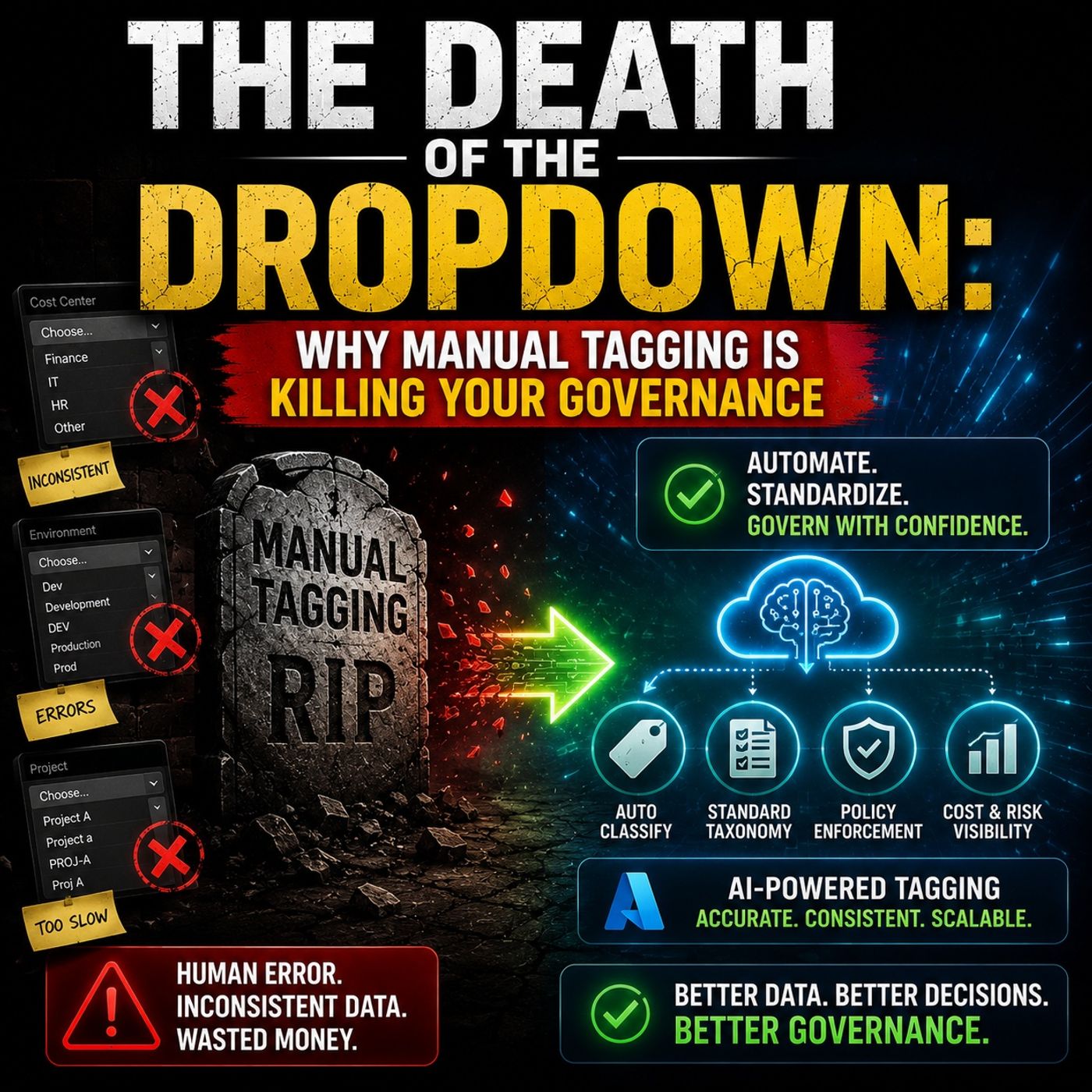
Quick answer: AI-powered metadata classification for Microsoft 365 is covered in this M365 FM episode with a practical focus on how it works, where it fits, and the architecture, security, governance, or operational choices that matter in real Microsoft environments.
Manual dropdown tagging creates real challenges for governance. You face errors, inconsistency, and limited scalability when you depend on manual processes. The death of the dropdown signals a shift. Your data grows fast, and manual processes cannot keep up. Poor tagging leads to dark data, hiding important files from your organization. Compliance suffers, and your ai tools lose effectiveness. You need strong governance to manage data and support ai in your workplace.
Key Takeaways
- Manual dropdown tagging leads to errors and inconsistencies, making data governance challenging.
- Automation and AI can reduce human effort in data classification by up to 80%, improving accuracy significantly.
- Implementing automated tagging helps organizations manage data efficiently and ensures compliance.
- Decentralizing metadata ownership allows domain experts to manage tags, increasing accuracy and flexibility.
- Real-time metadata injection keeps your tag management systems up to date and supports compliance.
- Regular monitoring of governance outcomes helps identify gaps and improve data accuracy.
- Training users on automated tools enhances their skills and builds a strong data governance culture.
- A living metadata layer adapts to changes, ensuring your organization remains ready for future challenges.
Death of the Dropdown in Data Governance

Why Dropdowns Persist
You have seen dropdown menus and manual tagging dominate website tag governance for years. In Microsoft 365 environments, dropdowns became the standard for metadata governance. You relied on them to tag files, emails, and documents. This approach seemed simple at first. You could select a tag from a list and move on.
Dropdowns offered a quick solution for tagging data, but they created hidden risks for governance.
- The article highlights the decline of dropdowns in governance practices.
- Manual tagging in metadata governance within Microsoft 365 led to challenges that you cannot ignore.
You often skipped fields or guessed which tag to use. Sometimes you chose the default tag just to finish faster. This behavior caused inconsistent data and weakened governance. As your data grew, dropdowns failed to keep up. You faced more errors and lost control over website tag governance. The death of the dropdown signals that you need a new way to manage data.
The Shift Away from Manual Tagging
You now see a shift in data governance. Automation and ai-driven solutions are changing how you tag content. You no longer depend on manual tagging for website tag governance. Automation reduces human errors and improves data integrity. Ai-driven classification identifies and tags sensitive data automatically. You gain real-time updates across all governed content without manual reclassification.
- Automation and ai can reduce human effort in data classification by up to 80%.
- Accuracy improves by 25-40% compared to manual tagging.
- The combination of automation and ai moves governance from a reactive process to continuous assurance.
You benefit from this shift. Your data gets tagged correctly and quickly. You do not need to remember to tag every file. Ai tools help you manage website tag governance and keep your data ready for compliance. The death of the dropdown means you can focus on your work while governance happens in the background. You unlock the power of your data and prepare for future ai advancements.
Website Tag Governance Challenges
Human Error and Inconsistency
Manual tag selection creates many problems for your data governance initiatives. You often face tedious and error-prone tasks when you tag files by hand. Studies show that manual metadata management leads to frequent mistakes. You may forget to tag a file, or you may choose the wrong tag. These errors lower data accuracy and make it hard for your organization to trust its data.
Skipped Fields
You sometimes skip fields when you tag content. This happens because you want to finish your work quickly. You may not see the value in every tag, or you may not know which tag fits best. Skipped fields leave gaps in your metadata. These gaps hurt data accuracy and weaken your governance. When you skip tags, your data becomes harder to find and use.
Guesswork and Defaults
You may guess which tag to use if you are unsure. You might pick the default tag just to move on. This guesswork lowers data accuracy and creates confusion. When you use the wrong tag, your data ends up in the wrong place. Your ai tools cannot find or use this data correctly. Over time, these mistakes add up and damage your data governance initiatives.
Fragmented Metadata
Fragmented metadata creates silos in your organization. You may use different tags for the same type of data. This leads to inconsistent definitions and low data discoverability. For example:
- A fintech company, Naranja X, struggled with fragmented metadata. They used manual processes and Excel sheets to manage tags.
- Their data governance initiatives became hard to scale and failed to meet regulations.
- Fragmented metadata made it difficult for teams to make decisions and slowed down their ai projects.
When you have silos, your data accuracy drops. Your ai tools cannot connect related data. You lose the full value of your data governance initiatives.
Dark Data Risks
Dark data hides in your systems when you do not tag files correctly. This untagged data creates risks for your organization. You may store data longer than allowed by law, which can lead to fines. Regulators may penalize you for failing to secure or classify sensitive data. During legal cases, dark data can surface and cause unexpected problems.
Dark data often contains sensitive information like personal details, credentials, or financial records. Hackers target this data because it is unprotected and unmonitored.
- Cybercriminals can exploit old archives or exposed file shares.
- You may not know when someone accesses or steals dark data.
- Attacks on dark data can lead to identity theft, data breaches, or reputational damage.
- Legacy backups or archived emails may expose customer information, resulting in compliance failures.
You need strong governance and accurate tag practices to reduce these risks. Proper tagging supports your ai tools and keeps your data safe and compliant.
Data Governance Strategy for Modern Workplaces
Scaling Beyond Manual Processes
You need a data governance strategy that grows with your organization. Manual tagging cannot keep pace with the volume of data in cloud platforms like Microsoft 365. You must scale your governance by using automated tools and clear policies. This approach helps you manage data efficiently and reduces errors in tagging. You can use automation to tag files, emails, and documents as soon as they are created. This ensures that your data stays organized and ready for ai tools.
To build a scalable data governance strategy, you should:
- Establish clear data usage policies to define how you use and share data.
- Implement retention and deletion policies to manage the lifecycle of your data.
- Create security and privacy policies to support compliance.
- Set up governance escalation paths for handling exceptions or policy violations.
- Standardize workspace creation with naming conventions and templates to ensure accountability.
- Establish lifecycle management rules for archiving or deleting inactive workspaces.
- Monitor data usage and enforce policies through regular reporting.
- Implement scalable access review cycles and automated permissions tracking.
You can use these steps to create a strong data governance strategy that supports ai and compliance. Automation helps you tag data accurately and keeps your governance system running smoothly.
Compliance and Audit Gaps
Manual tagging creates gaps in compliance and audits. You may miss important files or fail to tag sensitive data. This can lead to problems during compliance audits. You need a data governance strategy that closes these gaps and keeps your data safe.
Here is a table showing common compliance and audit gaps caused by manual tagging:
| Compliance and Audit Gap | Description |
|---|---|
| Reliance on static documentation | You may use outdated documentation that does not reflect current data, leading to compliance issues. |
| No real-time monitoring | Batch monitoring can leave breaches undetected for long periods, increasing vulnerability. |
| Limited lineage coverage | Incomplete data lineage can hinder audit readiness, especially when data moves across environments. |
| Manual audit preparation | Extensive manual work during audits creates operational burdens and delays compliance responses. |
You must use automation to tag data in real time. This helps you meet compliance requirements and makes audits easier. Your data governance strategy should include tools that monitor data and tag files automatically. This reduces risks and supports ai readiness.
Ownership and Accountability
Clear ownership and accountability improve metadata management in your workplace. You need a data governance strategy that defines who is responsible for tagging and managing data. This helps you avoid confusion and ensures that your data stays organized.
You can improve metadata management by:
- Fostering a shared understanding of data across departments. This supports effective communication and decision-making.
- Establishing clear standards for metadata creation and classification. This prevents discrepancies and makes metadata easy to find and understand.
You must assign roles for tagging and data governance. This makes your strategy stronger and supports compliance. When you know who owns each tag, you can track changes and fix problems quickly. Your ai tools will work better because your data stays accurate and well-tagged.
Tip: Assign data owners for each workspace or project. This helps you maintain accountability and ensures that your data governance strategy works at every level.
You can build a modern data governance strategy by scaling beyond manual tagging, closing compliance gaps, and defining ownership. This prepares your organization for ai and keeps your data safe and organized.
AI-Driven Data Governance Solutions

Automated Tagging with AI
You face many challenges when you rely on manual tag management. Errors, skipped fields, and inconsistent tag choices make your data unreliable. Automated tagging with ai changes this. You can use ai-driven data governance to tag files, emails, and documents without manual effort. Ai scans your content and applies the right tag based on context. This improves tag management and reduces mistakes.
SharePoint with AI-powered add-ons can automatically tag documents with metadata, which Copilot can then use to perform more robust queries and assist with organizing content.
We’re using the SharePoint AI capabilities to help with things like automatic processing and auto-tagging. These are mundane tasks that people don’t like to do.
It’s about integrating AI capabilities into daily practices to automate mundane tasks like tagging content, making it more discoverable, and keeping it up to date.
You gain consistency in tag management systems. Ai-driven data governance ensures every tag is accurate and relevant. You do not need to guess or select defaults. Your tag management becomes faster and more reliable. You avoid the failure to adapt to ai by using automated data governance. Your data stays organized, and your compliance improves.
Here is a table showing the differences between traditional and ai-driven data governance:
| Feature | Traditional Data Governance | AI-Driven Data Governance |
|---|---|---|
| Focus | Structured data, reporting, compliance | Unstructured & real-time data, model training, explainability |
| Goal | Accuracy, compliance, data reuse | Model fairness, trust, regulatory readiness |
| Scope | Data quality, cataloging, access control | Data lineage, annotation standards, AI ethics, risk monitoring |
| Stakeholders | IT, compliance, data stewards | Data scientists, ML engineers, legal, ethics teams |
Microsoft 365 Governance Tools
You need strong tag management systems to support compliance and ai. Microsoft 365 Governance offers tools that automate tag management and classification. Microsoft Purview is one of these tools. It uses ai to tag data, track data lineage, and manage compliance. You can rely on Purview to handle tag management across your organization.
Microsoft Purview has evolved into a platform for data governance, security, and compliance. Its Unified Catalog helps you discover data and automate tag management. You can meet standards like GDPR, CMMC, HIPAA, and SOC 2. Purview uses ai to manage policies and provide lineage insights.
| Supported Compliance Standards | Core AI Features |
|---|---|
| GDPR, CMMC, HIPAA, SOC 2 | Auto-tagging, lineage insights, AI-based policy management |
You benefit from tag management systems that work across Teams, SharePoint, and OneDrive. Ai-driven data governance helps you avoid the failure to adapt to ai. You keep your data ready for audits and ai projects. Your tag management becomes proactive, not reactive.
Real-Time Metadata Injection
Real-time metadata injection gives you a new way to manage tag management. You do not wait for manual reviews or batch updates. Ai injects metadata as soon as you create or modify data. This supports real-time monitoring and keeps your tag management systems up to date.
- Active metadata management enables real-time governance by dynamically detecting data or model drift, reducing the need for manual reviews.
- Governance tools provide transparency by documenting data sources, transformations, and downstream usage, which is essential for auditing and validating AI outputs.
- These capabilities help organizations build an AI-ready data architecture, ensuring compliance, risk management, and alignment with regulatory requirements.
You gain transparency and control over your tag management. Real-time metadata injection helps you track data lineage and meet compliance standards. Your tag management systems become smarter and more responsive. You build a foundation for ai and future analytics.
Tip: Use real-time monitoring to catch errors and update tags instantly. This keeps your data accurate and supports compliance.
You can transform your tag management with ai-driven data governance. Automated tagging, Microsoft 365 Governance tools, and real-time metadata injection help you manage data, improve compliance, and prepare for ai. Your tag management systems become a living layer that adapts to your needs.
Action Steps for Better Governance
Adopt Automated Tools
You need to move beyond manual tag processes to achieve real governance. Automated tools help you reach higher accuracy and reduce errors in your tag system. These tools use ai to scan your files and apply the correct tag without human guesswork. You save time and improve compliance because automated systems enforce rules every time you create or update content.
Here is a table that shows the measurable benefits you gain when you use automated tools for governance:
| Benefit | Description |
|---|---|
| Improved Data Quality | Continuous validation and rule enforcement boost accuracy and trust in your tag system. |
| Faster Compliance Reporting | Automation shortens audit cycles and speeds up compliance processes. |
| Increased Operational Efficiency | Streamlined audits and fewer manual tasks save time for your team. |
| Enhanced Trust in Data Systems | Automated governance builds trust, helping you make decisions with confidence. |
Automated tag monitoring also helps you spot issues as soon as they happen. You can set up alerts for missing or incorrect tags. This real-time monitoring keeps your tag accuracy high and supports compliance. Ai-driven tools make your tag system smarter and more reliable. You can focus on your work while the system handles the details.
Tip: Choose automated tools that offer real-time tag monitoring and ai-powered classification. This will help you maintain accuracy and compliance as your data grows.
Decentralize Metadata Ownership
You improve governance when you give ownership of tags to the people who know the data best. Decentralizing metadata ownership means that domain experts manage their own tag systems. These experts understand the context and can ensure the right tag is used every time. This approach increases accuracy and makes your tag system more flexible.
- Domain owners take responsibility for tag accuracy and decision-making.
- Governance checks built into domain pipelines catch issues early and prevent problems from spreading.
- Policies adapt to real usage, so your tag system stays aligned with your operations and compliance needs.
- Automated, self-enforcing systems help your governance scale and keep tag accuracy high without extra manual work.
When you decentralize, you also improve compliance. Each team can monitor their own tag system and fix issues quickly. This reduces the risk of errors and keeps your tag system ready for audits. Ai tools can support each domain by suggesting the best tag based on content and context. You get better accuracy and faster responses to changes in your data.
Note: Assign clear tag ownership for every workspace or project. This helps you track who is responsible for tag accuracy and compliance.
Track Governance Outcomes
You need to track governance outcomes to see if your tag strategy works. Monitoring your tag system helps you measure accuracy, compliance, and efficiency. You can use metrics to spot gaps and improve your process. Ai tools can help you collect and analyze these metrics in real time.
Here is a table with key categories and example metrics you should monitor:
| Category | Description | Example Metrics |
|---|---|---|
| Data Quality & Trust | Measures accuracy, completeness, and consistency of your tag system. | % of tables with tag descriptions, owners, or lineage. # of tag accuracy incidents per month. |
| Compliance & Risk | Checks if your tag system meets compliance rules and controls access to sensitive data. | % of sensitive tags with access controls. Audit trail completeness. Time to revoke access. |
| Data Usage & Adoption | Tracks how often users find and use tagged data. | Active users of the tag catalog. # of certified tags vs. total tags. |
| Operational Efficiency | Looks at how quickly you resolve tag issues and onboard new users. | Time from tag issue identification to resolution. Time to approve tag access requests. |
You should set up regular tag monitoring to keep your tag system healthy. Use dashboards to visualize tag accuracy and compliance trends. Ai can help you spot patterns and suggest improvements. When you track governance outcomes, you make sure your tag system supports your business goals and keeps your data ready for ai projects.
Callout: Regular tag monitoring and tracking governance outcomes help you maintain high accuracy, meet compliance needs, and prepare for future ai advancements.
Educate and Enable Users
You play a key role in successful data governance. Automated tools help you manage data, but you must understand how to use them. Training and enablement programs give you the skills to work with these tools. You need ongoing formal training to keep up with new features and best practices. This training helps you avoid mistakes and builds confidence.
You benefit most from training that matches your role. Data stewards, engineers, and business users each need different skills. Role-specific curricula make learning easier and more relevant. For example, data engineers focus on pipelines and automation. Business users learn how to use data catalogs and search for information. Tailored training keeps you engaged and helps you master your tasks.
You can choose from several training methods. In-person sessions let you ask questions and practice skills. Virtual live sessions connect you with experts and other learners. Self-paced modules give you flexibility to learn when you have time. Each method has strengths. You can combine them to fit your schedule and learning style.
Tip: Track your training progress with a learning management system (LMS). This helps you stay compliant and shows your growth.
You must keep training up to date. Governance tools change often. New policies and features appear. Updated training helps you stay current and avoid confusion. You can use external resources to learn faster and reduce the need for custom programs.
You need to understand governance policies. These cover data access, quality, and compliance rules. You learn about data quality standards, lineage documentation, and trust-building. Security training teaches you about role-based access controls and handling sensitive data. When you know the rules, you protect your organization and support strong governance.
Here is a list of best practices for user enablement:
- Adjust training for each role to address specific needs.
- Track training centrally for compliance and progress monitoring.
- Keep training up to date as tools and procedures evolve.
- Leverage external training resources to reduce custom program burden.
- Choose intuitive governance tools to simplify training and accelerate adoption.
You help your organization succeed when you learn and use automated governance tools. Training gives you the knowledge to manage data, follow policies, and support compliance. You become a trusted user and help build a strong data governance culture.
Future-Proofing with AI and Automation
Building a Living Metadata Layer
You need a living metadata layer to keep your organization ready for change. This layer adapts as your business grows and as new tools appear. You can avoid data classification issues by following best practices. Start with a clear strategy for what metadata you need and who will maintain it. Use a controlled vocabulary so everyone uses the same terms for each tag. Organize your tags with a taxonomy to make information easy to find and use.
| Best Practice | Description |
|---|---|
| Establish a Clear Metadata Strategy | Define what metadata is needed, which systems will use it, and who is responsible for it. |
| Create and Maintain a Controlled Vocabulary | Use a standard list of approved terms for each tag and update it often. |
| Implement a Taxonomy or Ontology | Structure your tags in hierarchies to improve navigation and precision. |
A unified metadata layer helps you unify governance across platforms. Automation enriches each tag with context, turning static records into a dynamic pipeline. This approach supports compliance and makes auditing easier. You can enforce policies across all ai workloads and keep your data ready for new challenges.
Preparing for AI Readiness
You must prepare your data for ai. Start by building a strong foundation. Standardize your tags and organize your data to avoid data classification issues. Assign clear ownership for each tag and make sure everyone knows their role. Upgrade your infrastructure to handle the storage and processing needs of ai.
- Build a strong data foundation for ai integration.
- Establish a scalable governance framework with clear tag ownership.
- Standardize and organize data for consistency.
- Upgrade infrastructure for ai workloads.
- Ensure continuous improvement and compliance with regulations.
You can unify governance across platforms by using these steps. Start with small pilot projects to test ai applications. Invest in data preparation to keep quality high and avoid bias. Engage teams from across your business to align ai with your goals. Protect your data with strong access controls and review your ai models often. This keeps your compliance strong and supports auditing.
Continuous Improvement
Continuous improvement keeps your governance effective as technology changes. Set up a framework that aligns people, processes, and technology. Populate your data catalog with key assets and keep it updated. Empower business stewards to manage tags in their areas. Curate your assets to build trust and knowledge. Apply policies and controls to protect sensitive data and support compliance.
- Establish a governance framework with clear responsibilities.
- Populate and maintain your data catalog for auditing.
- Empower business stewards to drive tag management.
- Curate and refine asset attributes for trust.
- Apply policies and controls for compliance.
- Foster collaboration in your data community.
- Monitor and measure curation for ongoing improvement.
You should also focus on ethics and privacy. Create guidelines to reduce bias and discrimination in ai. Control data quality and manage the lifecycle from collection to storage. Protect sensitive data with strong access measures. Define stewardship and ownership for each tag. These steps help you meet compliance needs and make auditing more efficient.
Organizations that use ai and automation see big gains. Automation leads to better standardization, higher compliance, and fewer data-related incidents. You can achieve faster time-to-compliance and reduce risk. Real-time monitoring and predictive governance will shape the future. GenAI will help you classify data, monitor for anomalies, and update tags dynamically. This will make auditing and compliance easier and more reliable.
Tip: Review your governance strategy often. Use ai tools to monitor tag accuracy, access, and compliance. This keeps your data ready for any challenge.
You need to move beyond manual dropdowns to achieve scalable governance. Manual tagging slows you down, introduces errors, and limits your ability to grow. AI-driven automation improves accuracy, speeds up workflows, and reduces compliance risks. Microsoft 365 Governance empowers you with unified controls, automated audits, and intuitive dashboards.
- Automation embeds governance into your data workflows, keeping controls effective as your business grows.
- AI frees your team from repetitive tasks and enhances search, compliance, and cost efficiency.
Data leaders should prioritize modern governance strategies to future-proof your organization and unlock the full value of your data.
FAQ
What is manual tagging in data governance?
Manual tagging means you select tags for files or documents yourself. You use dropdown menus or type in values. This process often leads to mistakes and missing information.
Why should you move away from dropdown tagging?
Dropdown tagging slows you down. You may skip fields or choose the wrong tag. Automation helps you tag data faster and more accurately.
How does AI improve metadata tagging?
AI scans your content and assigns the right tags. You do not need to guess or remember rules. This process increases accuracy and saves time.
What are the risks of poor metadata tagging?
Poor tagging hides important files. You may face compliance issues or lose track of sensitive data. Hackers can target untagged files.
How does Microsoft 365 Governance help with compliance?
Microsoft 365 Governance uses AI to tag and organize your data. You meet regulations and prepare for audits. The system updates tags in real time.
Can automation solve data access bottlenecks?
Yes. Automation removes delays caused by manual tagging. You find and use data faster. This helps your team work without waiting for information.
Who should own metadata in your organization?
Domain experts should own metadata. They know the data best. Assigning ownership improves accuracy and keeps your system organized.
How do you keep users engaged with new governance tools?
You should offer training and support. Use simple tools and clear instructions. Track progress and celebrate success to keep users motivated.
🎧 Listen to this episode
Want a practical explanation of AI-Powered Metadata Classification for Microsoft 365 Governance? This episode breaks down the topic in clear language and shows why it matters for Microsoft 365, Azure, Power Platform, security, AI, and modern work.
Listen to this episode if you want to:
- Understand the key concepts behind AI-Powered Metadata Classification for Microsoft 365 Governance
- See how it fits into the wider Microsoft technology ecosystem
- Learn where it can create practical value for your organization
You may also enjoy these related M365 FM episodes:
- Fixing the SharePoint Metadata Gap for AI and Governance
- Scaling CI-CD: The Governance Blueprint
- Graph-Powered AI Agents: An Enterprise Architecture Guide
- AI Governance from Microsoft Copilot to Quantum Computing
- AI-Powered SharePoint Intranets: Beyond Static Design
Discover more practical Microsoft conversations on M365 FM.
Last reviewed: July 2026.
Who Should Listen
This episode is for Microsoft administrators, architects, developers, security professionals, and business leaders who need a practical foundation before making implementation, operations, or governance decisions.
🎧 You Should Also Listen To
- AI Agents — A strongly related next step for extending this topic.
- Power Platform — A strongly related next step for extending this topic.
- Microsoft Graph Data Connect — A strongly related next step for extending this topic.
Apple Podcasts · Spotify · YouTube · YouTube Music
Host: Mirko Peters