 EN
 Deutsch
 Español
 Français
 Italiano
 Português
 Nederlands
 Polski
 Bahasa Indonesia
 Русский
 Українська
 العربية
 עברית
 हिन्दी
 日本語
 한국어
2026-07-26 · Season 2
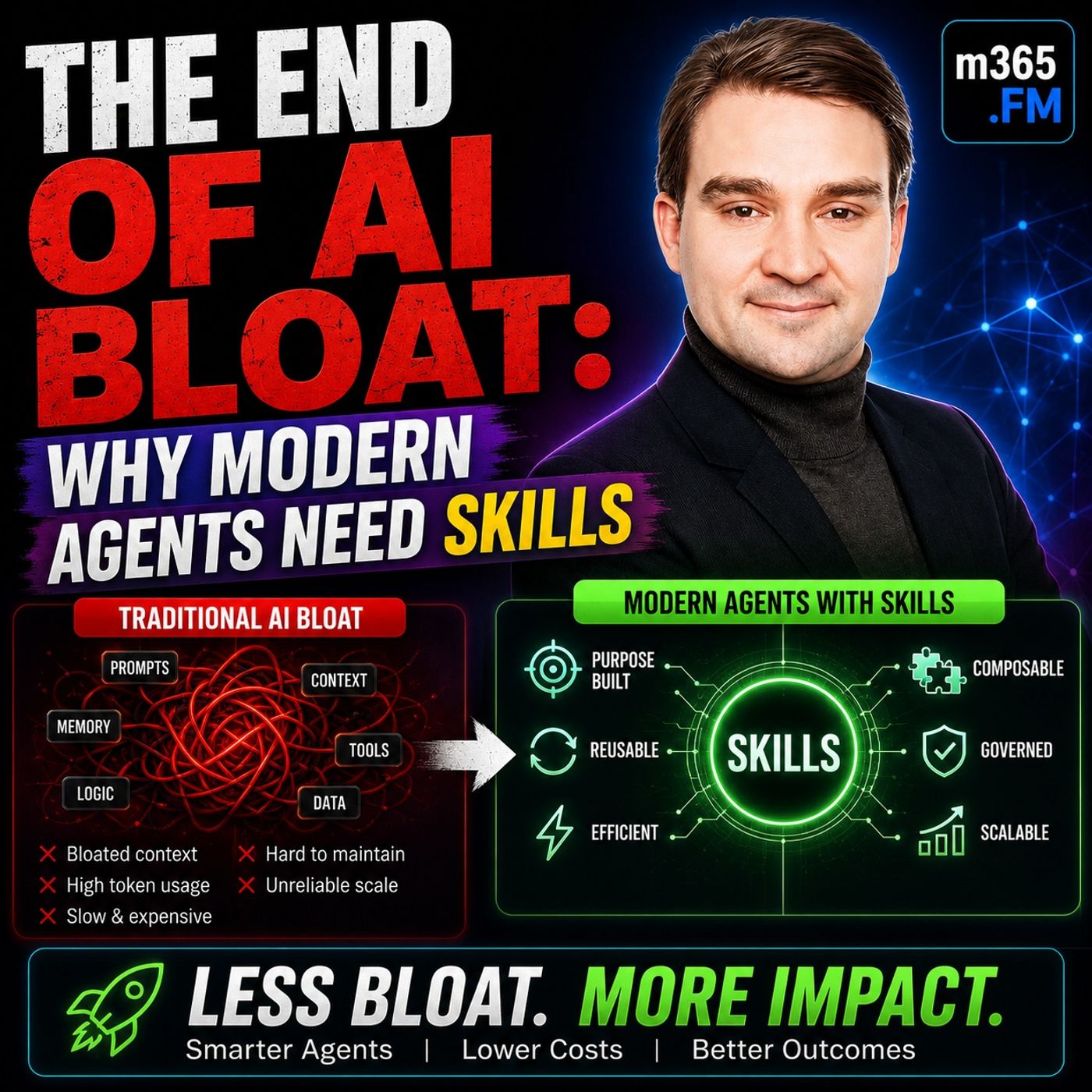
The End of AI Bloat: Why Modern Agents Need Skills
Show notes
Many AI agents start out fast, responsive, and surprisingly intelligent. But after a few months of real-world use, something changes. Response times increase, costs rise, prompts become enormous, and accuracy begins to decline. Organizations often respond by upgrading to larger models, expanding prompts, or adding more orchestration—but the underlying problem remains. The issue isn't the model. It's the architecture. This episode explains why monolithic prompts create what is known as the Context Tax, how modular Skills solve the problem through progressive disclosure, and why Skills are becoming the architectural foundation of modern AI agents across Microsoft Copilot Studio, GitHub Copilot, Claude Code, and the broader enterprise AI ecosystem. THE CONTEXT TAX Every enterprise AI project eventually faces the same challenge. At first, an agent contains a relatively small system prompt describing its role, tone, business rules, and guardrails. As the organization grows, more instructions are added:
- Policies
- Compliance rules
- Business procedures
- Examples
- Edge cases
- Department-specific workflows
Eventually the prompt becomes thousands of tokens long. Every user request forces the model to process every instruction—even when ninety-five percent of them are completely irrelevant. This hidden processing overhead is called the Context Tax. Rather than making agents smarter, larger prompts increase latency, raise inference costs, introduce reasoning noise, and gradually reduce answer quality. The presentation argues that the real problem isn't insufficient AI capability—it is forcing the model to continuously reason over information it doesn't actually need. WHY AGENTS DEGRADE OVER TIME Agent degradation is remarkably predictable. Organizations usually begin with one comprehensive instruction document that contains everything the AI should know. Initially this works well. Then new departments request additional functionality. Policies evolve. Compliance requirements expand. New workflows are added. Instead of restructuring the architecture, teams simply keep extending the same prompt. The result is context saturation. The model spends increasing amounts of effort searching through irrelevant guidance before finding the instructions that actually matter. This produces several side effects:
- Higher token consumption
- Slower responses
- Increased hallucinations
- More inconsistent reasoning
- Higher operational costs
The AI hasn't become less intelligent. Its reasoning path has simply become overwhelmed by unnecessary context. ALWAYS-ON GUIDANCE VS SITUATIONAL EXPERTISE One of the most important architectural distinctions introduced in this session is separating always-on guidance from situational expertise. Always-on guidance includes information that applies to every conversation:
- Agent identity
- Tone of voice
- Universal compliance rules
- Security requirements
- Core behavioral instructions
Situational expertise is different. It only matters when specific scenarios occur. Examples include:
- Vendor onboarding
- Leave eligibility
- Tax regulations
- Refund workflows
- Regional compliance
- Incident response procedures
Traditional agents mix both categories into one enormous prompt. Modern agent architectures separate them. Only universal guidance remains permanently loaded. Everything else becomes modular Skills that activate only when required. WHAT IS A SKILL? A Skill is much more than a prompt. It is a reusable package containing:
- Structured instructions
- Metadata
- Trigger descriptions
- Optional scripts
- Reference documents
- Templates
- Supporting assets
The core of every Skill is the SKILL.md file. This file defines:
- Name
- Description
- Purpose
- Trigger conditions
- Workflow
- Procedural guidance
The orchestrator doesn't initially load the entire Skill. Instead, it evaluates only the metadata. When the user's request matches the Skill description, the complete instructions are loaded into context. This dramatically reduces unnecessary reasoning while keeping specialist knowledge available exactly when needed. THE REASONING BOUNDARY The presentation introduces another important architectural concept: Skills define reasoning boundaries. Rather than forcing an AI model to treat every instruction as universally relevant, Skills establish clear expertise domains. A leave management Skill applies only to leave requests. A procurement Skill activates only during purchasing workflows. A compliance Skill loads only when compliance questions arise. Each Skill becomes an isolated reasoning domain. Instead of thinking about every possible business process simultaneously, the model focuses exclusively on the knowledge required for the current task. This improves both precision and consistency. PROGRESSIVE DISCLOSURE One of the core design principles behind Skills is Progressive Disclosure. Instead of loading every instruction at startup, agents maintain only a lightweight catalog containing Skill names and descriptions. When a matching scenario appears:
- The orchestrator identifies the relevant Skill.
- The Skill loads into context.
- The task executes.
- The Skill unloads after completion.
Everything else remains outside the context window. This significantly reduces:
- Token usage
- Latency
- Compute requirements
- Infrastructure costs
The architecture keeps the default state intentionally lean. Become a supporter of this podcast: https://www.spreaker.com/podcast/m365-fm-microsoft-365-azure-cloud-power-platform-ai--6704921/support.
Apple Podcasts · Spotify · YouTube · Deezer
Host: Mirko Peters
Related articles
Transcript
Read the full transcript
Your agent starts fast by month three at sluggish. You notice it first in the response times. A question that took three seconds now takes eight. You add more context hoping it helps. You paste in policies, procedures, guardrails, and examples. You want the model to have everything it might need. But then the cost goes up, the errors increase, and the agent gets slower. So you do what seems logical. You add a bigger model. You refine the prompt. You try different orchestration patterns. None of it works. Because the problem isn't the model, the problem is the structure. Every turn that agent reads the entire manual, every token in your system prompt gets processed. Every policy, every procedure, and every edge case is something the model attends to, whether it's relevant or not. That's the context text. And it's killing enterprise AI deployments. The fix isn't bigger models or better prompts. It's architecture. Why agents degrade? This is what most organizations don't understand about agent decay. It starts with what feels like a simple design choice. You write a comprehensive instruction set. You document how the agent should behave, what tone it should adopt, and what rules it must follow. You add domain knowledge like your data model, your business rules, and your compliance requirements. You throw in examples. You anticipate edge cases. The result is a monolithic instruction blob. Everything in one place, one system prompt, one version, one owner. For the first few weeks, it works fine. The agent is fast. The responses are good. Users adopt it. Then you need to add something new. A new policy. A different workflow for a specific department. A guardrail for a recent incident, you add it to the blob. The blob grows. By month three, that instruction set has become this massive, undifferentiated pile of rules. Some are critical. Some apply only once a quarter. Some contradict each other in subtle ways. But the agent loads all of it. Every single turn. That's context saturation. Here's what happens at scale. The model reads more tokens. Reading more tokens costs more. It also takes longer. Latency increases. The reasoning parts gets noisier because the model has to pass through irrelevant guidance to find what matters. So accuracy drifts. False positives increase. The agent starts making mistakes it didn't make before. You notice the agent feels dumb. It is. Not because the model got worse, but because it's drowning in noise. The research is clear on this. When you split a monolithic instruction set into modular skills, loading only the guidance relevant to the current task. Organizations report 96% token savings. Not a small percentage, 96%. That same split delivers a 93% latency improvement. 9/10 faster. But the issue runs deeper than just speed and cost. There's a structural flaw nobody talks about. Organizations treat all rules the same way. A universal guardrail that must apply to every conversation gets piled into the same instruction file as a specialized workflow that applies to maybe 5% of your use cases. The specialized guidance is always loaded, always consuming tokens, and always slowing down the reasoning path. Even though most of the time it's irrelevant. The difference is between always on guidance and situational expertise. Always on guidance is your tone, your role, your identity. Universal compliance rules. Things that apply to every single conversation, regardless of what the user asks for. Situational expertise is different. It's the step-by-step procedure for handling a refund above a certain threshold. It's the checklist for onboarding a new vendor. It's the specific tax rules for a particular region invoked only when that region matters. It's specialized knowledge that the model doesn't need in context unless the scenario actually comes up. When you throw both into the same instruction file, you've created a bloated context that the agent has to pass on every turn. The model wastes computation reading irrelevant procedures. The latency balloons, the cost climbs, and the accuracy suffers because important guidance gets buried. This is the structural flaw. The moment your agent starts handling more than one type of scenario, a monolithic architecture breaks, not immediately, but predictably, by design. The fix is to separate them. Keep the always on guidance lean and sharp. Move situational guidance into skills. These are reusable, on-demand instruction sets that the orchestrator loads only when needed. Load the one thing the agent actually needs for this task. Ignore the other 47 draws. That's the architecture shift. That's what modern agents are doing. And it's where we're heading next. The skill as a reasoning boundary. So what exactly is a skill? At its core, a skill is a self-contained package. It contains three things, structured instructions for a specific workflow, metadata that tells the orchestrator when to use it, and bundled resources. Like scripts, templates, or documents, the foundation is the skill. MD file, this is just a markdown document with the YAML front matter. It declares the name, a description of when it applies and the procedural steps. It sounds straightforward, almost boring. But the format matters because it has become portable. In late 2025, I'm tropic published an open standard that created a shared language for these capabilities. That format was quickly adopted by OpenAI, Microsoft, and dozens of other platforms. This didn't happen because of a committee or a mandate. It happened because it worked. The format was simple enough to adopt, expressive enough for real workflows, and lightweight enough to move between systems without any translation. Today, you can write a skill once and use it across GitHub co-pilot, Claude code, and co-pilot studio without rewriting a single line. But here is the part most people miss, the metadata, the name and the description. Isn't just documentation, it is an API. Think about it this way. The orchestrator has one job. It reads the user's request, looks at the context, and asks the single question, which skill should I load right now? To answer that, the orchestrator does not read the full instructions. It doesn't pass 30 paragraphs of step-by-step guidance. Instead, it evaluates the name and description against what the user is trying to do. The name and description are the routing signals. This is why precision in naming is everything. If you name a skill HR help, it will fail because the scope is too broad. The orchestrator can't tell if the user needs help with benefits, pay, or leave policies. The result is that the system either loads the skill every time HR is mentioned, which pollutes the context window or it never loads at all because the description is too vague to match. But HR leave eligibility triage actually works. The name is specific, the description is precise. You tell the system to use this skill when a user asks about leave eligibility, require documents or a crew calculations. Now the orchestrator can make a real decision. When a user asks how much paid time off they have, the model reads that description, sees the match, and loads the skill. But when that same user asks about their salary, the skill stays unloaded. The orchestrator's job is matching intent to expertise. Once the skill is selected, the full instructions finally come into context. Now the model has the step-by-step procedure, the examples, and the guardrails for that specific workflow. It executes with precision. And when the conversation shifts, the orchestrator unloads it and brings in something else. This is the reasoning boundary. A skill isn't a straight jacket that forces the model to act a certain way. It is a boundary that marks where one area of expertise ends and another begins. It tells the model that the specialized knowledge applies to this specific scenario, but it shouldn't treat this guidance as universal. Skills also use what we call soft-pointing. This means they reference tools without being permanently bound to them. A skill can tell the model to call a leave-approval action, but it doesn't require that action to exist to function. If the action isn't in the toolkit, the skill still loads, and the model simply adapts by acknowledging the limitation or escalating the issue. The skill provides the blueprint, not an iron-clad mandate. This architecture separates instruction from execution and knowledge from tools. Each piece can evolve on its own. And the orchestrator, the intelligent router, decides what gets loaded and when. That is the shift. That is what a skill actually is. The progressive disclosure pattern. There is a design principle underneath all of this called progressive disclosure. It works like this. Your agent does not load the entire skill library at startup. Instead, it loads the metadata, the lightweight summary. For every skill, that is just the name and the description. It is compact and uses minimal tokens. Think of it as a directory that the orchestrator keeps in view at all times to decide what is relevant. Everything else, the instructions, the examples, and the scripts stays on the disk until the moment it is needed. When the orchestrator decides, a skill matches the user's intent, the full content loads. The instructions enter the context mid-conversation, the reasoning path shifts. Suddenly, the model has access to specialized guidance that was not available a few seconds ago. This matters for operations in ways that go away beyond the obvious. When a skill is unloaded, those tokens are not sitting in the prompt. They aren't there at all. This means that for every response, the model processes a smaller prompt with fewer tokens to attend to. Processing time drops as a result. A conversation that would have taken 45 seconds with a bloated monolithic prompt might only take 15 seconds when only the active skill is loaded. That isn't just a small improvement. It is a structural change. The latency math is very simple. Model inference time scales with token count. If you cut the tokens per turn and half, you cut the latency roughly in half. If you reduce tokens by 80%, which is realistic when you split situational guidance out of the main instructions. The speed follows. Your response time improves proportionally, but the real leverage shows up when the system is under load. When you have multiple conversations happening at once, throughput becomes the bottleneck. Every conversation consumes compute. If your instruction set forces every turn to process 10,000 tokens, you are burning through your computational budget at an incredible rate. If you add 50 concurrent users, you will hit rate limits and start queuing requests. The service feels sluggish to everyone. Progressive disclosure changes that equation. Because skills load on demand, the baseline context stays lean. Most turns process a fraction of the tokens they would in an old school architecture. 50 concurrent users now occupy much less compute allowing your throughput to scale. You can handle more conversations simultaneously before you ever hit a limit. This is why a skills architecture scales better than a monolithic agent. It isn't just that skills are faster. It is that they let you do more work with the same budget. The cost lever works the same way. Every time the model generates a response, you pay for tokens. Every search or tool invocation has a cost measured in co-pilot credits. When you reduce the tokens per turn through progressive disclosure, you reduce the reasoning cost at the same time. Because the skill architecture lets you handle more conversations per unit of compute, you reduce the total API calls per conversation. You have fewer round trips to external systems and fewer searches because the model has targeted guidance. Your spend on co-pilot credits goes down and that difference is measurable and significant. Organizations are reporting that they keep their metadata layer, the names and descriptions. Under a few hundred tokens total, as conversations branch into different scenarios, different skills activate. One conversation might load three separate skills over its lifetime while another might only load one. But every single turn, the baseline stays lean. Only what is needed is in the context. This is the efficiency of the architecture. It isn't about one single feature. It is about the structural principle. Keep the default minimal. Load what is needed. Unload when you are done. Repeat. Manageability is a first-order problem. This is where the real value of skills emerges. And it's almost never the first thing people talk about. Performance matters, cost matters. But what determines whether an AI system actually survives in an organization is manageability? Can you maintain it? Can you update it without breaking something else? Can you own it? In a monolithic architecture, you have one instruction file, one massive document, one version, one review cycle, one owner, at least theoretically, but in reality, when everything is interconnected, ownership becomes fuzzy. Someone adds a guardrail. Someone else adds a policy. A third person refines the tone. Now you have a file that nobody fully understands, maintained by committee, with no clear owner accountable for the whole thing. When you need to change something, the review surface is enormous. You're updating a 5,000 line instruction file where a change to one workflow can have ripple effects on unrelated logic. Everything is entangled. You don't know what will break, so you test exhaustively. You get nervous, you move slowly, or you move fast in things break in production. Neither is good, with modular skills, the dynamic reverses. One skill is one version, one owner, one review cycle. A skill for leave eligibility is owned by the HR team. While a skill for vendor onboarding is owned by procurement, and a skill for incident escalation is owned by operations. Each team maintains their own expertise. Nobody has to be an expert in everything. The review surface for any single skill is small enough that humans can reason about it completely. A hundred line instruction set for a specific workflow is something a person can read and review in 15 minutes. But a 5,000 line monolith takes hours, change management becomes granular. You update the leave eligibility skill, and your only risk breaking leave eligibility workflows. Incident escalation is unaffected. Vendor onboarding is unaffected. You can deploy that skill change to production on a Thursday without nervousness because the blast radius is defined. If something goes wrong, you roll back one skill, not an entire system. Version history becomes meaningful. You can see exactly what changed. When and why? You can compare versions and understand the delta. The operational reality is that teams actually maintain modular systems better. This isn't anecdotal. It's how software engineering works at scale. Micro-Services 1, monoliths lost. Not because microservices are always faster or smaller in total lines of code, but because humans can reason about them. A team can own a service. A team can deploy a service independently. A team can be paged when that service breaks. You have accountability, clarity, and speed. Skills work the same way. The boundaries matter too. A skill that serves as a specialist. Narrow expertise called in occasionally is easy to own. It has one job. A skill that serves as a playbook, the known sequence for a recurring situation, is similarly bounded. A playbook skill for quarterly reviews has a clear scope. The steps, the approvals, the outcomes. A guardrail skill for compliance is explicit. These are the rules that must never be violated. Each archetype has a natural boundary. When you try to combine them, when you throw a reference manual, a specialist procedure, a playbook, and a guardrail all into one skill. You've recreated the monolithic problem at a smaller scale. The routing becomes ambiguous. The ownership becomes unclear. The review surface expands. And you've defeated the purpose of modular architecture. So the first order question isn't performance or cost. Though those follow, its manageability. Can we own this? Can we maintain it? Can we change it safely? Skills let you answer yes to all three. The four skill archetypes, not all skills are the same. And trying to force different types into a single skill is where most implementations start to break. There are four distinct patterns, recognizing which one your building determines whether routing works. Whether the orchestrator can invoke it at the right moment. And whether the model can actually follow it. The first is the reference manual. This is a skill that teaches the model something it doesn't know. Your data model, your schema, your business terminology. The LLM wasn't trained on your internal customer classification system or your proprietary process names. So you documented a reference manual skill is pure knowledge transfer. It's usually heavy on structure, tables, definitions, examples, and light on procedure, it says. Here's the universe of things that exist in our system and what they mean. When a user asks a question that requires understanding your domain, the orchestrator loads this skill. The model reads the definitions. And then it can answer accurately. The reference manual skill doesn't tell the model what to do. It tells the model what exists. The second is the specialist. This is a narrow area of expertise that the model only occasionally needs. Think region-specific tax rules applied only when a user asks about a particular geography or a specialized approval workflow for high-value orders. Triggered only when the order amount exceeds a threshold. The specialist skill is focused. It has one job. It's called rarely. But when it's called, it's called because the situation is specific and the guidance needs to be precise. A specialist skill usually contains decision trees and conditional logic. If the amount is under 5,000, follow path A. If it's between 5 and 50,000, follow path B. If it exceeds 50,000, escalate to this person. Specialists are easy to root to because their trigger conditions are clear. The third is the playbook. A playbook skill describes a known sequence for a recurring situation. On boarding a new customer running a quarterly review cycle, processing a leave request, a playbook is procedural. Step one happens. Then step two, then step three, there are decision points. But the overall flow is deterministic. The model's job is to follow the steps, ask the right questions at each stage, collect the necessary information, and move through the sequence. A playbook skill is narrative in structure. It reads like instructions because it is instructions. Most organizational workflows fit this pattern. The fourth is the guardrail. A guardrail skill exists to enforce rules that cannot be violated. You may not refund an order without going through approval. You may not grant certain permissions without audit evidence. You may not delete records that have legal holds. A guardrail skill is constraint-based. It doesn't guide behavior. It forbids specific behaviors. It's often negative. Never do this, rather than positive guidance. Guardrails are usually brief and explicit because they're about drawing a hard line. Not explaining a process. Here's what matters. Each archetype has a different triggering condition, a different structure, and a different relationship to the model's reasoning. When the orchestrator evaluates whether to load a skill, it's matching the user's intent to the skill's scope. A reference manual skill should load when the user is asking questions about your data model, your terminology, or your system structure, especially skill loads when the triggering condition is met, like a high-value order or a specific region. A playbook skill loads when the user wants to initiate or progress through a known workflow. A guardrail skill loads when the user is attempting an action that's restricted. Now here's where it breaks. When you mix archetypes in a single skill, the routing becomes ambiguous. The description can't be specific because it's trying to cover multiple patterns. The name has to be so broad that it matches too many situations. The orchestrator either loads the skill constantly or never loads it at all. And the model's behavior becomes unpredictable. Is it reading reference material following a procedure enforcing a constraint? The skill doesn't have a coherent type. So the model's reasoning path fragments. A well-designed skill knows what it is. Reference manual, specialist, playbook, or guardrail. Not all four, not even two. One clear archetype, one clear purpose, one routing condition that the orchestrator can evaluate precisely. That clarity is what makes the entire architecture work. Copilot Studio's skill integration. This is where theory meets practice. Copilot Studio implements the agent skills open format directly. You can author and manage skills within the platform. No exporting to separate systems. No learning a different tool set. The interface is straightforward. Inside Copilot Studio, there is a skills tab. From there you have two entry points. You can create a skill from scratch or you can upload an existing one. Creating from scratch gives you a guided workflow. You provide the name, description, and instructions. The platform scaffolds the skill.md structure for you. You fill in the content, you save it, and the skill is now part of your agent. Uploading means you already have a skill. Maybe you authored it elsewhere. Maybe you downloaded it from a community registry. Either way, once it is in Copilot Studio, the platform manages it. But skills are not just marked on file sitting alone. They are bundles. A skill in Copilot Studio can carry bundled resources along with the skill.md file. You can include scripts like Python, Shell, or reference code that the skill uses during execution. You can bundle references like documentation files, schemas, and examples. Anything the agent might read to understand the context goes in the bundle. You can include assets like templates, configuration files, and sample data. All of this travels together as a single unit. Think of it like a folder. The skill.md is the manifest in the instructions. The script's subdirectory holds your executable code. References contain the documentation the model reads. Assets hold your data structures and templates. When the skill loads, the entire bundle comes with it. When the skill is versioned, all of these files are versioned together. When the skill moves, everything moves. This bundling approach matters for application lifecycle management. Copilot Studio is built on the Power Platform, which has a mature solution model. Skills can be packaged into Power Platform Solutions. That means the skill is not just a loose artifact sitting in your agent. It is a managed component that moves through your environment strategy. You develop a skill in your development environment. You test it. You promote it to a test environment for validation. Then you promote it to production. At each stage, the entire bundle moves together as a versioned unit. Your pipelines can track skill changes. Your environment separation is preserved. Your agent moves with its skills intact. This is solution-aware ALM. The skills are not agent-scoped in isolation. They travel as part of your solution package. You can update a skill in development, test the change, and promote it to production without touching other skills or the agent itself. Each component has its own version history, its own change log, and its own deployment cycle. The soft-pointing pattern is equally important for integration. A skill can reference agent tools without hard binding to them. When a skill says, "Call the approval action," it is not declaring that action as a required dependency. If the action exists in the agent's toolkit, the skill can invoke it. If it does not, the instruction can acknowledge the limitation and work around it. The agent adapts. This matters because it means skills can be authored without assuming a specific agent configuration. The same skill can work across agents that have slightly different tool sets as long as the core capabilities are present. Soft-pointing extends to flows, connectors, and MCP servers. A skill can reference a power-automate flow without binding to it. The reference is loose. The model knows the tool exists and tries to use it, but it can adapt if conditions do not allow. This flexibility is what enables skills to be reusable across different environments and agent configurations. There is one current limitation worth noting. Skills in Copilot Studio are agent-scoped. A skill belongs to a specific agent. You cannot create a tenant-wide skills library and have all agents consume from it automatically. That is the roadmap direction. Shared catalogs. Cross-product reuse. A true enterprise skill library. But today, skills live within the agent they were created for. If you want to reuse a skill across multiple agents, you have to import it separately into each one. That is changing, but it is the current constraint. The data versus MCP bridge. Up until now, we have talked about skills as agent-scoped artifacts. They live inside a particular agent and move with it through environments. But at enterprise scale, this creates a problem. If you have 50 agents across your organization, do you replicate the same skill 50 times? Do you maintain 50 copies of your vendor on boarding procedure? That is not scalable. That is not maintainable. It is the opposite of what you wanted when you move to skills in the first place. This is where the model context protocol enters the architecture. MCP is an emerging standard that defines how AI agents access tools, data, and context from external servers. Multiple vendors are converging on it. In Copilot Studio, MCP serves a specific purpose. It lets agents reach out to a centralized server to discover and invoke skills. That centralized server is data-verse. Data-verse is the foundation of Power Apps and Dynamics 365. Traditionally, it stores operational business data. Customers orders cases, the transactional entities that run your business. But in 2026, its role is expanding. Data-vers is becoming the system of record for business procedures themselves. Not just what happened, but how things should happen. Business skills stored in data-verse are procedures, policies, and playbooks stored as data. When a vendor on boarding skill is authored, it no longer lives inside a single agent. It lives in data-verse, indexed, and versioned as a first-class asset. When a user asks an agent about vendor onboarding, that agent connects to the data-verse MCP endpoint and queries available skills. The orchestrator evaluates the user's intent against skill descriptions stored in data-verse. On-match, the agent retrieves the skill and loads it into context. The endpoint is straightforward. Every data-verse environment has this specific URL structure. Any agent in the tenant can connect or auth secures the connection. When an agent connects, it acts as the authenticated user. Data-vers enforces role-based access. If a user lacks permission to access certain data, the agent does not retrieve it. Security boundaries are preserved transparently. Cross-environment access becomes possible. You have separate development and production data-verse environments, development host, draft skills, and experimental procedures. Production hosts only certified approved ones. A development agent connects to development data-verse for testing. A production agent connects to production data-verse for live use. The same MCP protocol applies in both. You do not have different connection patterns or access methods. It is unified and environment-aware. The centralization is where governance gains real power. In an agent-scoped model, a skill is a local artifact versioned within that agent. It is reviewed once and it lives or dies tied to that agent's deployment. But when a skill lives in data-verse, it becomes an enterprise asset. It is versioned in the native system of data-verse. It is owned by a team. It is reviewed once and reused across many agents. When you update the skill in data-verse, all consuming agents see the update immediately. You update once. 50 agents benefit. The audit trail becomes comprehensive. Data-verse records who created the skill and when they created it. It tracks who modified it and when each change occurred. That trail is queryable, reportable and exportable. For compliance audits and change management reviews, you have a complete record. Skills are no longer forensic blind spots. They are transparent, traced assets. Skills become organizational intelligence rather than embedded instructions. They are managed like critical business assets. They can be evaluated and certified. They can be assigned clear ownership. You can mark them as experimental, approved or deprecated. You can tag them with compliance categories or domain ownership. The architecture shifts fundamentally. Instead of agents containing their own knowledge, agents discover knowledge from a central system. That shift enables enterprise scale without sacrificing control or auditability. A skill created in data-verse becomes the single source of truth. Multiple agents reference it. Multiple users benefit. One governance surface owns it all. This is the leverage point. This is where skills move from a feature to a structural principle. It is the foundation of how enterprise AI operates. The routing problem solved. The cleanest theory collapses the moment reality arrives. You implement skills, you write descriptions, you deploy your agent, and then something breaks. A skill fires when it shouldn't, or it never fires at all. The model invokes the wrong skill for the scenario. Or it loads multiple conflicting skills simultaneously. The routing problem is real. In fact, it's the most common failure mode in early skill implementations. But here's the problem. When a description is vague, the orchestrator can't make a reliable decision. Consider a skill description that says, use this for financial questions. Now a user asks about the revenue forecast for next quarter. That matches financial questions, load the skill. But that same description also matches questions about approving an expense or actual spend from last month or how to request a budget increase. All of these are financial. All of them treat are the same skill. But in reality, they are entirely different workflows. They have different tools, different constraints, and different outcomes. The skill loads when it shouldn't, or it loads and the model struggles because the instructions assume a specific type of financial question that doesn't match the user's intent. On the other extreme, a description that's too narrow never triggers. If you tell the agent to use a skill only for processing Q4 vendor reimbursements over $5,000 submitted after a specific budget freeze, it might match three scenarios per year. Users never get the benefit because they don't phrase their requests in those exact terms. The skill sits dormant, the routing fails silently. The distinction between routing metadata and documentation is critical here. Your skills instructions, the step-by-step procedures, those are documentation. They explain how to execute the workflow to a human reading the file. They can be long. They can include caveats and examples. The name and description are different. They are signals. They are the data the orchestrator uses to make a binary decision. Load this skill or don't. If the description is ambiguous, the orchestrator has to guess. If it's too narrow, it never matches. Precision here isn't optional. It determines whether the routing actually works. So how does the orchestrator actually select a skill? It reads the user's request and extracts the intent. It compares that intent against the name and description of every available skill and scores the matches. The skill with the highest relevance score loads. If the score is below a threshold, no skill loads, and the agent reasons from its baseline instructions. This is where the precision rule applies. If two reasonable makers would disagree about whether a skill should load for a particular request, the description isn't specific enough. You need to revise it until the boundary is unambiguous. The reasoning view is your main debugging surface for this problem. Inside Copilot Studio, you can open the reasoning view to see exactly what happened. You can see which skill loaded, why it was chosen, and what the matching score was. If the wrong skill loaded, the reasoning view shows you that the description didn't provide enough distinction or the name overlapped with another skill. You can watch the model's actual reasoning path. You see the choice and the justification. From there, you can refine the description, make it more specific. At exclusion language like, do not use for payroll questions. Clarify the trigger condition, narrow the scope. Itterate. Two broad causes constant unwanted firing. Two narrow causes routing failure. The balance point is precision. This is solvable and solved correctly. It's invisible. The skill loads exactly when it should. The user doesn't think about routing. They ask their question, the right expertise loads, and execution proceeds smoothly. But get the descriptions wrong and the entire architecture falls apart. When to use instructions versus skills? Here's the practical question every architect faces. Where does this guidance live? Does it go in the instructions? Or do I extract it into a skill? The answer hinges on a single question. Is this rule true in every conversation? If yes, it belongs in instructions. If no, it belongs in a skill. That's the decision tree. Instructions are the always on layer. They're loaded before any skill and before the user says anything. Instructions are what you want the agent to be, regardless of the scenario, your tone, your identity, the way you speak. You are helpful, direct, and professional is an instruction. It applies when handling leave requests and it applies when processing expense approvals. It's constant. It belongs in the instruction layer. Same with roll. You are an HR assistant sets your identity. That doesn't change between conversations. Universal guardrails belong here too. You might tell the agent to never promise legally binding outcomes or to always protect personal data according to policy. These rules apply universally. They're not situational. A leave eligibility skill doesn't need to restate them because the base instructions already hold them. The skill can assume they're true and focus on the specifics of leave. This is the manageability payoff. Your instructions stay lean because they're not trying to encode every procedure and every edge case. They're the common baseline. Everything situational lives elsewhere. Now flip the question, is this true only in specific scenarios? Situational guidance belongs in skills. The step-by-step procedure for processing a vendor refund above a certain threshold is situational. It applies to that specific scenario but it doesn't apply when processing employee reimbursements or customer refunds. It doesn't apply most of the time, so it lives in a skill. When a user asks about vendor refunds, the skill loads. When they ask about something else, the skill stays unloaded. The rules for approving a leave request during a blackout period are situational. They only matter during blackout and only for leave requests. Skill. The checklist for high-value contracts over $2 million with specific legal review requirements is situational. Skill. The difference is context dependency. Always true rules live in instructions. Context dependent rules live in skills, but here's the subtlety. Some guidance feels universal because it's complicated and you want the model to have it available. Resist that impulse. Complicated doesn't mean always on. Ask yourself if the user encounters this in every conversation. If the answer is no, it's situational. Extract it into a skill. Let's look at a concrete example. An organization builds an HR agent. The initial approach is to dump everything into the instructions, leave policy, salary questions, benefits enrollment, performance reviews, and compensation structure. They add payroll tax treatment, holiday schedules, remote work policies, and disability leave, all in one instruction file, thousands of lines. The instructions are so bloated that the model has to process all of it for every single turn. Most of it is irrelevant to most conversations. The alternative approach is to keep instructions minimal. Identity, you are the HR assistant. Tone, professional, empathetic, clear. Universal guardrails. All salary information is confidential. Never promise benefits decisions without HR review. That's the instruction layer. It's a hundred lines maximum. Now create three skills. One for leave eligibility, covering a cruel rules and blackout periods. One for compensation, covering salary grades and review cycles. One for enrollment, covering benefits and retirement plans. When someone asks about their PTO balance, the leave skill loads. The model has the specific rules for PTO, a cruel and company specific policies. So it answers with precision. When someone asks a different question, a different skill loads. The instructions are unchanged. The model's identity and values are consistent. But the procedural guidance is modular. The leave team owns the leave skill and the compensation team owns the compensation skill. Each can update their domain without touching the other. If leave policies change, you update one skill, not a massive instruction file. This distinction prevents context saturation. It keeps instructions lean. It distributes ownership. It makes the system maintainable at scale. The decision is simple. Universal, instructions, situational, skills. Everything follows from that. The skill versus new agent decision. So when does the skill actually become a separate agent? This is the inverse question. We've established when to pull guidance out of instructions and into a skill. Now comes the harder part. You've built a skill. It's working. Teams are using it, but now you're wondering if it's grown so large that it should just be its own standalone agent. The answer isn't about size. A skill can be comprehensive. It can have hundreds of lines of logic. It can bundle scripts, templates, and reference materials into one package. Size alone doesn't determine the boundary. The real distinction comes down to audience and knowledge domain. Think of it as an audience test. Does this skill serve the same users as the parent agent? Does it share the same knowledge boundary? When you have an HR agent, a leave eligibility skill serves HR users asking HR questions. The knowledge domain is consistent. The same people interact with leave questions, compensation questions, and benefits questions. It's all HR. A single agent with multiple skills makes sense here because the user population is unified and the domain is coherent. But if you find yourself building a skill that serves a completely different group, that's a signal. Or if it serves the same users, but for an entirely different business domain, that's also a signal. An IT agent handles password resets, access provisioning, and software requests. These are all IT operations. They serve IT users. One agent with multiple skills works because the audience and the domain align. Now consider a different scenario. You have an IT agent. You're building a skill for data governance. This covers policies about PII handling, data classification, and retention rules. That skill serves IT staff sure. But it also serves business analysts, project managers, and compliance teams. The knowledge domain isn't IT operations anymore. It's data governance. The user population extends far beyond the IT desk. The semantic boundary is fundamentally different. At that point, a separate data governance agent makes more sense. Different users, different expertise, different knowledge boundary. The toolset test adds another dimension. Research shows that accuracy can degrade as an agent's available toolset grows. There is a practical limit to what one agent can juggle. When you exceed that limit, you're better off splitting into separate agents, rather than piling more tools into one. An IT agent that resets passwords, orders hardware, and manages licenses has broad reach. But it's still unified by the toolset and the domain. Now add data governance tools, compliance reporting, and audit logging. You've crossed the threshold. The toolset has become so expansive that the agent's reliability starts to suffer. You're better off separating them into two agents with focused curated tool sets. Look at a concrete example. An organization's IT support handles password resets, access approvals, and incident triage. And these are three distinct workflows, three skills, one agent. The agent can root to the right skill based on what the user wants. When a user says they forgot their password, the reset skill loads. When they ask for access to the financial system, the approval skill loads. When they report a server outage, the triage skill loads. Three scenarios. One agent, one unified user experience. Contrast that with HR and IT support. Yes, they're both internal operations, but they serve different users in different business domains. An HR agent and an IT agent should be separate. Users don't switch between them randomly. A user needing leave approval goes to the HR agent. A user needing a password reset goes to the IT agent, different entry points, different expertise. The modularity principle is worth restating here. Skills are about teaching an agent new expertise within a domain. A skill adds capability without changing the agent's fundamental identity. A separate agent is what you build when the domain, audience, or toolset becomes so large that unification no longer makes sense. When in doubt ask, would a user see this as one cohesive service? Would they naturally go to this one agent for everything in this domain? If the answer is yes, use skills. If the answer is no, build separate agents. Accuracy through targeted guidance. Accuracy is where the real payoff of skills reveals itself. And it's not obvious at first glance. You might think accuracy depends entirely on the model. Bigger models are smarter, better training data produces better answers, fine tuning improves performance on your specific domain. Those things are true, but they aren't the whole story. Model quality matters, but so does signal clarity. This is where skills become a lever you can actually pull. The problem with broad generic guidance is noise. When you give an agent instructions covering every possible scenario, you're bearing the critical details. The model reads 100 lines of guidance when it only needs three to do the job well. The rest is just context it has to pass and dismiss. Cognitively, that's expensive. The model attends to relevant and irrelevant information at the same time. It has to decide what matters. Sometimes it guesses wrong. Consider a tool use scenario. You have an approval workflow. The model is about to trigger it. There are parameters like threshold amounts, required approval levels and notification lists. There's an escalation path for urgent cases and fallback behavior if people are unavailable. Now, if all of that lives in a generic instruction set alongside 10 other workflows, the model is processing a lot of material just to finish one task. It's reading about budget codes when it should be focused on whether this specific request triggers an approval at all. The signal to noise ratio is poor. The model might forget a validation step. It might apply the wrong threshold. It might miss an escalation condition. Contrast that with a targeted skill. The skill exists specifically for approval workflows. When it loads, every single line of instruction is about approvals. Nothing else. The rules are explicit. Amounts under 5,000 require level 1 approval. Amounts over 50,000 require executive leadership. The validation steps are clear. Check the fields. Verify the requester. Confirm the level exists. The model process is targeted content. High signal, no noise. Every line moves the task forward. The accuracy of the tool invocation improves because the guidance is concentrated. There's no cognitive load from passing irrelevant material. There's no ambiguity about which rules apply. The model executes with precision. This isn't just theory. Teams that implement skills report higher accuracy on specific tasks compared to relying on broad documentation. The improvement isn't universal. It depends on the task, the tool set, and how well the skill is written. But narrow, curated skills consistently outperform broad guidance for specialized workflows. The distinction matters between accuracy gains that are structural and those that are use case dependent. Some improvements are structural. When you remove noise and leave signal, the model's reasoning path is clearer. That's universal. But other improvements depend on whether your skill actually captures something the model struggles with. If the model would get the task right, even with generic guidance, a skill won't help much. It's already accurate. The skill adds clarity, but not necessarily a performance boost. You have to measure to know which category you're in. This is where the evaluation requirement becomes critical. Before you move a workflow into a skill, measure the baseline. How often does the model get it right with generic guidance? How often does it make mistakes document the failure modes? Then implement the skill, run the same test cases through the skill-driven workflow. Measure again. Did accuracy improve by how much? Is the improvement consistent across different types of requests or only in specific cases? Don't assume skills help. Measure. Some tasks are already handled well by a capable model with basic guidance. Adding a skill won't move the needle because the baseline is already high. That's fine. You've still gained from modularity and manageability even if accuracy stayed the same. Other tasks are fundamentally difficult. A skill helps, but it doesn't solve everything. The model still makes mistakes just fewer of them. That's still a win. And some tasks improve dramatically because the skill removes confusion and clarifies the exact steps. The measurement discipline keeps you honest. It prevents the assumption that skills are a silver bullet. There are two. They work when the problem is signal to noise clarity. They work less well when the problem is an inadequate model or a task that's inherently ambiguous. Know the difference. Measure before and after. Let the data guide where you invest in skill development. Speed and cost economics. Here is the business reality. Most engineers do not lead with. Running agents at scale is expensive. Every inference costs tokens. Every token costs money. In the world of co-pilot credits, every single conversation is a line item on your budget. When you are running hundreds of conversations every day, that arithmetic starts to matter. A single slow conversation that takes twice as long to finish does more than just annoy your users. It doubles the token consumption for that one interaction. If you multiply that across your entire user base, you are looking at a massive spike in operational spend. Skills change the economics because they change the token equation. Think about the per turn math. In a monolithic architecture, every single response turn has to process the entire instruction set. Let's say your baseline instruction file is 5,000 tokens. No matter what the user actually asks for, those 5,000 tokens are processed every time. The model reads them, the API counts them. They show up on your bill. But here is the shift. When you implement skills, you can reduce those baseline instructions to maybe 1,000 tokens. You keep the core identity and the universal guardrails there, but everything else moves. The specific guidance lives in the skills. On average, when a user asks a question, only one relevant skill loads. If that skill is 800 tokens, your total context for that turn is now 1,900 tokens. You just reduce your per turn token count by more than half, the math compounds quickly. If your agent handles 1,000 conversations a day with 10 turns each, you are looking at 10,000 turns daily. At 5,000 tokens per turn, you are burning 50 million tokens every day. But if you reduce that to 1,900 tokens, you drop to 1,900,000. That difference is not marginal. It is structural. Lower token counts lead directly to lower latency. The model process is faster because it has less to read. This also helps you scale your throughput. With the same computational budget, you can handle more people at once, because each conversation is not eating through tokens so aggressively. But here is where things change. The throughput under load is where skills give you the most leverage. Most agents do not slow down gradually. They fail catastrophically once they hit a limit. You might be running fine with 50 users, but at 60, you hit a quota wall. Request start to queue. Response times spike. The whole system feels broken. Skills prevent this by keeping the baseline context window lean. At 50 users, you are not consuming 10 times the tokens you would use for five users. You are consuming proportionally less because the context changes based on the task. When the load spikes, you have more room to breathe before you hit your infrastructure limits. This changes how you plan for capacity. Instead of asking how many users a configuration can support, you ask what the per user token budget is. Because skills let you right size the allocation for every conversation, you can pack more users into your existing capacity. The impact on co-pilot credits is easy to see. Fewer tokens per turn and fewer turns per task mean you burn fewer credits to reach the goal. Organizations that move away from bloated instruction files often see a 60% reduction in tokens loaded per turn. If your costs are driven by tokens, that is a 60% direct saving on your workload. The always on everything model is an anti-pattern that destroys these economics. When every agent loads every possible piece of guidance permanently, you are paying for knowledge the user will never need. You are paying for a full reference manual when the user just needs a checklist. You are paying to load specialized procedures that do not apply to the situation, that overhead adds up across every single conversation in your enterprise. The real-world benchmarks prove this works. Organizations moving to modular skills report lower costs per user and per task across their entire deployment. When you combine lower consumption with faster speeds and higher capacity, the economic argument for skills is impossible to ignore. It is not about optimization theater. It is about fundamental efficiency. Load what is needed, pay for what is loaded, scale by keeping the default lean. The skill bundle, scripts and resources. A skill is not just a markdown file. It is a package. Understanding what belongs in that package is the difference between a demo and a production-ready tool. It starts with the skill MD file. This is your manifest. It holds the metadata like the name, version and author that the orchestrator uses for rooting. Below that is the instruction section. This is narrative content. It is the procedural guidance and the decision trees that the model reads to understand how to do the job. But here is the rule. Code does not go in the skill. MD file. Raw scripts, binary data and complex templates live separately. They are bundled alongside the manifest. Scripts are the executable code, the skill calls while it is working. This could be Python or shell scripts. When a skill needs to validate a data structure or generate a report, it calls a bundled script. The script runs and returns an answer. And then the model uses that result in its reasoning. We do not put the script in the instructions because the model is not supposed to read it as a story. It is supposed to execute it. Imagine a vendor onboarding skill. The instructions explain the steps, like collecting info and running background checks. But one step requires checking a tax ID against the government database. That logic is too complex for a tax prompt, so you bundle a Python script instead. When the skill runs, it triggers the script. The script handles the API call. The result comes back and the instructions continue. The script stays in the bundle because it needs to travel with the skill. When you move the skill to production, the script moves to. When you version the skill, you version the script. If you revoke access to the skill, the script is gone. They are coupled by design. References are the documents the agent reads but does not execute. This includes things like schemers, policy documents, or reference tables. A skill for customer data might bundle a schema file that describes the fields and relationships in your database. The model reads this to understand the data it is looking at. It is reference material, not code. Assets are your templates and sample data. A contract review skill might include a template of standard company terms. An expense report skill might bundle a sample report to show the model the expected format. These assets load on demand. They are part of the package, but they only appear when they are called. It is important to understand how this loading actually works. When the orchestrator picks a skill, it loads the skill. MD instructions into the context immediately, the model starts thinking, but the scripts and the reference files do not load yet. They are available, but they do not consume tokens until the agent actually needs them. If a conversation finishes without ever needing that tax validation script, that code was never tokenized. It never cost you a cent. That is the efficiency of the bundle. The package travels as one unit, but the parts load only when necessary. We also have to talk about the security surface. Bundled scripts are untrusted code. When you pull a skill from an external registry, those scripts could contain anything from malicious payloads to credential theft. You cannot just let them run. You have to treat them like any third party code. You review them statically, run them in a sandbox, and watch how they behave. If a script looks suspicious, you do not load it. The skill can usually still function because the instructions are independent, but if you are going to run bundled code, you need real governance. This is why enterprise governance focuses on the whole bundle. The instructions are usually safe, but the scripts are where the real risk lives. The governance crisis, supply chain risk. Up to this point, we have talked about skills as a technical fix for architectural problems. Better performance, lower costs, and easier management are all part of the story. But there is a darker reality that enterprise architects are just starting to face, and it changes everything about how you put skills into production. Skills are code. The instructions themselves are just guidance or narrative content for a model to read, but skills also bundle executable scripts like Python and Shell commands. Once you allow executable code into an agent framework, you have opened a supply chain attack surface that most organizations are not ready to defend. The evidence is alarming. A deep analysis of nearly 100,000 skills from public registries found 157 confirmed malicious skills. These were not just suspicious or poorly written, but were specifically designed to steal credentials and exfiltrate data. While 157 attacks were verified in this first wave of adoption, the actual number is likely much higher because many skills enclosed registries were never analyzed. These attack patterns follow the same playbooks we see in software supply chains. Attackers use typosquoting by publishing a skill named vendor onboarding, and hoping users do not notice the misspelling when they are looking for the real vendor onboarding skill. Other skills use credential harvesting to log authentication tokens, while some focus on privilege escalation to request higher permissions than they actually need. Some skills even look legitimate and perform their stated task, but they secretly copy sensitive data to external endpoints while they are running. The industry is moving toward a tiered trust model to handle this. Green zone skills come from verified vendors and are signed cryptographically after being reviewed by a security team. When you import a green skill, you are trusting that the vendor did their job, which is a strong signal, even if it is not a perfect guarantee. Amber zone skills are contributed by the community or known authors who have not been fully verified. Someone in the community has reviewed them, but that review might have been thorough or it might have been cursory. Many of these skills are perfectly fine, but because the assurance is lower, you're accepting more risk by using them. Red zone skills are completely un-vetted and often published anonymously. There is no review and no way to know what they do without reading every line of code yourself. Red skills simply do not belong in production systems. The problem is that 60% of enterprise agents currently in use have arbitrary code execution enabled. Most organizations have not set up tiered governance yet, so they are importing skills without reviews and running red zone code in production without even knowing it. This creates a forensic black hole when something goes wrong. In traditional software, you have deployment records and audit trails to see what happened during a breach, but in many skill deployments, those records do not exist. A skill loads and a script runs, but there is no log of file operations or network calls to show what actually happened. If a script is malicious or a good script gets compromised, you are flying blind with no way to investigate the damage. The only real antidote is a strict approval workflow. Before any skill reaches production, it must pass through static analysis to scan for hard coded credentials and unusual system calls. It needs to run in a sandbox environment where you can observe if it accesses systems, it should not or leaks data. Finally, you need runtime monitoring to log every material action the skill takes so you have a record if things go sideways. This governance framework is not a nice to have feature. Organizations that deploy skills without these rules are just betting that attackers have not found them yet, and that is a vulnerability, not a strategy. Zoned governance architecture, knowing that skills need governance is one thing but building the framework to enforce it is another. The pattern that actually works at scale is environmental zoning. This is not a security add on you bolt on at the end, but the foundational structure for how skills flow through your entire organization. Everything starts with your environment strategy. You are likely already using development, test and production environments in the power platform, and that structure now becomes your governance backbone. Each environment accesses a zone with its own rules about which skills can run and who is allowed to publish them. Green zones are your spaces for experimentation and innovation. These are development environments where makers build new skills and test out different workflows. The default setting here is permissive so teams can import skills from public registries and test them against development data. The goal is to let people try things safely, but safety still requires some control. You still apply DLP policies to block dangerous connectors like unrestricted HTTP calls, but you let teams experiment with internal systems because any failure is isolated to that one environment. Yellow zones are where multiple makers collaborate on skills that are heading toward production. Governance gets tighter here and only curated skills that have been reviewed by a competent person are allowed to enter. This is not a full corporate approval yet, but it is a checkpoint where an architect confirms the code does what it claims to do. Makers can still iterate and test against realistic data, but the pace slows down. Before a skill moves to the next stage, a lead must sign off to confirm they understand the code and it is ready for validation. Red zones are your production environments where only certified skills are allowed to live. Certification means the skill has passed security reviews, performance tests and operational readiness checks. It has been signed by an approver and logged in a corporate catalog with clear ownership. In these red zones, the mentality shifts entirely toward minimizing surprises. You block entire categories of connectors and restrict network access to ensure nothing unexpected happens. DLP is the enforcement layer that makes these zones real rather than just a suggestion. Data loss prevention policies govern which connectors can talk to specific endpoints across your tenant. You might block all unauthenticated HTTP connectors at the top level, but allow them in green zones so developers can learn. As a skill moves toward production, the policy becomes progressively more restrictive until only allow listed endpoints are accessible. Environment level isolation is the physical mechanism for moving skills through these zones. A skill does not just drift from green to yellow on its own. A developer has to export it and request a promotion which serves as your natural checkpoint to ask if it was tested. The skill travels through your environments as a managed artifact, ensuring that what ends up in production is exactly what was approved. The center of excellence plays a critical role here by setting the baseline policies for the whole organization. They decide which connectors are blocked and which skills need formal approval while domain-specific teams in HR or finance maintain their own catalogs within those guardrails. When you set it up this way, governance is no longer just overhead, but the actual operating system for your agents. Trust and review patterns. The Zoned governance framework gives you the structure but structure without a process is just bureaucracy. The actual work happens in how you review skills before they enter yellow and red zones and how you maintain that trust over time. Start by treating external skills exactly like you would treat third-party code you are about to put into production. You would not download a random library from GitHub and drop it into your code base without looking at it first. You would run security scans. You would review the code, you would test how it behaves in isolation to understand what it accesses. The same discipline applies here. The review checklist is your operational standard. Before a skill moves from green to yellow, someone competent has to verify the details. First is provenance. Where did the skill come from? You need to know who authored it and if they have a track record you can trust. A skill from an official Microsoft catalog carries a different weight than one from an anonymous GitHub user. Next is intent. What does the skill claim to do? Read the metadata and the instructions to see if the scope is narrow or dangerously broad. Then look at dependencies. What does the skill need to run? You need to know which systems it calls and what permissions it requires. A skill that only needs read only access to customer data is a much lower risk than one that needs right access to your financial system. Finally, check for injection risks. Look for embedded instructions that could be overwritten by a user. If it passes untrusted input without validation, an attacker could manipulate it into doing something other than its stated purpose. Static analysis is your first gate. You run automated tools over the bundled scripts to catch obvious red flags like hard-coded API keys or passwords. These tools scan for suspicious file operations and network calls to unexpected destinations. It is fast and catches the easy mistakes, but it is not enough on its own. Static analysis finds known patterns, but it misses new types of attacks. Sandbox execution is where you see what the skill actually does. You take the script and put it in an isolated environment like a container or a virtual machine. You give it minimal permissions and then you watch. Does it read files? Which ones? Does it try to start new processes or change the system state? You capture everything it does and compare those observations to the original intent. If a skill says it validates a text ID, but tries to make external HTTP calls, you have a mismatch. You investigate that before you ever deploy it. Permission scoping is how you limit the damage when something goes wrong. If a skill needs to call an approval API, it does not need access to your entire database. You create a service account with permissions limited to that one specific operation. By giving the skill those exact credentials, you are following the rule of least privilege. If the skill is compromised, the attacker can only do what that one credential allows. The recertification requirement reflects a hard truth. Skills drift, an approved skill is frozen in time the moment you say yes to it, but systems change in APIs evolve. A skill written for an older version of a database might not work correctly on the new one. Even worse, a new vulnerability in a library can make a safe skill risky overnight. Reviews are not one-time events, they are checkpoints. Every quarter, you should reexamine your high-risk skills to see if the threat landscape has changed. This discipline costs resources. Reviewing takes time and sandbox testing requires infrastructure. Recertification is an ongoing cost you have to pay. But this is the price of running untrusted codes safely. Organizations that skip these steps get a little speed now. But they get a lot of vulnerability later. The teams that build these practices into their daily flow are the ones who make skills safe to use at scale. The skill catalog future. Today, the way skills work in co-pilot studio has a big limitation. Skills are stuck inside the agent that contains them. If you build a skill for agent A and want it in agent B, you have to duplicate it or refactor everything to use a shared dataverse skill. Duplication is a mess to maintain. Refactoring works, but it takes a lot of extra effort. Neither way is easy. But this constraint is temporary. It shows where the market is right now in mid-2026, not where it is going. The path forward is clear. Microsoft is moving toward tenant-wide skill catalogs. This means you author a skill once, govern it once, and use it across every agent in your company. GitHub co-pilot is doing the same thing with portable packages. Claude code is following along, too. Everything is moving toward the openskill.md standard as the common language for what an agent can do. The goal is to write once and run everywhere. You might author a skill for onboarding a new vendor. That skill is just instructions and metadata in markdown, maybe bundled with a few scripts. That same skill can run in co-pilot studio, in GitHub co-pilot for automation, or in Claude code for engineering. It becomes one source of truth with many different ways to use it. You do not have to rewrite it or adapt it for every new tool. The skill carries its intent with it. This is not just a theory. Organizations are already building this way by keeping their skills and git repositories. They version them just like code and move them across different platforms. The tools are still a bit clunky and you might have to tweak a format here and there, but the vision is set. The skill is becoming the portable unit of what an agent can do. Dataverse intelligence is the layer that makes this vision work. Business skills stored in Dataverse are company assets that you own, approve, and eventually retire. They are not locked into one agent. You publish them to an enterprise library where any authorized agent can find them. In this model, the Dataverse skill is the system of record. And the agents are just clients. This flips the old architecture where every agent had to own its own knowledge. The marketplace for this is still forming, but the potential is huge. Eventually vendors will publish pre-built skill libraries for specific jobs. Sales force could offer a library for CRM tasks and SAP could do the same for financial processes. Your company would subscribe to these libraries and immediately give your agents the best practices for those fields. Right now that is still a bit speculative, the ecosystem is young and the quality of skills varies a lot. We do not have solid models for how companies will sell or distribute these yet, but the architecture is ready for it and the pressure to build it is real. Every big company asking how to scale their agents hits the same wall. They need to know how to share expertise efficiently. Skills are the answer and the infrastructure to share them is finally showing up. In 2026, an enterprise skill library is a curated collection of procedures kept in a central system. It is the company's version of a manual but the manual is machine readable so agents can actually do the work. Domain teams keep it updated. It is auditable and compliant. It is the foundation for how an AI native company actually functions. Most organizations are not there yet. They are still building single agents or just learning how skills work in one place, but you can see where this is going. First comes skill sharing, then using them across different platforms and finally a full marketplace. Each step builds on the one before it. The zoned governance framework actually becomes more important as you share more. You need stronger controls when one skill serves 50 agents instead of just one. The dataverse endpoint becomes your central hub for everything your company knows how to do. This is where the architecture gets deep. Skills are how you encode intelligence. You do not put it in a separate document or a static system. You turn it into an executable procedure that an agent can use. The skill catalog becomes the memory of your organization. It is how you make sure the right way to do things is shared, improved and enforced across every agent you run. The orchestration shift, your old chatbot was built on a map. It used deterministic dialog trees. If the user clicks A, the bot goes to B. If the user says X, the bot follows path Y, it was rigid, it was predictable and it was completely incapable of judgment. The system didn't think it just navigated a pre-drawn maze, modern agents have moved away from that. They don't follow a map anymore. They use semantic routing. When a user asks a question, the orchestrator doesn't look for a hard-coded branch. It looks for meaning, it asks, what is this person actually trying to do? It asks, which skill in my library is the best match for this specific moment? It asks, do I even need a skill? Or can I handle this with my own reasoning? This isn't treat reversal. It's dynamic matching between a user's intent and the agent's capabilities. Here is how that decision actually happens. A message comes in, the orchestrator looks at the metadata of every available skill. The names, the descriptions, the purpose, then it scores them. It might decide there is an 85% match for the leave eligibility skill, but only a 5% match for benefits, the high score wins, the skill loads. But here is the shift. The skill doesn't lock the agent into a cage. It provides expertise, not a script. It says, if you're talking about leave, here are the rules and the steps you need to follow. But the model still has its own brain. If the user has a weird, specific nuance that the skill didn't plan for, the model adapts if the request is slightly outside the box, the model extrapolates, the skill orients the reasoning. But it doesn't constrain the output. You see this most clearly in multi-turn conversations. A user asks about leave, the leave skill loads, the agent answers, then the user follows up. What if I want to extend it? The orchestrator realizes we are still talking about leave. The skill stays loaded, the context remains active, because the skill is already there, the cost of thinking stays low. The agent doesn't have to relearn the rules for every new sentence, but then the user pivots. How do I update my direct deposit? That isn't leave, that's payroll. The orchestrator sees the mismatch and unloads the leave skill immediately. It shifts its cognitive load to a new set of expertise. The path changes because the intent changed, sometimes these skills chain together. One skill validates a vendor, and that success triggers a second skill to set up payment terms. The completion of that might trigger a third skill to notify procurement. Work flows flow, but the orchestrator is the one managing the timing. This is why modern agents feel different. The skill provides the expertise, the model provides the judgment. The model without a skill is slow and makes mistakes. A skill without a model is just a rigid brittle procedure. But when you combine them, you get a system that knows exactly when to follow the rules and when to use its head. Measuring skill effectiveness, there is a massive gap between a skill that should work, and a skill that actually works in production, most organizations stumble here. They build, they deploy, and then they assume everything is fine. Months go by, the agent feels slow, the savings aren't there, the team stops maintaining the skills because nobody knows what they're actually doing. The reason is simple, nobody measured. If you want this to work, you have to be systematic. There are five dimensions that actually matter. First is triggering accuracy. Does the orchestrator call the skill when it's supposed to? If your leave skill is firing when people ask about their paycheck, your routing is broken. You need to watch the rates. If a skill usually fires 10 times a day and suddenly drops to two. Something changed. Either your users stopped caring or your routing quality degraded. Second is isolation. Does the skill work when it's the only thing running? Don't worry about complex interactions yet. Just run core scenarios against the skill by itself to make sure the logic holds up. Third is coexistence. This is where things get messy. What happens when you load five skills at once? Do the descriptions overlap so much that the orchestrator gets confused? Do the instructions in skill A, contradict skill B? Testing coexistence ensures your skills aren't fighting each other for control. Fourth is instruction following. When the skill is active, does the model actually listen to it? You have to watch the reasoning path. If the skill says a step is mandatory and the model skips it, you have a design flaw. Usually this means your instructions are too ambiguous for the model to follow. Fifth is output quality. This is the bottom line. The routing worked. The instructions were followed. But was the answer right? If a human expert wouldn't sign off on the response, the skill failed. To make this real, you have to benchmark. Before you turn a workflow into a skill, you need a baseline. Take 10 common requests. Run them through your old system. Record the success rate, the token count, the latency, and how many turns it took to finish. Then, deploy the skill and run those same 10 requests again. Compare the numbers. If the success rate didn't go up or the token count didn't go down, the skill didn't help. Don't guess. Measure. Real world testing is the final hurdle. Lab tests are clean, but users are messy. They ask things you didn't expect. They use language you didn't plan for. Collect the logs. Look for the failure modes. Maybe an overbroad description is making the skill fire too often. Maybe an API changed and your bundled script is now spitting out garbage. Maybe two skills are now locked in a conflict you didn't see in the lab. When the data shows a skill is missing its targets, you refactor it. If it's trying to do too much, you split it. If it's not being used, you retire it. Let the data drive the architecture. Not your assumptions. Implementation patterns. Where do you actually start when you're ready to build your first skill? Most teams make this harder than it needs to be. They spend weeks designing a perfect modular architecture or planning 30 skills in advance. They create taxonomies and governance frameworks before they've even written a single line of code. That's organizational theater. And it doesn't help. You need to start small. Pick one workflow. Look for something high frequency that your agents handle repeatedly. It should be a task where you know every single step by heart. Maybe it's a password reset for your IT agent or an onboarding checklist for HR. It could even be a purchase or a validation for a finance copilot. Just find one task that users ask about 10 or 20 times a week. That is your candidate. Extract the logic. But don't try to redesign or optimize it yet. Just move what you already have into a skill. You likely have instructions sitting in a document, a wiki or an old email that nobody reads. That is your starting material. Write a skilled MD file and give it a clear name. Write the instructions in markdown and bundle any templates or reference data. It won't be perfect. And that's fine. Perfection comes later. The naming convention matters more than you think. Vague names cause rooting failures because they confuse the orchestrator. A name like HR help is too broad. So it triggers on everything HR related even when you need something specific. HR leave eligibility triage is much better because it's precise. The pattern that actually works is domain then specific task then constrained. The domain narrows the field, the task clarifies the action and the constraint marks the boundary. If you name a skill, finance, invoice approval under $10,000, the orchestrator knows exactly when to use it. Writing instructions for an orchestrator is a specific discipline. You aren't documenting for humans here. You're explaining a process to a reasoning system that needs to know exactly which decisions to make. Use numbered steps and make every condition explicit. Instead of saying high amounts need more review, give it a clear rule. Tell the system that if an amount is under 5,000, it goes to level one. If it's between 5,000 and 50,000, it goes to level two. If it exceeds 50,000, it requires executive sign-off. You need to be concrete, specific, and conditional. The soft-pointing pattern is how you reference tools without locking the skill to one specific piece of software. Don't say call the approval API. Instead, tell the system to root to the approval workflow for this level. You shouldn't embed specific API endpoints. Reference logical capabilities instead. Tell the skill to validate the vendor against the tax ID service without specifying which service or how to call it. This allows the same skill to work across different co-pilot studio setups. One agent might have a built-in workflow while another delegates to an external system. The instructions work both ways because the reference is logical, not technical. Versioning is how you stop skills from turning into technical debt. You have to treat them like code, give them version numbers, and document every change you make. When you update a skill, increment that version number, so you know exactly what's running in production. If something breaks after an update, you can just roll back to the previous version. If you need to know why the behavior changed, your change log will tell you, this turns your skills into reliable assets rather than mysterious black boxes. The A-LIM integration is where the skill becomes a real enterprise asset. You aren't just saving a file on a hard drive. You're adding it to a solution in the power platform that moves through your dev, test, and production environments. When you update a skill, that update moves through your existing pipeline. When you retire a skill, it's removed from every environment at once. This is version control and governance built directly into the system, not bolted on as an afterthought. Implementation patterns are where theory finally becomes operational. You aren't just scaling one skill. You're establishing a repeatable practice. Start small, name things precisely, and write clearly. If you do this with your first skill, scaling to 1,000 others becomes a simple repetition of the same process. The strategic shift, the transformation happening right now isn't just a small change. It's architectural. We are moving away from the old model where you build one omniscient agent that tries to know everything about your entire organization. The new model is an agent that knows exactly what it needs to know, only when it needs to know it. That sounds like a small distinction, but it changes everything. The old model told us to build a chatbot and give it every piece of knowledge possible. We thought comprehensive men smart. We thought it meant useful. The agent would load everything up front from HR policies and IT procedures to finance workflows and compliance rules. It was a polymath. We assumed that if the agent read every manual cover to cover, it could answer anything. But here's the problem. Omniscience is expensive, it's slow, it's prone to errors, and it simply doesn't scale. The new model is fundamentally different. You build a focused agent that has the ability to load expertise on demand. It becomes selective about what it looks at. An agent in this model doesn't pretend to know everything. It knows a little bit about the whole company. And a lot about what is relevant right now. When a user asks about leave eligibility, the agent doesn't waste time rummaging through payment systems or compliance training. It loads the leave expertise, period. If the conversation shifts to a new topic, the agent swaps the expertise. This shift ripples through every part of the system. The efficiency gain is the most obvious part. We've seen the data. Lean context windows lead to faster inference. Using fewer tokens per turn lowers your operational costs and fewer reasoning loops mean less latency for the user. But this isn't just about speed, it's about sustainability. A monolithic agent gets heavier as your organization grows. You add more policies and procedures, the instruction file balloons, and performance starts to degrade. Eventually, the cost per conversation rises until you hit a wall. A modular agent grows differently. You can add new skills, but the baseline stays lean. The system scales because you aren't forcing every single conversation to carry the weight of every piece of knowledge you own. The governance gain is quieter, but it's just as important. When your rules are modular, ownership is distributed across the company. A skill for leave eligibility stays under HR's control. An approval workflow belongs to finance. Each team manages its own expertise, so updates happen independently. When HR changes a rule, they update their skill without worrying about breaking a finance workflow. This makes everything auditable. You can trace any decision back to a specific version of a skill at a specific time. If you need to see every skill that touches customer data, you can find them in seconds. Modular ownership creates modular accountability. Reliability ties all of this together. When an agent loads targeted guidance at the right moment, it makes better decisions. The signal to noise ratio improves, because the model isn't drowning in irrelevant data. When you measure this, accuracy improves consistently. The effect compounds over time. Better guidance leads to fewer mistakes and fewer turns to reach a resolution. The scalability gain is structural. A monolithic agent eventually hits a hard limit. If you add too many tools or too much knowledge, the orchestrator becomes unreliable. It loses the path because too many directions are possible at once. A modular agent scales because every skill is independent. You can run 10 skills or a thousand without the complexity becoming exponential. You can handle more users because the token load for each conversation is predictable and lean. All of this matters for your AI roadmap, because it's the difference between a tactical experiment and a sustainable operating model. Experiments prove value, but they always hit a wall. Operating models scale because they are built for growth from day one. A modular skills architecture is how you move from one to the other. Common mistakes. Teams building skills for the first time usually hit the same walls. It's not because the concept is difficult, it's because the details matter and details are where your intention meets reality. The first mistake is treating skill descriptions like documentation. Most makers write descriptions for humans. They write things like, "This skill helps with HR questions about pay, benefits and time off." That sounds like a help file. It tells a person what the skill does, but it does nothing for the orchestrator. The orchestrator has to decide if this skill matches what the user wants. A vague description creates noise. Is this the right skill for leaf questions? Maybe. Is it for benefits enrollment? Probably. So when a user asks about benefits, the orchestrator gets confused. It loads both skills, or it guesses wrong, and loads the leaf skill when it shouldn't. Your description needs to be a rooting signal, not marketing copy. It must be precise, bounded. It needs to say exactly when to use it and when to stay away. Use for questions about a cruel and blackout periods. Do not use for benefits enrollment. Now the orchestrator has clarity. The second mistake is the mega skill. This happens when teams decide all of HR should be one single skill. Leave, benefits, pay and policy. All bundled into one massive instruction set. The skill fires on every HR question, then the model has to struggle to find the right subdomain. You've created reasoning overhead you didn't need. You just moved the monolithic problem from the agent level down to the skill level. Mega skills are slow to update. Changing one rule about leave might break how the whole skill behaves. They are hard to test because you're validating five different domains in one unit. The fix is to split them. Leave is a skill, benefits is a skill, compensation is a skill. Each one loads independently. Each one is testable in isolation. And each one can be owned by the team that actually knows the data. The third mistake is ignoring the governance surface. You bundle your scripts, you test them, you push the production, but you never review the code. You never sandbox it. You never look at the logs. You just assume the script does what the instructions say it does. Then something breaks. Data leaks out. A credential is exposed. Performance drops for no reason. You have no audit trail. You don't know what the script actually did. So you can't trace the incident. This happens because teams think scripts are just implementation details. They think governance is just overhead. They are wrong. Scripts are untrusted until you prove otherwise. Governance isn't an add-on. It's the foundation. Review the code. Sandbox it. Monitor the output. If you aren't willing to do that, don't bundle scripts. The fourth mistake is failing to measure the before and after. You roll out skills and just assume they're helping. Three months later, you realize you aren't sure. Did you actually save tokens? Did the latency go down? Are the agents actually better at their jobs? You don't know because you never set a baseline. Measurement takes discipline. You have to run the tests before you change anything and then run them again after. It's the only way to know if the work actually mattered. Without numbers, you're just flying on intuition. And intuition is expensive. The fifth mistake is forgetting that skills are guides, not guarantees. A skill gives the model expert reasoning. But the model is still a model. It can still misinterpret the guide. It can still hallucinate details that aren't there. It can ignore your instructions and just improvise. A skill makes a good outcome more likely, but it doesn't make it certain. Some teams learn this the hard way. They deploy a skill to enforce a critical process only to find out the model skipped a step. The protection wasn't real. Skills are guidance layers. They are not guardrails. If you need to enforce a rule absolutely, you need a structural guardrail, a workflow step, an approval gate, something deterministic. The skill can guide the thinking that leads to the gate, but the gate itself has to be part of the architecture. The architecture principle, skills aren't just a feature you add to an agent. They are a structural principle. The principle is simple. Load only what you need exactly when you need it. This applies to your instructions. It applies to your knowledge. It applies to your tools. And to the reasoning itself, the payoff is something you can actually measure. Faster agents, lower costs, higher reliability. Most organizations are still building monoliths. That is the status quo. But now you know the difference. The question is what you do with it. If this changed how you think about AI agents, follow me, mycopeters on LinkedIn. And if you want more of this, leave a review. It helps more people find it.