 EN
 Deutsch
 Español
 Français
 Italiano
 Português
 Nederlands
 Polski
 Bahasa Indonesia
 Русский
 Українська
 العربية
 עברית
 हिन्दी
 日本語
 한국어
2026-05-17 · Season 2
Agentic Coding with Nick Doelman [MVP-MCT]

Agentic coding is transforming how you build with technology. You now move from manual code writing to a world where ai and collaboration lead the way. Today, ai agents work alongside you, automating tasks and improving every stage of technology creation. Microsoft Power Platform stands as a top example, letting you use natural language to develop apps and solve problems faster.
Collaboration between humans and ai sparks new creativity.
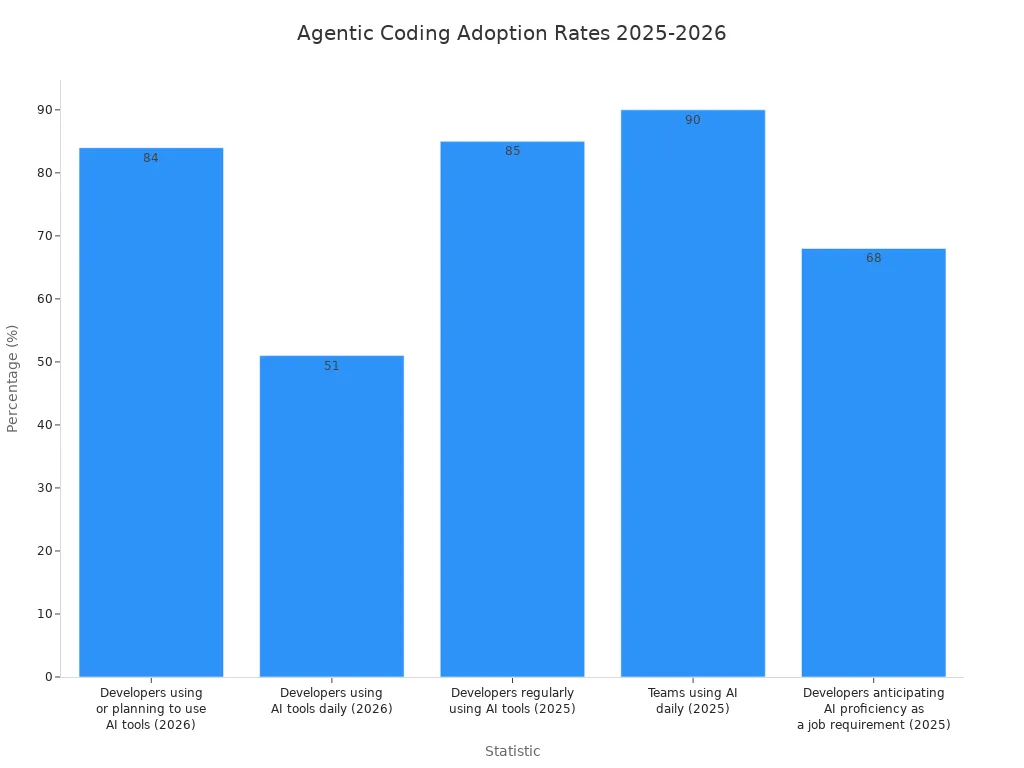
You see this shift everywhere—teams using agentic coding and ai daily reach 90% adoption, as shown below:
Power Platform makes technology accessible, empowering more people to join the creation process. This democratization of technology means you can contribute no matter your background. As you embrace ai-driven collaboration, you must also focus on governance and security to keep your technology safe and reliable.
Key Takeaways
- Agentic coding allows you to collaborate with AI agents, transforming software development from manual coding to a more efficient, automated process.
- Platforms like Microsoft Power Platform enable you to create applications using natural language, making technology accessible to everyone, regardless of coding skills.
- AI agents can handle complex tasks autonomously, allowing you to focus on high-level design and strategic decision-making.
- Effective collaboration with AI can save you up to 55% of your coding time, reducing mental fatigue and increasing job satisfaction.
- Adopting agentic coding requires new skills, such as prompt engineering and agent orchestration, to effectively manage AI workflows.
- Strong governance and security measures are essential to ensure that AI agents operate safely and align with organizational standards.
- The rise of agentic coding democratizes software creation, empowering non-technical contributors to solve business challenges directly.
- Embracing agentic coding positions you to innovate faster, improve code quality, and enhance collaboration across teams.
What Is Agentic Coding?
From Tools to Agents
You have seen software development change from using simple tools to working with intelligent agents. In the past, you wrote every line of code by hand. Now, agentic ai lets you focus on what you want to build, not just how to build it. These agents use large language models to understand your goals and carry out tasks with partial autonomy. Instead of only supporting you with suggestions, agentic ai can plan, execute, and even coordinate multi-step workflows across your entire codebase.
Here is a comparison to help you see the difference:
| Aspect | Traditional Development | AI Coding Assistants | Agentic Coding |
|---|---|---|---|
| Primary role | Manual development by engineers | Supports developers with suggestions | Executes tasks with partial autonomy |
| Interaction style | Fully human-driven | -response interaction | Goal-driven execution |
| Scope of work | Single task or feature | Single file or local context | Multi-step workflows across repositories |
| Planning | Done manually by developers | Minimal or none | Built-in multi-step planning |
| Tool use | Humans use tools directly | Limited tool awareness | Active tool use: tests, terminals, PRs, CI |
| Context awareness | Based on developer knowledge | Usually, the current file or context | Broader codebase and workflow context |
| Code generation | Fully manual | Assisted generation | Autonomous implementation and iteration |
Agentic ai does not just automate tasks. It creates a collaborative ecosystem where you and intelligent systems work together to solve complex problems.
Key Features of Agentic Coding
Agentic coding platforms stand out because they use ai agents for complex tasks. You can collaborate with these agents as partners, not just as tools. They plan and execute structured tasks, improve code quality, and operate across multiple layers of the development stack. This approach compresses the software development lifecycle, making it faster and more efficient.
| Feature | Agentic Coding Platforms | Legacy Development Environments |
|---|---|---|
| AI Integration | Uses AI coding agents for complex tasks | Limited or no AI assistance |
| Collaboration | Acts as a collaborator with developers | Primarily a tool for individual coding |
| Task Execution | Can plan and execute structured tasks | Manual task execution by developers |
| Code Quality | Focus on improving code quality and efficiency | Often lacks automated quality checks |
| Development Stack | Operates across multiple layers of the development stack | Typically operates within a single layer |
With agentic ai, you move from manual execution to orchestrating intelligent systems. This shift allows you to focus on strategic and creative work, while the ai handles repetitive or complex coding tasks.
Human-AI Collaboration
Collaboration between you and agentic ai is at the heart of this new approach. Studies show that human-ai collaboration can save you up to 55% of your time on coding tasks. You also experience less mental fatigue and greater satisfaction. When you and ai agents work together, you create higher-quality code, especially when you apply strong engineering practices.
Tip: Use agentic ai to handle routine tasks, so you can spend more time on design and collaborative innovation.
Large language models power these agents, making them capable of understanding your intent and adapting to your workflow. In collaborative ecosystems, you and agentic ai learn from each other. You provide feedback, and the ai improves its suggestions. This teamwork leads to better results and helps you manage complex projects with ease.
Agentic coding is not just about faster development. It is about building a collaborative, creative, and secure environment where you and ai agents drive innovation together.
Agentic Coding Evolution

Early Coding Tools
You have seen software development change a lot over the years. In the beginning, you wrote code by hand. You used simple editors and basic compilers. This manual approach required you to manage every detail. You had to remember syntax, organize files, and fix errors on your own. These early tools shaped how you think about building software.
As technology advanced, you started using smarter tools. These tools could highlight errors, suggest code, and help you find problems faster. They allowed you to explore codebases, spot unused dependencies, and clean up your projects. You could generate integration tests and run them in continuous integration environments. You also received summaries of test failures with clear steps to fix them. Some tools even helped you debug runtime issues by tracing logs and finding root causes. You could propose architectural changes, scaffold new services, and see real-time visualizations of your application’s structure.
This journey set the stage for agentic ai. You moved from doing everything yourself to working with tools that could act on their own. These early steps made it possible for agentic systems to become part of your daily workflow.
Note: Early coding tools gave you the foundation to trust and collaborate with intelligent systems.
| Milestone | Description |
|---|---|
| Manual Coding | Traditional solo developer workflow where coding is done manually. |
| AI-Assisted Development | Introduction of tools that enhance productivity and assist developers. |
| AI-Orchestrated Development | Fully autonomous systems that manage the software development process. |
Rise of Agentic AI
You now live in an era where agentic ai is changing how you build software. Over the past decade, you have seen a huge increase in the use of ai agents. In 2024, less than 5% of enterprise applications included integrated ai agents. By 2026, this number will reach 40%. By 2028, one-third of all enterprise software will use agentic ai. Leaders in the industry believe that scaling ai agents gives them a competitive edge. Every industry is expanding its use of ai.
This rise did not happen overnight. You saw the introduction of code models that could generate code inline as you typed. You started having conversations with ai agents about your goals. These agents became aware of your entire codebase. They learned to use tools, execute tasks in the background, and remember past actions. They could review and validate your work. You no longer had to do everything yourself. You could delegate tasks and focus on higher-level design.
Here is how the evolution unfolded:
- Code models
- Inline generation
- Conversation
- Codebase awareness
- Tool use
- Background execution
- Persistent memory
- Review and validation
You now see agentic ai as a partner, not just a tool. This partnership lets you move faster and build better software.
Agentic SDLC Paradigm
You have entered a new phase in software development. The agentic software development lifecycle (SDLC) changes how you work. You no longer just write code. You orchestrate intelligent agents that plan, generate, test, review, and execute changes for you. These agents act as autonomous collaborators. They understand your high-level goals and manage complex processes like requirements analysis and code generation.
Platforms like Microsoft Power Platform, GitHub Copilot, Claude, and Visual Studio Code show you what is possible. For example, GitHub Copilot works as your assistant inside your development environment. It helps you from the first line of code to task delegation, issue management, feature building, and pull request reviews. Microsoft Power Platform lets you use natural language to create apps, making agentic ai accessible to everyone. Claude and Visual Studio Code also bring agentic features into your workflow, allowing you to focus on creativity and strategy.
Nick Doelman, a leader in this field, explains that you now have conversations with ai agents. You do not just give commands. You collaborate, share ideas, and solve problems together. This shift to human-ai conversation and teamwork marks a new era. You become the orchestrator, guiding agentic ai to deliver results that match your vision.
Tip: Use agentic ai to automate routine tasks and free up your time for innovation.
The agentic SDLC means you can trust ai agents to handle the details. You set the direction. The agents do the work. This approach makes software development faster, more reliable, and more creative.
Impact on Development Workflow
Faster Delivery
You experience faster delivery when you use agentic coding in your projects. With ai agents, you can generate complex, multi-file components quickly. You no longer spend hours writing every line of code. Instead, you focus on translating your domain knowledge into prompts for ai. This shift boosts your efficiency and speeds up your coding pace by two to five times. Teams that invest in infrastructure, such as rules, commands, plans, and documentation, see even greater benefits. These investments help ai agents produce predictable outputs and improve project delivery speed.
Here is a table showing how agentic coding accelerates delivery:
| Evidence Type | Description |
|---|---|
| Code Generation | AI agents generate complex, multi-file components, speeding up the coding process. |
| Knowledge Translation | Developers translate domain knowledge into prompts for AI, enhancing efficiency. |
| Performance Increase | Coding pace increases by 2x to 5x with agentic coding. |
You also notice that agentic workflows extend these benefits beyond individual teams. When you build a strong foundation for ai, you improve the efficiency of your entire system.
Enhanced Productivity
Agentic coding enhances your productivity in several ways. You benefit immediately from ai-driven workflows. You delegate high-level tasks to ai agents, which then plan, test, and integrate code for you. This reduces your workload and allows you to focus on creative and strategic tasks. Amazon’s use of agentic ai coding tools saved over 4,500 developer-years and generated $260 million in efficiency gains by migrating 30,000 applications.
You see productivity gains across your team, but the benefits are not always uniform. Domain experts may face a steeper learning curve, while junior engineers must maintain their debugging skills. Long-term technical expertise and ownership remain important for sustained productivity.
| Evidence | Description |
|---|---|
| Productivity Gains | Developers benefit immediately from agentic coding, leading to enhanced productivity. |
| Maintenance Risks | Maintenance of agent-generated code can affect long-term productivity. |
| Uneven Benefits | Productivity gains vary across roles, with domain experts facing challenges. |
Tip: Use agentic workflows to automate routine tasks and free up your time for innovation.
Managing Complexity
You manage complexity more effectively with agentic coding. Strong governance provides clear guardrails, visibility, and accountability for ai agents. Controlled access ensures that agents operate under strict policies and align with organizational standards. You integrate autonomy, control, and visibility into your workflows to maintain reliability and safety.
Agentic workflows follow structured processes that ensure correctness, traceability, and automation for enterprise tasks. Automation leads to higher quality assurance compliance in your development processes. You define high-level tasks, and ai agents parse and execute them, reducing your burden and helping you handle complex projects.
| Impact Type | Description |
|---|---|
| Task Delegation | Developers define high-level tasks, which are then parsed and executed by autonomous agents. |
| Automation | Agents autonomously perform task planning, testing, and code integration, reducing developer burden. |
| Structured Workflows | Follows structured workflows that ensure correctness, traceability, and automation for enterprise tasks. |
| Increased QA Compliance | Automation leads to higher quality assurance compliance in development processes. |
Note: Integrate autonomy, control, and visibility into your agentic workflows to maintain reliability and safety.
Developer Role Transformation
From Coder to Orchestrator
You now step into a new role in the agentic era. Instead of writing every line of code, you oversee a team of specialized ai agents. Each agent handles a different phase of software development. Some agents plan, others code, test, review, document, or deploy. Your main job becomes high-level oversight and task distribution. You focus on integration and quality, not just manual coding.
- You manage multiple agentic ai agents at once.
- You assign tasks to agents for planning, coding, testing, and deployment.
- You monitor progress and ensure all agents work together smoothly.
As orchestrator, you guide the agentic process. You set goals, review results, and make strategic decisions. This shift brings a big boost in productivity. A small team can now manage many ai processes. You move from hands-on coding to strategic oversight. You design and validate, while agentic ai handles most coding tasks.
New Skills for Agentic AI
To thrive in this agentic environment, you need new skills. You must learn how to interact with ai agents and design effective collaboration models. Your job is not just about giving commands. You work with agentic systems in feedback-driven loops. These systems make autonomous decisions and adapt based on your input.
Designing effective human–ai collaboration models is a key challenge. You must develop user interfaces, set up interaction protocols, and create frameworks for sharing responsibilities between you and agentic agents. This new model turns you into an interactive collaborator, not just a command-giver.
Here are some important skills for agentic ai development:
- Prompt engineering and mechanism design: You craft clear prompts and rules to guide agentic behavior.
- Agent orchestration: You use frameworks to manage complex, multi-agent workflows.
- System tuning and evaluation: You monitor and improve agentic ai performance over time.
As agentic ai takes over low-level tasks, you focus on designing and refining the systems that generate code. You become the architect of agentic workflows, not just a coder.
Human-Agent Teamwork
Agentic coding changes how you work with ai. You and agentic agents form a team. Trust and collaboration become essential. Studies show that people trust human-like agents more and blame them less when things go wrong. Higher levels of human-like behavior in agentic ai increase trust and teamwork. When you work with agentic agents, you share responsibility and build stronger teams.
| Evidence Description | Source |
|---|---|
| Low-rank human-like agents are trusted more and blamed less in human-autonomy teaming. | Li et al. (2016) |
| Higher levels of anthropomorphism invoke CASA effects, influencing trust dynamics in teams. | Gambino et al. (2020) |
| Participants apportioned less blame to an autonomous car compared to a human driver, indicating a shift in blame attribution. | Lyons et al. (2021) |
You and agentic ai agents learn from each other. You provide feedback, and agents improve their performance. This teamwork leads to better results and a more creative development process. In the agentic world, you do not work alone. You lead, guide, and collaborate with ai to achieve your goals.
Multi-Agent Systems
Single vs. Multi-Agent
You may start your journey with a single ai agent. This agent can handle simple, multi-step tasks. However, when you face complex problems, a single agent often struggles. You need a system that can break down big challenges into smaller parts. This is where the internet of agents comes in. It connects many specialized agents, each with its own skill set. These agents work together to solve problems that one agent alone cannot handle.
- Single agents manage straightforward tasks but have limits with complex, diverse challenges.
- Multi-agent systems break down tasks, assign them to specialists, and check the quality of each step.
- The internet of agents allows these systems to collaborate, making them a core part of modern agentic coding.
When you use multi-agent systems, you create a digital team. Each agent focuses on what it does best. You get better results because each part of the problem receives expert attention.
Coordination and Delegation
You need strong coordination to make the internet of agents work well. Multi-agent systems use different patterns to organize their work:
- Sequential pipeline: Agents complete tasks one after another. This method is simple and easy to follow.
- Hierarchical delegation: One agent acts as a manager, breaking tasks into smaller pieces and assigning them to others.
- Collaborative discussion: Agents share ideas and adjust their plans together. This approach is flexible but can sometimes slow things down.
- Event-driven orchestration: Agents respond to events as they happen. This method scales well and keeps agents independent.
The internet of agents lets these digital teams work around the clock. They do not wait for you to be available. You can trust them to handle complex engineering tasks quickly and efficiently.
Tip: Use the internet of agents to build teams that never sleep. Your projects move forward even when you are not at your desk.
Technical Debt Management
Managing technical debt is important in any project. The internet of agents helps you fix small issues, like formatting errors or missing comments. These agents can spot and correct these problems faster than you can. However, when you face bigger challenges, such as duplicate code or confusing structures, you still need to step in.
For example, if the internet of agents creates several similar user interfaces, you may end up with too much code. You should simplify and organize the code to make it easier for both humans and agents to understand. Agents do well with routine fixes, but you must guide them on big architectural decisions.
| Task Type | Who Handles It Best |
|---|---|
| Formatting, Linting | Internet of agents |
| Duplicate Patterns | Human oversight |
| Architecture | Human oversight |
You get the best results when you combine the speed of the internet of agents with your own judgment. This teamwork keeps your codebase clean and your projects on track.
Democratizing Software Creation
Non-Technical Contributors
You no longer need to be a professional developer to build powerful applications. Agentic coding opens the door for non-technical contributors in every industry. You can now solve your own business challenges by creating applications that fit your needs. Sales and marketing teams use agentic coding to design applications that track leads, manage campaigns, and analyze customer data. You do not have to wait for engineering teams to deliver solutions. You can address your problems directly and quickly.
This shift means you gain more control over your work. You can build applications that reflect your expertise. You understand your business best, so you create applications that match your goals. Agentic coding reduces your reliance on IT departments. You become a creator, not just a user, of technology. This change empowers you to innovate and respond to new challenges with custom applications.
Cross-Functional Teams
Agentic coding transforms how you work in cross-functional teams. You see intelligent agents act like real engineering teams, helping you coordinate and deliver applications faster. These agents organize workflows, share context, and reduce the time it takes to move applications from idea to reality. You do not waste time on endless meetings or emails. Agents help you focus on what matters most—building great applications.
| Aspect | Description |
|---|---|
| Workflow Orchestration | Intelligent agents function like real engineering teams, improving workflow orchestration across teams. |
| Coordination Overhead Reduction | The approach reduces coordination overhead, leading to faster and higher quality software delivery. |
| Context Sharing | Agents help in sharing context across teams, enhancing collaboration and understanding. |
| Structural Shift | There is a fundamental shift in how software moves through the organization, compressing latency. |
| Human Attention Redefinition | The focus on where human attention is most valuable is redefined, optimizing team efforts. |
You work with people from different backgrounds to create applications that solve real problems. You see your ideas come to life as agents handle the technical details. This teamwork leads to better applications and more satisfied users.
Power Platform’s Role
Microsoft Power Platform stands out as a leader in democratizing application development. You can describe your ideas in plain language, and the Power Platform Plan Designer turns them into structured application plans. You do not need to know how to code. You simply explain what you want, and the platform builds the foundation for your applications. The Plan Designer includes user roles, data models, application components, and suggested workflows. This guided process helps you and your team create applications quickly and confidently.
- The Power Platform Plan Designer lets you describe ideas in plain language, which it transforms into structured application plans.
- You get components like user roles, data models, application parts, and suggested workflows.
- The platform guides you through the process, making it easy for both professional and citizen developers to build applications.
You can also write tests for your applications using natural language. This feature allows you to check if your applications work as expected without writing code. Business users can create and maintain tests that reflect their understanding of business processes. These tests serve as living documentation, making it easier for everyone to understand and improve applications.
Power Platform’s AI-assisted features simplify the process of building, testing, and maintaining applications. You can focus on your ideas and let the platform handle the technical work. This approach makes application development accessible to everyone, not just developers. You become part of a new wave of creators, building applications that drive your organization forward.
Redefining Productivity
Measuring Output
You need clear ways to measure how well agentic coding works in your projects. Traditional metrics like lines of code or hours spent do not capture the value of intelligent agents. Instead, you should look at new metrics that reflect the unique strengths of agentic systems. Here is a table that shows important metrics for agentic coding environments:
| Metric Name | Definition | Importance |
|---|---|---|
| Task Success Rate (TSR) | Proportion of tasks completed based on criteria | Shows how well agents meet your goals |
| Step Efficiency / Action Cost | Number of actions to finish a task | Measures how efficiently agents work |
| Tool-Use Accuracy | Correct use of external tools without errors | Ensures reliable tool interactions |
| Planning Coherence | Alignment of plans with actual execution | Reflects agent reasoning and logic |
| Memory Recall | Consistent storage and retrieval of information | Important for agents that remember context |
| Robustness to Perturbation | Consistency when inputs change | Measures reliability in changing settings |
| Autonomy Index | Ratio of agent-made to human-assisted decisions | Shows how independent agents are |
| Latency and Throughput | Response time and task completion rate | Critical for performance |
| Quality of Reasoning | Logical evaluation of agent decisions | Ensures agents think, not just react |
| Context and Data Groundedness | Relevance and accuracy of used information | Keeps responses based on real data |
These metrics help you see where agents excel and where you may need to step in.
Quality and Innovation
Agentic coding changes how you think about software quality and innovation. You see faster product development because AI agents can plan, build, and develop features at the same time. This speed lets you bring new ideas to life quickly. You also notice higher code quality and consistency. AI-driven engineering follows set standards, which reduces mistakes and keeps your codebase clean.
You benefit from continuous optimization. Agents automatically debug and test your code, which helps maintain code integrity. Your team can scale up development without hiring more people. However, you should remember that some industry benchmarks do not always measure what matters most, like security or maintainability. Sometimes, agents may optimize for test scores instead of real-world quality. You need to focus on production-ready qualities to ensure your software remains strong and secure.
- You get faster product development.
- You achieve higher code quality and consistency.
- You enjoy continuous optimization through automatic debugging and testing.
- You scale your software without extra staff.
Note: Always check that your agents focus on real-world needs, not just passing benchmarks.
Organizational Value
When you adopt agentic coding, your organization gains many benefits. You see improved productivity as developers complete tasks faster and with fewer errors. Teams work together more smoothly, which leads to quicker delivery of new features. Developers feel less mental strain because they can focus on solving problems instead of managing complex code.
Here is a table that highlights the value agentic coding brings to your organization:
| Benefit | Description |
|---|---|
| Improved Productivity | Developers get more done in less time |
| Reduced Error Rates | Fewer mistakes appear in your code |
| Enhanced Collaboration | Teams work better together and deliver features faster |
| Lower Cognitive Load | Developers spend less effort on complexity and more on solutions |
You create a work environment where people and AI agents support each other. This partnership helps your organization stay competitive and ready for future challenges.
Organizational Adoption
Integrating Agentic Coding
You start your journey with agentic coding by focusing on integration at every level. You connect agentic tools with your existing workflows. You bring together your development teams, business users, and IT leaders. You look for ways to blend agentic solutions with your current processes. You often use system integration to link agentic platforms with your databases, APIs, and cloud services. You might set up github actions workflows to automate testing and deployment. You make sure your integration plan covers both technical and human factors.
You see that integration is not just about technology. You also need to align your team’s mindset. You encourage everyone to learn how agentic systems work. You help your team understand how agentic agents can support their daily tasks. You create training sessions and workshops. You build a culture where people trust agentic solutions and see their value. You review your integration progress often and adjust your approach as needed.
Benefits and Challenges
When you adopt agentic coding, you notice many benefits:
- Faster delivery of new features
- Automated bug fixing
- Reduced workload for developers
- Improved system integration across teams
You also face some challenges:
- Need for strong governance and oversight
- Risks from autonomous decision-making
- Concerns about transparency in agentic AI decisions
- Skepticism from experienced developers about black-box automation
- Requirement for retraining teams in agentic workflows and agent supervision
You see that agentic integration brings both opportunities and tensions. You must balance the speed and efficiency of agentic systems with the need for control and security. You often find that traditional management principles do not fit perfectly with agentic integration. You may need to adapt your frameworks or create new hybrid approaches to manage agentic adoption effectively.
Tip: Regularly review your integration strategy to ensure agentic systems align with your organization’s goals and values.
Change Management
You play a key role in managing change during agentic integration. You guide your team through the transition. You communicate the benefits of agentic coding clearly. You address concerns about system integration and AI autonomy. You set up feedback channels so your team can share their experiences.
You provide ongoing training to help everyone adapt to new agentic workflows. You encourage collaboration between technical and non-technical staff. You celebrate small wins to build confidence in agentic integration. You monitor progress and adjust your change management plan as your organization grows.
You know that successful agentic integration depends on strong leadership and open communication. You create a supportive environment where everyone feels comfortable exploring new agentic solutions. You help your organization move forward with confidence in the age of agentic coding.
Governance and Security
Secure Agentic Development
You play a key role in keeping agentic development secure. As you work with agentic platforms, you must set clear boundaries for every agent. You define the scope and guardrails so agents cannot make uncontrolled changes. You restrict agents to non-production environments and limit their privileges. This approach helps you maintain trust in your systems.
You also apply strict dependency governance. Every package or library suggested by an agent must pass supply chain reviews. You require a software bill of materials for each dependency. You collect compliance evidence for every agent action. This creates a strong audit trail and supports frameworks like SOC 2 or HIPAA. You integrate oversight into your pipelines. All agent-generated code goes through automated security checks and mandatory human review. You connect agent activity to enterprise visibility platforms. This helps you prioritize risks and maintain trust.
Tip: Always monitor for new vulnerabilities unique to agentic workflows. Your vigilance builds trust and keeps your systems safe.
Governance Best Practices
You follow best practices to ensure agentic coding remains safe and reliable. Here are some steps you can take:
- Define scope and guardrails for every agent to prevent unintended changes.
- Apply strict dependency governance and require supply chain reviews.
- Enforce compliance evidence collection for all agent actions.
- Integrate oversight into your development pipelines.
- Route all agent-generated code through security checks and human review.
- Leverage enterprise visibility platforms for risk management.
- Monitor for new classes of vulnerabilities in agentic workflows.
- Run controlled red team exercises to test your guardrails.
- Perform layered security testing, including static and dynamic analysis.
- Continuously refine your controls based on findings.
- Require agents to produce and run tests before accepting changes.
You build trust by making these practices part of your daily routine. You ensure every agentic process supports accountability and transparency. You also require mandatory code reviews for all agent-generated code. This step increases trust and helps you catch issues early. You compel agents to create test files and run them before any changes go live. These actions improve the trustworthiness of your agentic systems.
New Security Risks
Agentic coding introduces new security risks that you must address. You need to understand these risks to maintain trust in your workflows. Here is a table that outlines some of the main risks:
| Risk Type | Description |
|---|---|
| Compliance and audit gaps | Changes made by coding agents outside of approval processes lead to loss of traceability and compliance challenges. |
| Escalation of errors | Small mistakes can escalate due to autonomous loops, causing significant system instability. |
| Data exposure risks | Increased access to codebases raises the risk of sensitive information being mishandled or exposed. |
You see that agentic systems can sometimes act outside of normal approval processes. This can create compliance gaps and make audits harder. You also notice that small errors can grow quickly if agents operate in loops. You must watch for these risks and act fast to protect your systems. You build trust by staying alert and updating your controls as agentic technology evolves.
Future of Agentic AI
Strategic Implications
You see agentic ai changing the way you approach software development. Agentic systems move from being passive tools to active co-developers. You must focus on trustworthy infrastructure and human-centered design. These priorities shape the future of agentic software creation. You notice that agentic ai transforms engineering roles. You shift from traditional coding to managing autonomous systems. You need new skills, such as systems thinking and agent orchestration. These skills help you guide agentic workflows and ensure reliable outcomes.
You also observe new business models emerging. Agentic solutions create unique opportunities for organizations. You can build products and services that were not possible before. You must consider robust governance and ethical standards. These factors protect your organization and users as agentic ai becomes more common.
- Agentic ai drives new business models.
- You must focus on governance and ethics.
- You need to develop skills for agentic orchestration.
Note: Agentic ai requires you to rethink your approach to software engineering. You become a manager of intelligent systems, not just a coder.
Next-Gen Software Creation
Agentic ai enables you to build next-generation applications. You use agentic platforms to automate complex tasks and streamline workflows. You describe your goals, and agentic systems turn them into working solutions. You see faster development cycles and higher quality software. You can scale your projects without increasing your team size.
You work with agentic agents that plan, code, test, and deploy. You focus on design and strategy. Agentic ai handles the details. You gain more time for innovation and creative problem-solving. You also see agentic ai improving collaboration across teams. You share ideas and feedback with agentic agents. This teamwork leads to better products and more satisfied users.
Here is a table showing how agentic ai changes software creation:
| Aspect | Traditional Approach | Agentic Approach |
|---|---|---|
| Task Execution | Manual coding | Autonomous agentic ai |
| Collaboration | Human-only teams | Human-agentic teamwork |
| Development Speed | Slow | Fast and scalable |
| Innovation | Limited | Enhanced by agentic ai |
Preparing for Change
You must prepare for the rise of agentic ai in your organization. You start by learning new skills. You study agentic orchestration and systems thinking. You build a culture that values collaboration between humans and agentic agents. You encourage your team to experiment with agentic platforms.
You set up training sessions and workshops. You help your team understand how agentic ai supports their work. You review your processes and update them for agentic workflows. You create feedback channels so everyone can share their experiences.
You also focus on governance and security. You define clear rules for agentic agents. You monitor their actions and ensure compliance with standards. You stay alert for new risks and update your controls as agentic ai evolves.
Tip: Embrace agentic ai as a partner. You gain new opportunities for growth and innovation when you adapt to this change.
You lead your organization into the future of agentic software development. You build trust in agentic ai and create a strong foundation for next-generation solutions.
Agentic coding changes how you build software. You now work with AI as a partner, not just a tool. To succeed, you must adapt your skills, update your workflows, and strengthen your governance.
Explore platforms like Microsoft Power Platform to unlock new ways to create and innovate.
You stand at the start of a new era. Embrace agentic coding to shape the future of technology.
FAQ
What is agentic coding?
Agentic coding lets you work with AI agents that plan, code, and test software. You describe your goals, and the agents help you build solutions faster and more efficiently.
How does Microsoft Power Platform support agentic coding?
You use Power Platform to create apps with natural language. The platform’s AI features turn your ideas into working solutions. You do not need deep coding skills to get started.
Can non-developers use agentic coding tools?
Yes! You can build apps and automate tasks even if you do not have a technical background. Agentic coding platforms make technology accessible to everyone in your organization.
How do you keep agentic coding secure?
You set clear rules for AI agents. You review all agent-generated code. You use automated security checks and require human approval before changes go live.
What skills help you succeed with agentic coding?
You benefit from prompt engineering, system design, and teamwork. You learn to guide AI agents, review their work, and focus on creative problem-solving.
How does agentic coding change your workflow?
You spend less time on repetitive tasks. You focus on design, strategy, and innovation. AI agents handle much of the coding, testing, and integration for you.
What are the main benefits of agentic coding?
You deliver software faster, improve code quality, and reduce errors. You also empower more people to create solutions and drive innovation in your organization.
Do agentic coding platforms replace developers?
No. You still play a key role. You guide, review, and make decisions. AI agents support your work, but you remain responsible for the final product.
🎧 Listen to this episode
Want a practical explanation of Agentic Coding with Nick Doelman [MVP-MCT]? This episode breaks down the topic in clear language and shows why it matters for Microsoft 365, Azure, Power Platform, security, AI, and modern work.
Listen to this episode if you want to:
- Understand the key concepts behind Agentic Coding with Nick Doelman [MVP-MCT]
- See how it fits into the wider Microsoft technology ecosystem
- Learn where it can create practical value for your organization
You may also enjoy these related M365 FM episodes:
- Power Apps AI and Vibe Coding with Keith Atherton [MVP-MCT]
- AI-First UX for Microsoft Power Platform with Tchesco Ayih [MVP-MCT]
- Secure Azure Networking with Rex de Koning [MVP-MCT]
- Microsoft Security Exposure Management with Uros Babic [MVP-MCT]
- Agentic Operating Model for Enterprise AI and Copilot
Discover more practical Microsoft conversations on M365 FM.
Official Microsoft MVP profile: Nick Doelman on Microsoft MVP
Apple Podcasts · Spotify · YouTube · YouTube Music
Host: Mirko Peters